LTO Correction of Entry OR CR 2026: How to Fix Wrong Details on Your Registration

An LTO correction of entry OR CR is the process of fixing a wrong detail on your vehicle’s Official Receipt or Certificate of Registration — a misspelled name, a wrong plate number, a transposed engine or chassis number, or any entry that does not match the real vehicle or owner. The two documents are the legal identity of your vehicle: an error on them can block a renewal, a sale, or an insurance claim. This guide explains which errors the LTO can fix administratively, which ones need more proof, and the steps to follow.
What an LTO correction of entry OR CR fixes
The Official Receipt (OR) proves you paid the registration fees; the Certificate of Registration (CR) is the official record of the vehicle and its registered owner. Together they are the documents every enforcer, buyer, insurer, and LTO window asks for — and every entry must match the vehicle in front of them.
The entries most often corrected are the owner name, the plate number, and the engine or chassis number — but the fix differs by error: a one-letter typo is a different transaction from an engine number that does not match the vehicle. Work out which kind it is first; that decides the documents and the clearances.
Clerical error vs substantial correction
Philippine practice draws a line between clerical errors and substantial corrections, and the LTO treats them differently.
| Type | What it means | Typical examples | What it usually needs |
|---|---|---|---|
| Clerical or typographical error | An obvious slip — visible to the eye, with no doubt about what the correct entry is | Misspelled first name, wrong name format, transposed digit in a plate number | Affidavit, proof of the correct entry, LTO inspection |
| Substantial correction | A change that affects the vehicle’s identity, ownership, classification, or legal status | Engine or chassis number mismatch, body type, classification, ownership, suspected tampering | All of the above, plus PNP-HPG clearance and macro-etching, and possibly another agency or a court order |
A clerical error is correctable administratively, because the correct entry is obvious from your supporting documents. A substantial correction needs more: the LTO must be sure the vehicle is what you say it is, and that it is not being used to launder a stolen or illegally modified vehicle. If the numbers on the vehicle match no document, expect the full inspection and clearance route.
Some changes look like corrections but are not: changing the vehicle’s color after a repaint, changing the engine, or transferring ownership are separate LTO transactions — see our guides to the LTO change of vehicle color and the LTO change of vehicle ownership. A correction fixes what was recorded wrongly; it does not record a change that really happened.
Where the wrong entry usually comes from
Most OR/CR errors come from one of three places — and the source tells you which proof to bring.
- Encoding error at the LTO. A clerk typed the entry wrongly when the vehicle was first registered or a transaction was encoded. The correct entry is usually obvious from the documents already in the file.
- Dealer submission error. The dealer submitted the wrong detail when the brand-new vehicle was registered — a transposed chassis digit, a wrong year model, or a misspelled buyer name. If the dealer made the error, the dealer should help correct it.
- Supporting document error. The CR is only as correct as the documents behind it. If your PSA birth certificate itself carries the wrong spelling, the LTO cannot fix the CR from your word alone — the civil registry record must be corrected first (see below).
A CR that does not match the vehicle can be questioned at a checkpoint, block a transfer of ownership, or delay an insurance claim — the insurer compares the CR against the policy. Do not ignore the error.
Documents you will need
Bring originals and photocopies of everything below — the exact list depends on the error, but the core set is the same for most corrections.
| Document | Why it is needed |
|---|---|
| Original OR and CR | The documents being corrected; the LTO keeps the old CR and issues a corrected one |
| Valid government-issued ID | Proves you are the registered owner |
| Notarized affidavit of discrepancy | Your sworn statement of the wrong entry, the correct entry, and the cause |
| Proof of the correct entry | The document showing the right detail — PSA birth certificate for a name, sales invoice or deed of sale for vehicle details, import documents for an imported vehicle |
| Motor Vehicle Inspection Report (MVIR) | The LTO inspector’s report, including the stencil of the engine and chassis numbers |
| PNP-HPG Motor Vehicle Clearance | Confirms the vehicle has no carnapping or theft record; required where the engine or chassis number is in question |
| Authorization letter + representative’s ID | Only if someone else files on your behalf |
For a name correction, the strongest proof is a PSA birth certificate showing the correct spelling; for a vehicle detail, it is the original sales invoice or the manufacturer’s certificate. Bring at least two documents that agree on the correct entry — one alone is often not enough, and offices apply this rule differently, so confirm at your branch.
Step-by-step: how to correct an OR/CR entry
- Compare every field before you file: read the CR line by line against the OR, your IDs, and the sales invoice, and note each wrong entry, the correct entry, and which document proves it. You can review your records on the LTMS Portal before you go.
- Gather the proof of the correct entry: a PSA birth certificate for a name, or the sales invoice, deed of sale, or import document for a vehicle detail. If the supporting document itself is wrong, fix that record first — the LTO cannot correct the CR from a document with the same error.
- Have an affidavit of discrepancy notarized: it states the wrong entry, the correct entry, the cause of the error, and the supporting document. Notarial fees vary and are commonly reported at around ₱100–₱400 if you bring your own draft, or ₱500–₱800 if the notary drafts it.
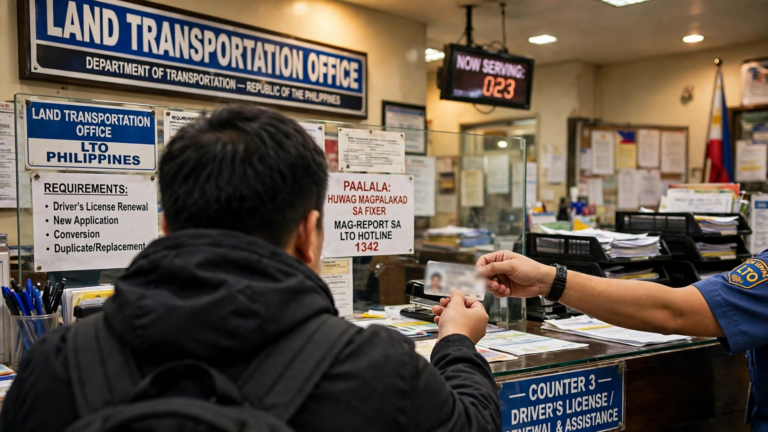
- File at the originating LTO district office, where the vehicle is registered. Bring the vehicle: the inspector needs to stencil the engine and chassis numbers for the MVIR. Our LTO OR CR guide explains how to read every field on both documents.
- Get the PNP-HPG clearance if the error involves the engine or chassis number: it confirms the vehicle is not flagged as stolen, and macro-etching verifies whether the numbers were tampered with. Not needed for a simple name spelling error.
- Pay at the cashier: the revision fee is commonly listed at ₱30 per record, plus any computer fee shown on the assessment. The cashier’s computation is final.
- Collect the corrected CR and check it before you leave: read every field again at the counter — a second error on the replacement starts the process over, so do not leave until it matches your proof documents.
If your OR or CR is lost or damaged rather than wrong, that is a duplicate, not a correction — see our guide to the LTO duplicate OR CR.
When the engine or chassis number is wrong
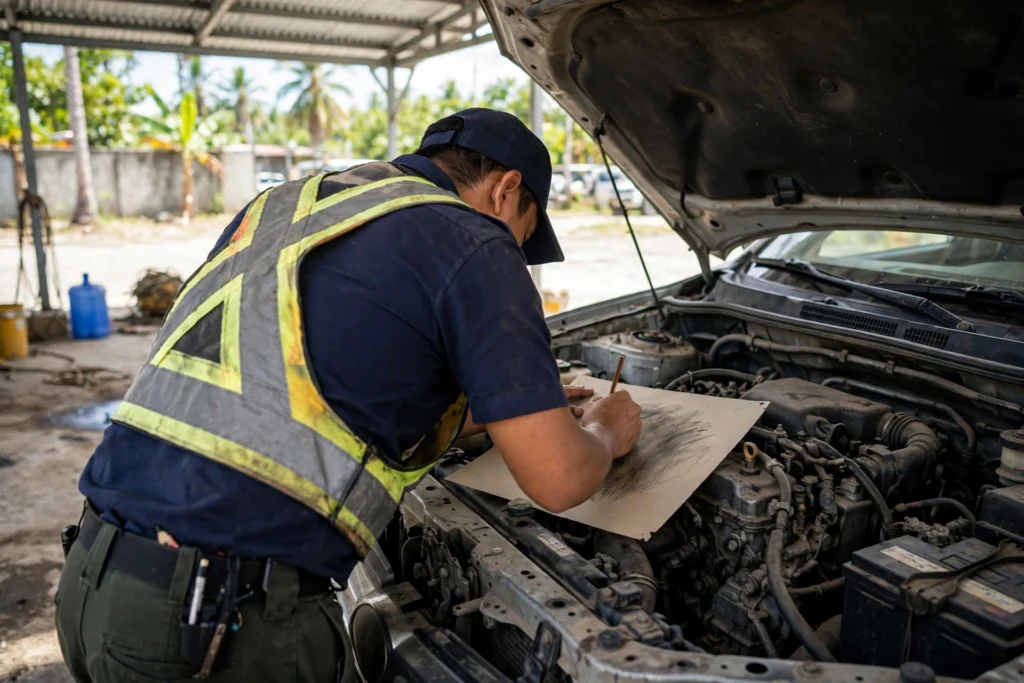
An engine or chassis number that does not match the vehicle is the most serious kind of correction: the numbers stamped on the vehicle are its identity, and if the CR says one number while the vehicle carries another, the LTO cannot tell from paperwork alone whether the entry was mistyped or the vehicle was altered.
Expect the full route: an LTO inspection with a stencil of both numbers, a PNP-HPG Motor Vehicle Clearance, and macro-etching, which verifies whether the numbers were tampered with. If the HPG report raises an issue, the correction becomes a law-enforcement matter — never alter, re-stamp, or “fix” a number yourself; that is falsification.
If the stencil and the clearance support your documents, the LTO corrects the entry and issues a new CR. If the numbers cannot be reconciled with any document, the LTO will not issue a corrected CR on the papers you have — trace the error back to the dealer, the importer, or the financing company and return with the document that explains it.
When the error is in your name or birth date
A wrong name or birth date on the CR usually traces to your civil registry record. Under Republic Act No. 9048, clerical or typographical errors in a name — including a misspelled first name — can be corrected administratively through the Local Civil Registry Office, without a court case. Republic Act No. 10172 covers the day or month of birth and the sex entry, where the error is clearly clerical. Both routes need a verified petition, supporting documents showing the correct entry, and the fee.
Once the civil registry record is corrected, get a fresh PSA birth certificate showing the correct entry and use it as proof for the LTO correction — the LTO will not correct a name on the CR from an ID alone while the PSA record still carries the wrong spelling.
A different rule applies when the change is not a correction at all: a name changed by marriage, or a court-ordered change, is a change of name on the license record, not a correction of entry on the CR — a separate LTO transaction with its own requirements. And if the wrong year of birth is involved, the correction is generally judicial — it needs a court order under Rule 108 — because the year affects civil status, not just spelling.
Fees and processing time
| Item | Typical amount | Notes |
|---|---|---|
| Record revision fee | Commonly listed at ₱30 per record | The LTO revision fee; the cashier’s assessment is final |
| Notarized affidavit of discrepancy | Commonly around ₱100–₱800 | Depends on whether you bring your own draft or the notary drafts it |
| PNP-HPG Motor Vehicle Clearance | As assessed | Only where the engine or chassis number is in question |
| Civil registry correction (RA 9048/10172) | Set by the local registrar | Only where the error is in the civil registry record |
| Corrected CR issuance | Included in the revision | The old CR is surrendered and a corrected one issued |
No fixed processing time is published for a CR correction. Simple clerical corrections are commonly completed in a single visit once the documents are accepted; corrections involving HPG clearance or a civil registry petition take longer, because the LTO must wait for the clearance or the corrected certificate. License-record revisions are commonly reported to take around 30 days, but that is for license records, not CR corrections — ask your district office for its current timeline.
What not to do
- Do not alter the CR yourself. Erasing, overwriting, or retyping an entry on the CR is falsification. The LTO issues a corrected CR; you do not correct the paper yourself.
- Do not pay a fixer. The correction is filed at the originating district office with an affidavit and proof documents — anyone offering to “fix” the entry for a fee outside the office is not part of the process.
- Do not drive with a CR that does not match the vehicle: if the plate, engine, or chassis number on the CR differs from the vehicle, an enforcer at a checkpoint has reason to hold it until the discrepancy is explained. Correct the entry before your next long trip.
- Do not skip the proof. An affidavit alone is rarely enough. Bring the PSA certificate, the sales invoice, or the import document that proves the correct detail.
Frequently asked questions about LTO correction of entry OR CR
1. What is an LTO correction of entry OR CR?
An LTO correction of entry OR CR is the process of fixing a wrong detail on your vehicle’s Official Receipt or Certificate of Registration — for example a misspelled name, a wrong plate number, or an engine or chassis number that does not match the vehicle. It is filed at the originating district office, with an affidavit and proof of the correct entry.
2. How is a correction different from a duplicate OR/CR?
A correction fixes a wrong entry on a document you still have; a duplicate replaces one that is lost, stolen, or damaged. The duplicate needs an affidavit of loss; the correction needs an affidavit of discrepancy and proof of the correct entry.
3. Can I correct a wrong engine number at any LTO office?
No. Corrections are filed at the originating district office — the office where the vehicle is registered and where its file is held. An engine or chassis correction also needs an LTO inspection with a stencil and a PNP-HPG clearance.
4. How much does a correction cost?
The record revision fee is commonly listed at ₱30 per record, plus any computer fee on the assessment. The notarized affidavit typically costs a few hundred pesos; if the error is in your civil registry record, the registrar’s filing fee is separate.
5. My name is misspelled on the CR. Do I need a court order?
Usually not. A misspelled first name is a clerical error correctable administratively under RA 9048 through the Local Civil Registry Office. Get the corrected PSA birth certificate first, then use it as proof for the LTO correction. A wrong year of birth is different — that generally needs a court order.
6. How long does a correction take?
No fixed processing time is published. A simple clerical correction can be completed in one visit once the documents are accepted. Corrections involving HPG clearance or a civil registry petition take longer, because the LTO waits for the clearance or the corrected certificate.
An LTO correction of entry OR CR is a paperwork fix with real consequences: the CR is the legal identity of your vehicle, and every entry should match the vehicle and the owner. Work out whether the error is clerical or substantial, gather the document proving the correct entry, have the affidavit notarized, and file at the office holding your file. Check the corrected CR at the counter.