LTO Change of Vehicle Ownership 2026: Complete Guide to Transfer Requirements, Fees, and Process

LTO change of vehicle ownership is the process of moving a vehicle’s Certificate of Registration (CR) from the seller’s name into the buyer’s name. Until that transfer is recorded, the seller remains the registered owner on paper, even though the buyer already holds the keys and drives the vehicle every day. That gap matters: traffic violations, alarms, and even criminal use tied to the plate can still trace back to the seller, while the buyer cannot renew the registration, claim a replacement plate, or prove ownership cleanly without the seller’s cooperation. This guide walks through the whole transfer in order: the documents to prepare, the PNP-HPG clearance, the LTO inspection and submission, the fees to expect, the special cases that change the paperwork, and the mistakes that send people home to start again.
The single most important rule comes first. Use a closed, notarized deed of sale — one that names the actual buyer, the actual seller, the vehicle, and the agreed price, signed by both parties before a notary. An open deed of sale, with the buyer’s name left blank so the vehicle can be passed on again without a transfer, is no longer accepted under current LTO rules and is the most common reason a transfer file is rejected. If you are buying, insist on a closed deed before you hand over full payment. If you are selling, do not hand over the vehicle on an open deed: your name stays on the record, and with it, the liability.
LTO Change of Vehicle Ownership: Documents You Need Before You Start
An LTO change of vehicle ownership file is only as strong as its documents. Gather these before you visit any office, and bring originals plus photocopies of everything:
- Notarized deed of sale (closed form). Signed by buyer and seller, notarized, with the full names of both parties, the vehicle details (make, model, year, engine number, chassis number, plate number, MV file number), and the selling price. Bring at least two notarized copies: one for the LTO file and one for your own records.
- Original Certificate of Registration (CR) and the latest Official Receipt (OR) of registration. If either is missing, the duplicate-document step must come first, because the transfer cannot be evaluated without the registration record.
- PNP-HPG Motor Vehicle Clearance Certificate (MVCC). Issued after the vehicle is inspected and its engine and chassis numbers are macro-etched (stenciled) and checked against alarm records. This clearance is obtained before the LTO submission, not after.
- Motor Vehicle Inspection Report (MVIR). Issued after the LTO’s own physical inspection of the vehicle, confirming that the stenciled numbers match the CR.
- Valid government-issued IDs of both buyer and seller, originals plus photocopies. The IDs must match the names on the deed of sale exactly; a nickname, a maiden-versus-married-name mismatch, or a misspelled name on any document is a common cause of delay.
- Taxpayer Identification Number (TIN) of the buyer, as required on the transfer forms. Have the number ready even if the form you are handed does not ask for it prominently.
- CTPL insurance (compulsory third-party liability) in the buyer’s name, if the current policy has expired or is still in the seller’s name. If the existing CTPL is still valid, confirm at the office whether it must be transferred or replaced; do not assume a policy in the seller’s name covers the new owner.
- Emission test or PMVIC result, where the registration is also due or the office requires a current roadworthiness result as part of the transaction. If the registration is current and only the ownership is changing, confirm whether a fresh test is required in your case rather than paying for one blindly.
Two conditional documents change the file for many real transactions. If the vehicle was previously financed, attach the original Cancellation of Chattel Mortgage (or the release of encumbrance from the lender). Without it, the encumbrance stays on the record and the transfer stalls. If either party is acting through a representative, that representative needs a notarized Special Power of Attorney (SPA); an SPA executed abroad generally needs apostille or consular authentication. If the registered owner has died, the file becomes an estate transaction, covered in the special-cases section below, and an ordinary deed of sale signed by relatives is not enough.

LTO Change of Vehicle Ownership: The 20-Day Rule Explained
The deadline question causes more confusion than any other part of an LTO change of vehicle ownership, because the rule changed twice in recent years. Enforcement of the 20-day transfer deadline was suspended in October 2024 after public complaints, and a revised version of the rule came back into effect on May 24, 2025. Under the revised rule, vehicles purchased after May 24, 2025 must begin the transfer within 20 days of the sale. That is the position reported consistently by current third-party guides in 2026.
What the deadline means in practice is narrower than people fear, and wider than people hope. It is a deadline to start and file the transfer, not a promise that the whole process finishes in 20 days — the HPG clearance alone can take several working days, and the LTO’s own processing adds more. Missing the window does not make the vehicle unregisterable, but it can draw a penalty or a citation, and it leaves the seller exposed for longer. The practical advice is simple: treat 20 days as your filing deadline regardless of which version of the rule your branch cites, and keep the dated deed of sale as proof of when the sale happened. If you are reading this months after buying, do not let the missed deadline stop you from filing at all — a late transfer is far better than no transfer, and the branch assessment will state any penalty that applies. Confirm the current enforcement position at your branch before you go, because branches have applied the suspended and revised rules unevenly.
Step 1: Get the PNP-HPG Clearance First
The PNP-HPG clearance is the first physical step, and it must come before the LTO submission. Take the vehicle, the original OR and CR, the notarized deed of sale, and the valid IDs of both parties (or the SPA, if a representative is acting) to a PNP Highway Patrol Group clearance center. The HPG technician macro-etches the engine and chassis numbers — the stencil — and checks the numbers and the vehicle against alarm and carnapping records.
Current guides report the HPG clearance fee at around ₱300 to ₱500, commonly paid through LandBank, and the certificate is typically released in 3 to 5 working days, though some centers release it sooner. The clearance has its own validity window, so do not obtain it months before you intend to file at the LTO: a clearance that has expired by filing day means a repeat visit. Plan the sequence as clearance first, LTO filing immediately after, with the vehicle available for both inspections.
If the HPG check finds an alarm on the vehicle, stop and resolve it before spending anything at the LTO. An alarm means the vehicle is flagged in the system, and no transfer can proceed until the flag is cleared. This is exactly the check a buyer wants done before full payment, not after: a seller who refuses an HPG clearance before the sale is a seller to walk away from.
Step 2: Inspection, Submission, and Payment at the LTO
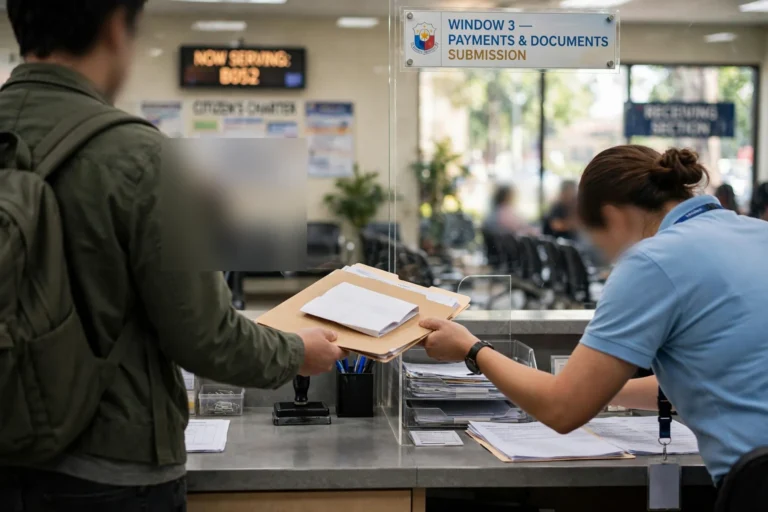
With the HPG clearance in hand, take the vehicle and the complete file to an LTO district or extension office. Current guides report that, as of 2026, the transfer may be filed at any LTO district office, not only at the office where the vehicle was originally registered (the mother file office). Confirm this at your chosen office before traveling, because older practice pointed everyone to the mother office and some offices still redirect complex cases there.
The LTO sequence runs in this order:
- Submit the file for evaluation. Present the deed of sale, original CR and latest OR, HPG clearance, valid IDs, TIN, CTPL, and any conditional documents (cancellation of mortgage, SPA, estate papers). The evaluator checks the documents against the LTMS record, verifies that the registration is current or computes the renewal and penalties if it is not, and checks for alarms or encumbrances.
- Undergo physical inspection. An LTO inspector verifies the stencil against the vehicle and issues the Motor Vehicle Inspection Report (MVIR). Bring the vehicle itself: the inspection cannot be done on papers alone.
- Pay at the cashier. Pay only at the official cashier and keep the official receipt. The assessment is the exact figure for your case; the fee table below is a planning range, not a quote.
- Claim the new CR. Once encoded into the LTMS system, the LTO prints and releases a fresh Certificate of Registration bearing the buyer’s name, together with a new Official Receipt. Check the new CR before leaving the counter: buyer name spelling, engine and chassis numbers, plate number, and MV file number. A spelling error caught at the counter is a same-day correction; caught weeks later, it is a new transaction.
For a clean file, current guides report LTO processing of 1 to 3 working days from complete submission, with the end-to-end process — HPG clearance plus LTO processing — typically taking 3 to 7 calendar days. Budget a full week, and do not promise a buyer or seller a same-day finish unless the branch confirms it.
LTO Change of Vehicle Ownership: Fees to Expect
No single official total exists for every transfer, because the assessment depends on vehicle type, whether the registration is current, and which clearances and tests your case needs. The table below collects the fee lines and ranges reported by current third-party guides, so you can budget honestly. Your branch assessment controls.
| Fee item | Reported range or line |
|---|---|
| LTO transfer processing fee | ₱225 to ₱530 for most vehicles; some guides report up to ₱1,500 depending on vehicle type |
| Computer fee | Around ₱169.06 |
| New CR | Around ₱30 to ₱100 |
| PNP-HPG clearance | Around ₱300 to ₱500 |
| Notarization of the deed of sale | Around ₱150 to ₱700, or 1% to 2% of the selling price at some notaries |
| Inspection / stencil | Around ₱400 to ₱700 where charged separately |
| CTPL insurance, if due | Around ₱300 to ₱800 for motorcycles; higher for cars |
| Emission test / PMVIC, if required | Around ₱450 to ₱700 |
Adding those lines, current guides place a typical straightforward total roughly between ₱2,000 and ₱5,000 — lower for motorcycles, higher for cars, and higher again if the registration is expired (renewal fee plus penalties are added to the same assessment) or if a duplicate CR or OR must be obtained first. Treat any guide that quotes a single exact total as a rough estimate for one vehicle type in one branch, not as your price. Bring more than the estimate, pay only at the official cashier, and keep the official receipt as the record of what was actually charged.
If the vehicle’s registration is also due, the renewal is normally handled in the same visit: the buyer pays the renewal and any penalties on top of the transfer, and the new CR reflects both the new owner and the renewed registration. Read our guide to car registration renewal for the renewal schedule and cost lines, and check the current fee lines in our LTO fees schedule 2026 before you go.
Special Cases That Change the Paperwork
Financed vehicle. The lender’s encumbrance must be cancelled on the record. Bring the original Cancellation of Chattel Mortgage and confirm the cancellation is annotated before filing. A transfer filed while the encumbrance is still annotated will be held, not approved.
Deceased registered owner. An ordinary deed of sale cannot be signed by someone who has died. The file generally requires an Extrajudicial Settlement of Estate (if there are no debts and all heirs agree) or the relevant court documents, plus the death certificate and the heirs’ IDs and SPA arrangements. This is the one transfer case where a lawyer’s help is worth paying for before the LTO visit, because a wrongly filed estate transfer can take months to unwind.
Company-owned vehicle. If the seller is a corporation, bring a board resolution or secretary’s certificate authorizing the sale and naming the authorized signatory, plus the signatory’s valid ID. The deed of sale must be signed by the authorized officer, not by any employee who happens to hold the keys.
Representative acting for buyer or seller. A notarized Special Power of Attorney naming the representative and the specific transaction is required. A general SPA that does not mention the vehicle or the transfer may be rejected. If the SPA was executed abroad, have it apostilled or authenticated first.
Lost OR or CR. Apply for duplicate documents at the registering office first, with an affidavit of loss for the missing document and the owner’s valid ID. The transfer cannot be evaluated cleanly without the registration record, and filing both problems in one confused visit is how files get returned.
Seller cannot be located. This is the hardest case, and there is no shortcut that safely replaces the seller’s signature. If the seller has disappeared after an open deed or an unnotarized sale, seek legal advice before paying anyone who promises a transfer without the seller: the registered-owner rule means the vehicle legally remains the seller’s until a proper transfer is recorded, and a buyer in this position needs a lawful route — such as an affidavit-based remedy or a court process — rather than a fixer. Never pay a fixer to manufacture a deed of sale signature.
Seller’s Checklist: Protect Yourself After the Sale
The seller’s job is not finished when the money changes hands. Until the LTO change of vehicle ownership is recorded, the seller remains the registered owner, and that is the risk the registered-owner rule creates. Sellers should:
- Sign only a closed deed of sale, with the buyer’s full legal name and the complete vehicle details, and have it notarized on the day of the sale.
- Keep a notarized copy of the deed of sale, photocopies of the buyer’s valid ID, and the original OR and CR photocopies, indefinitely — at least until the transfer is confirmed.
- Report the sale through the LTMS portal using the seller’s report-of-sale function, if available on the account. This creates a timestamped record that the vehicle was sold, even before the buyer’s transfer is completed. Read our LTMS portal guide for how to use the portal.
- Follow up with the buyer until the new CR is issued, and ask for a copy of it. A polite follow-up at 7 and 30 days is reasonable; a buyer who will not confirm the transfer is a warning sign.
- After the transfer, check the record through the LTO tracker page or the LTMS account to confirm the vehicle no longer sits under the seller’s name.
Buyer’s Checklist: Before You Pay in Full
Buyers carry the mirror-image risk: paying in full for a vehicle whose transfer later fails. Before full payment, a careful buyer:
- Verifies the seller’s identity against the CR: the person selling must be the registered owner, or hold a valid SPA from the registered owner.
- Checks the original CR and latest OR, and confirms the engine and chassis numbers on the papers match the numbers on the vehicle.
- Runs the HPG clearance (or insists the seller does, with the buyer present) before full payment, so an alarm is found while the money is still in the buyer’s hands.
- Uses a closed, notarized deed of sale, and pays the balance only when the deed is notarized and the HPG clearance is clean.
- Budgets the full transfer cost from the fee table above, rather than discovering it after the purchase.
- Files the transfer immediately — within the 20-day window for recent purchases — instead of driving for months on the seller’s registration.
Common Reasons a Transfer Gets Returned
Most returned files fail on a short list of avoidable errors. Check each one before you queue:
- Open deed of sale. The buyer’s name is blank, or the deed is unnotarized. Fix: a new closed, notarized deed signed by both parties.
- Name mismatch. The deed, the ID, and the CR spell a name differently. Fix: correct the document before filing, not after.
- Missing HPG clearance, or an expired one. The clearance was never obtained, or it was obtained so long before filing that it expired. Fix: obtain it fresh and file promptly.
- Expired registration folded in unbudgeted. The buyer arrives with transfer money only and discovers renewal plus penalties are due in the same assessment. Fix: check the registration expiry before the visit and budget both.
- Uncancelled encumbrance. The vehicle was financed and the mortgage cancellation was never annotated. Fix: obtain the cancellation from the lender first.
- Wrong office for a complex case. A straightforward transfer may be filed at any district office, but estate, encumbrance, and lost-document cases are often redirected to the mother office. Fix: confirm the office for your case type before traveling with the vehicle.
Frequently Asked Questions
How much does an LTO change of vehicle ownership cost?
Current guides place a typical straightforward total roughly between ₱2,000 and ₱5,000, lower for motorcycles and higher for cars. The LTO transfer fee line itself is reported between about ₱225 and ₱1,500 depending on vehicle type, plus a computer fee of around ₱169.06, HPG clearance of around ₱300 to ₱500, notarization, inspection, and CTPL or emission costs where due. Your branch assessment is the exact figure.
How long does an LTO change of vehicle ownership take?
For a clean file, guides report 1 to 3 working days of LTO processing from complete submission, and 3 to 7 calendar days end to end including the HPG clearance. Budget a full week.
Can I transfer vehicle ownership online through LTMS?
Only partially. The seller can report the sale and the parties can book appointments and prepare documents through the LTMS portal, but the physical inspection, signature verification, and release of the new CR still require an in-person visit. A fully online transfer with no branch visit is not available.
Is an open deed of sale still accepted?
No. Current LTO rules require a closed deed of sale naming the actual buyer. An open deed is a common reason for rejection, and it leaves the seller as the registered owner with the liability that follows.
What is the 20-day rule for transfer of ownership?
Under the revised rule in effect from May 24, 2025, vehicles purchased after that date must begin transfer within 20 days of the sale. Enforcement was suspended in October 2024 and then restored in revised form. Confirm the current enforcement position at your branch, and file promptly either way.
Do I need to go to the mother office (where the vehicle was first registered)?
For a straightforward transfer, current guides report that any LTO district office may accept the filing as of 2026. Complex cases — estate transfers, uncancelled encumbrances, lost documents — are often still redirected to the mother office, so confirm for your case type before traveling.
What if the seller cannot be found after the sale?
There is no safe shortcut. Seek legal advice about a lawful remedy rather than paying anyone to manufacture a signature. The vehicle legally remains the seller’s until a proper transfer is recorded.
What happens if I never transfer the ownership?
The seller remains the registered owner and can be traced for violations, alarms, and liabilities tied to the plate, while the buyer cannot renew, replace a plate, or prove ownership without the seller. Both sides lose, which is why the transfer should be filed immediately after the sale.
This LTO change of vehicle ownership guide compiles procedures and fees reported by current third-party guides and published LTO fee listings as of October 2026. Procedures, offices, and fees vary by branch and case, so confirm the exact requirements and assessment at your LTO office before transacting. This guide is not affiliated with or endorsed by the Land Transportation Office.