LTO PUV Registration Renewal 2026: Requirements, Fees, and Step-by-Step Process
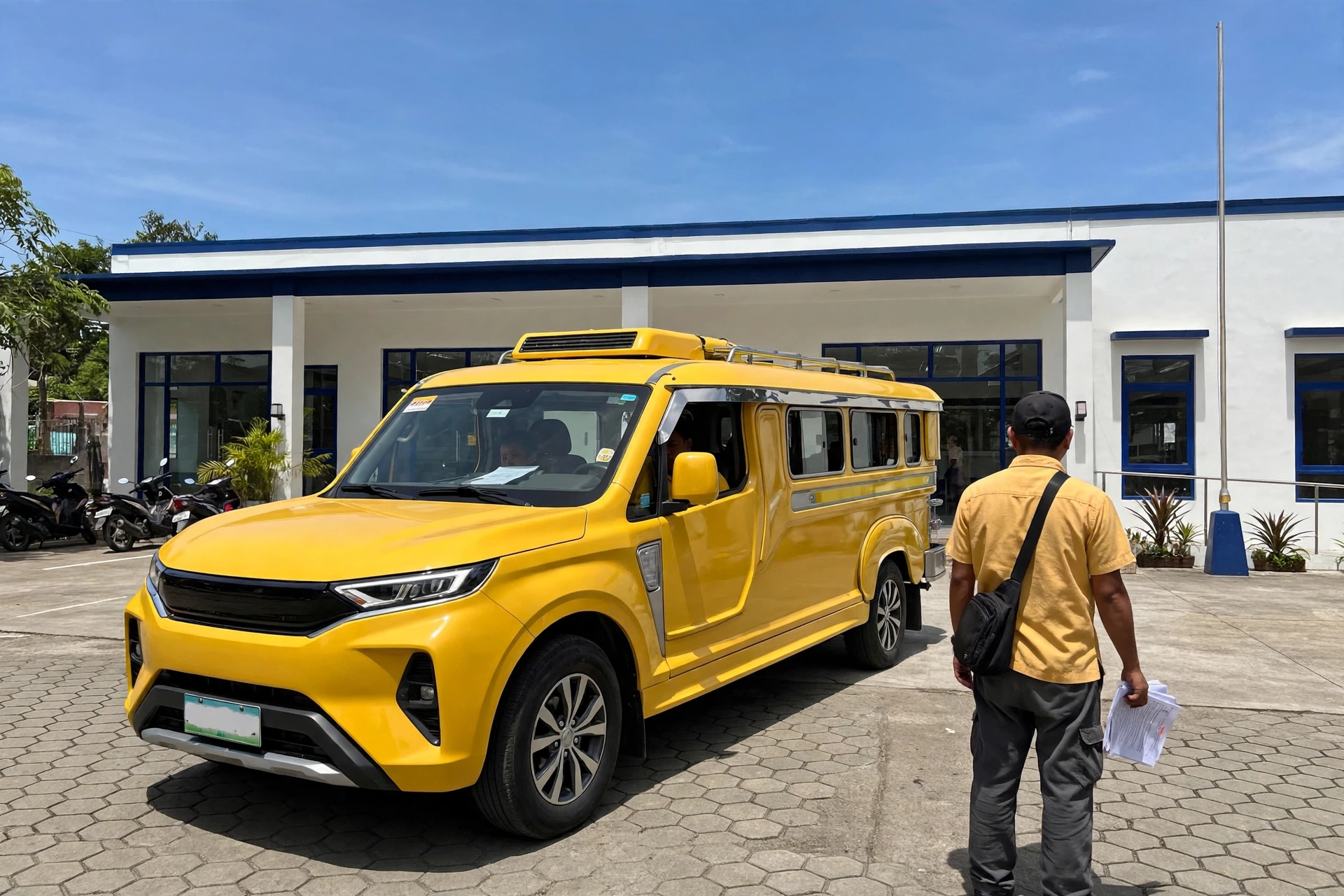
An LTO PUV registration renewal is the renewal of a public utility vehicle’s registration with the Land Transportation Office — the process that keeps a jeepney, bus, UV Express van, taxi, or ride-hailing car on the road. It looks like a private car’s renewal, but it is not the same transaction: a PUV needs a valid franchise from the Land Transportation Franchising and Regulatory Board (LTFRB), yellow for-hire plates, and inspection and insurance records that match its public-use classification. This guide explains both halves of the renewal, the documents to prepare, the fees to expect, and the 2026 franchise changes that affect operators.
What LTO PUV registration renewal covers
An LTO PUV registration renewal covers the LTO side of keeping a public utility vehicle legal: the yearly registration of the vehicle itself, the payment of the Motor Vehicle User’s Charge (MVUC) and other fees, the inspection and emission check, and the issuance of a new Official Receipt (OR) and registration sticker. It does not renew your franchise. The franchise — the Certificate of Public Convenience (CPC) that allows you to carry passengers for a fee — is issued and renewed by the LTFRB, a different agency.
That split matters most. An LTO registration does not give you the right to carry passengers for a fee; only an LTFRB authority does. A vehicle can hold a current registration with an expired franchise, or the reverse — either way, it cannot legally operate as a PUV until both are current. Track the two expiry dates separately.
LTO registration vs LTFRB franchise: two different renewals
The LTO and the LTFRB do different jobs, and confusing them is the most common reason operators waste a trip.
| Agency | What it handles | What expires |
|---|---|---|
| LTO | Vehicle registration, driver’s licenses, plates, inspection | Registration: every year, on the plate-ending schedule |
| LTFRB | Franchises (CPC), routes, fares, operator authority | Franchise: typically 5 years for a CPC; TNVS converted to a 5-year Authority to Operate Certificate (ATOC) in 2026 |
Your LTO renewal asks for proof that the franchise exists — usually a franchise confirmation transmitted electronically to the LTO, or an original copy if connectivity is not available. If the franchise has lapsed, the LTO will not complete the renewal as a for-hire vehicle.
For tricycles, the equivalent applies: a valid Motorized Tricycle Operator’s Permit (MTOP) from the city or municipality instead of an LTFRB franchise. The LTO still handles the registration; the local government handles the permit to operate.
Which vehicles count as PUVs
A public utility vehicle is any vehicle authorized to carry passengers or goods for a fee. The main types at an LTO district office are:
| Vehicle type | Typical use | Franchise authority |
|---|---|---|
| Jeepney (traditional and modernized) | Fixed-route passenger service | LTFRB CPC |
| Bus (city and provincial) | Fixed-route passenger service | LTFRB CPC |
| UV Express van | Point-to-point passenger service | LTFRB CPC |
| Taxi | Metered passenger service | LTFRB CPC |
| TNVS (ride-hailing car) | App-booked passenger service | LTFRB CPC, converted to ATOC in 2026 |
| Tricycle with sidecar | Short-distance passenger service | Local MTOP |
A private car used for paid trips without a franchise is not a PUV — it is a private vehicle operating illegally for hire. Changing a vehicle from private to for-hire is a separate LTO transaction (a change of classification, which also changes the plates from white to yellow) and requires the franchise first. See our guide to the LTO change of license classification for how that conversion works.
Requirements for renewing a PUV registration
Prepare these before you go — most match a private renewal, plus the franchise proof that makes it a PUV renewal.
- Original Certificate of Registration (CR) and latest Official Receipt (OR).
- Valid CTPL insurance (Compulsory Third-Party Liability) with the Certificate of Cover transmitted electronically to the LTO. For-hire CTPL is typically priced higher than private CTPL — confirm the amount with your insurer before you pay.
- Emission test result from an LTO-accredited Private Emission Testing Center (PETC), or a vehicle inspection report from a Private Motor Vehicle Inspection Center (PMVIC) or the LTO’s own inspection. The inspection report is transmitted electronically and is valid for 60 days, so schedule it within two months of your renewal date.
- Duly accomplished and approved Motor Vehicle Inspection Report (MVIR).
- Franchise confirmation — electronically transmitted to the LTO, or one original copy if connectivity is not yet available. For tricycles, the valid MTOP instead.
- Valid government-issued ID of the operator, or an authorization letter plus the representative’s ID if someone else renews on your behalf.
- Taxpayer’s Identification Number (TIN) of the operator.
- If the vehicle is still under financing, a certification from the financing company that it holds the CR and agrees to the transaction.
The LTO district office that handles your renewal is the one specified in your CPC. Do not queue at a random office — go to the office named in your franchise, or confirm jurisdiction with the LTFRB first.
Step-by-step: how to renew a PUV registration
- Check your franchise first: confirm the CPC is still valid and the franchise confirmation will be transmitted to the LTO. If the franchise is expired, renew it with the LTFRB before you start the LTO renewal — the LTO cannot finish a for-hire renewal without it. You can also check your registration status on the LTMS Portal before you travel.
- Get CTPL insurance from an accredited insurer and confirm the Certificate of Cover is transmitted electronically to the LTO. Keep the printed policy with you.
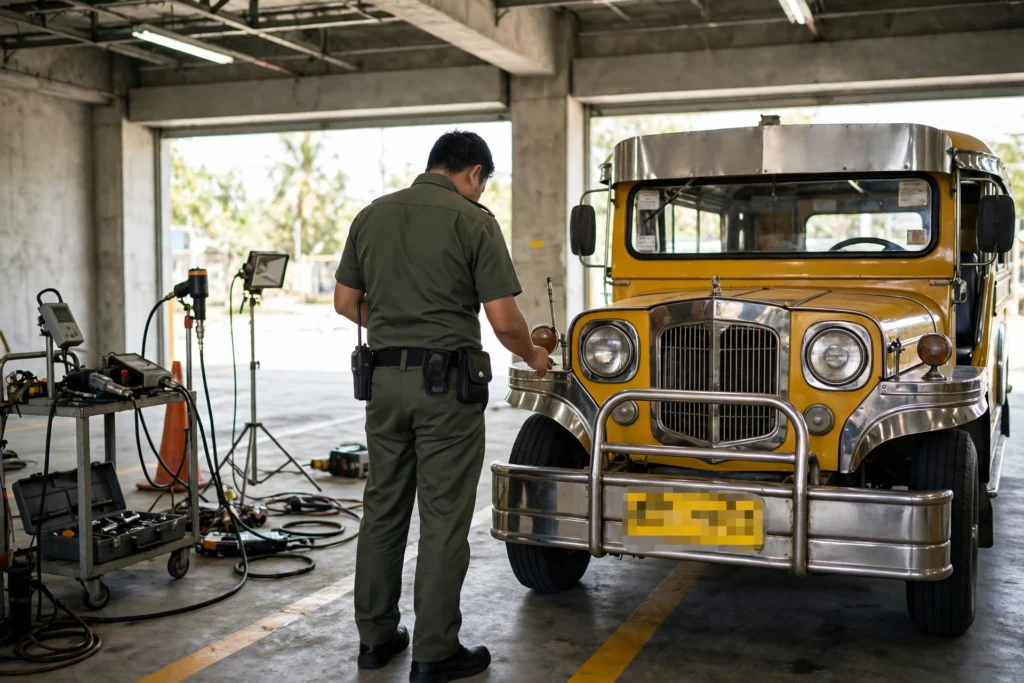
- Get the vehicle inspected and emission-tested. Go to an accredited PETC for the emission test, or to a PMVIC or the LTO district office for the inspection. Our PMVIC inspection guide explains what the inspection checks and what the fees are. Keep the inspection report — it is valid for 60 days.
- Go to the correct LTO district office with the OR/CR, your ID, the franchise confirmation, and the inspection and insurance records. File the renewal at the window and present the vehicle for the MVIR stencil if required.
- Pay at the cashier: the assessment on the OR lists the MVUC, computer fee, and any surcharges. Pay the assessed amount and keep the receipt.
- Collect your new OR and sticker. Check the OR before you leave: the plate number, vehicle details, and classification must read “for hire.” A wrong entry is far easier to fix on the spot than later.
Most renewals finish in one visit when the franchise, insurance, and inspection records are already transmitted. Delays almost always trace back to one of those three not being in the system yet.
Fees: what a PUV renewal costs
There is no single published total for a PUV renewal: the MVUC depends on vehicle type and weight, and insurance and inspection charges vary by provider. The table below shows the pieces and the figures most commonly reported for 2026.
| Charge | Typical amount | Notes |
|---|---|---|
| MVUC (Motor Vehicle User’s Charge) | Set by vehicle type and weight under RA 8794 | The main LTO charge; the exact amount is on your assessment — the cashier’s computation is final |
| CTPL insurance | Commonly higher than private-car CTPL | For-hire rates apply; confirm with your insurer |
| Emission test (PETC) | Around ₱400–₱500 | Per vehicle, at an accredited center |
| PMVIC inspection | ₱600 for light vehicles; ₱1,800 for heavy vehicles | Optional for renewal since 2021; an emission test or LTO inspection can satisfy the requirement |
| LTO MVIS inspection | ₱90 for vehicles under 4,500 kg | The traditional inspection at the district office |
| Computer fee | As assessed on the OR | Shown on the official receipt |
For reference, the private-car MVUC most commonly listed for 2026 is ₱1,600 for light cars up to 1,600 kg, ₱3,600 for medium cars, and ₱8,000 for heavy cars — our LTO car registration renewal guide lists the full private schedule. For-hire vehicles are assessed under the same law but by their own type and weight, so do not budget from the private figures. If the franchise is also being renewed, that is a separate LTFRB fee, not an LTO charge.
The 2026 franchise changes that affect your renewal
The LTFRB changed several franchise rules in 2026, and they change what you must prepare before your LTO renewal.
- CPC renewals no longer need a formal hearing. Under LTFRB Memorandum Circular No. 2026-038, renewing a CPC no longer requires another hearing, because the need for the service and the operator’s fitness were already proven at first grant. Operators must still keep a working email address on file for LTFRB notices.
- TNVS franchises converted automatically. Under LTFRB Memorandum Circular No. 2026-049, CPCs for Transport Network Vehicle Service (TNVS) valid when the circular took effect were automatically converted into five-year Authority to Operate Certificates (ATOCs), with no renewal application needed. A formal copy can be requested from the LTFRB Legal Division with no filing fee. This changes the franchise, not the LTO registration — the yearly registration renewal is still required.
- No more newspaper publication. Under LTFRB Memorandum Circular No. 2026-035, notices of hearing for CPC applications no longer need newspaper publication.
- No audited financial statements for franchise renewal. A Board Resolution issued on 30 October 2025 removed audited financial statements and annual income tax returns as requirements for renewing a PUV franchise, after the Board found they were not used in its daily functions. Older guides still list them — they are no longer required.
These changes ease the franchise side, but not the LTO side: the registration still renews every year, and the LTO still needs the franchise confirmation in its system before renewing a for-hire registration.
Renewal schedule and late penalties
A PUV follows the same plate-ending schedule as a private vehicle: the last digit of the plate sets the renewal month, and the second-to-last digit sets the week within that month. Our LTO registration renewal schedule guide lists the full month and week tables. Renewal is allowed up to two months early, so there is no reason to queue in the last week.
Late renewal carries a surcharge of 50% of the MVUC plus a monthly penalty, commonly listed at ₱200 per month of delay. Driving with an expired registration is a separate offence: operating an unregistered vehicle carries a ₱10,000 fine under Joint Administrative Order No. 2014-01 and the vehicle may be impounded. The penalty waiver under LTO Memorandum Circular No. MVL-2026-5048 expired on 31 July 2026, so late renewals now carry the standard surcharges again.
For TNVS operators: the ATOC conversion does not change the registration schedule. The franchise now runs five years, but the LTO registration still renews every year on the plate-ending month — missing it still means an expired registration and the same fines.
Common mistakes that delay a PUV renewal
- Starting at the LTO with an expired franchise. The LTO cannot renew a for-hire registration without a valid franchise confirmation. Renew or convert the franchise first.
- Insurance or inspection not transmitted. If the CTPL Certificate of Cover or the inspection report is not in the LTO system, the renewal stops until it is. Confirm transmission with the insurer and the inspection center before you queue.
- Going to the wrong district office. PUV renewals are handled by the district office specified in the CPC. Confirm the office before you travel.
- Forgetting the MTOP for tricycles. A tricycle renewal needs the local operator’s permit, not an LTFRB franchise. Bring the current MTOP.
- Assuming the ATOC conversion covers registration. TNVS operators sometimes assume the automatic franchise conversion means no renewal is needed at all. It covers the franchise only — the LTO registration still renews yearly.
- Leaving with an unchecked OR. Verify the plate number, vehicle details, and “for hire” classification on the new OR before you leave the counter. Correcting a wrong entry later is a separate transaction.
Frequently asked questions about LTO PUV registration renewal
1. What is an LTO PUV registration renewal?
An LTO PUV registration renewal is the yearly renewal of a public utility vehicle’s LTO registration — the MVUC and fees, the inspection and emission check, and the issuance of a new OR and sticker. It covers the vehicle only; the franchise (CPC) is renewed separately with the LTFRB.
2. Can I renew my PUV registration if my franchise has expired?
No. The LTO needs a valid franchise confirmation to renew a for-hire registration. Renew the franchise with the LTFRB first, or confirm whether your TNVS CPC was automatically converted to an ATOC under MC 2026-049.
3. Do TNVS operators still need to renew their LTO registration every year?
Yes. The 2026 ATOC conversion covers the franchise, which now runs five years without a renewal application. The LTO registration still renews every year on the plate-ending schedule.
4. Is a PMVIC inspection required for a PUV renewal?
No. A PMVIC inspection has been optional for renewal since 2021 — an emission test from an accredited PETC, or the LTO’s own MVIS inspection, satisfies the requirement. Our PMVIC inspection guide explains the options and fees.
5. How much does a PUV registration renewal cost?
There is no single published total: the MVUC depends on vehicle type and gross weight under RA 8794, and CTPL and inspection charges vary by provider. The cashier’s assessment on the OR is final — budget from the assessed amount, not from another operator’s total.
6. What happens if I drive a PUV with an expired registration?
Operating an unregistered vehicle carries a ₱10,000 fine under Joint Administrative Order No. 2014-01, and the vehicle may be impounded. Late renewal also adds a surcharge of 50% of the MVUC plus a monthly penalty.
An LTO PUV registration renewal is two renewals in one visit: the LTO registration for the vehicle, and the franchise proof that lets it earn. Check the franchise first, confirm the insurance and inspection are transmitted, go to the district office named in your CPC, and verify the new OR before you leave. Do that, and it is a single visit — not a week of return trips.