LTO Emission Test 2026: Requirements, Fees, and Step-by-Step Process
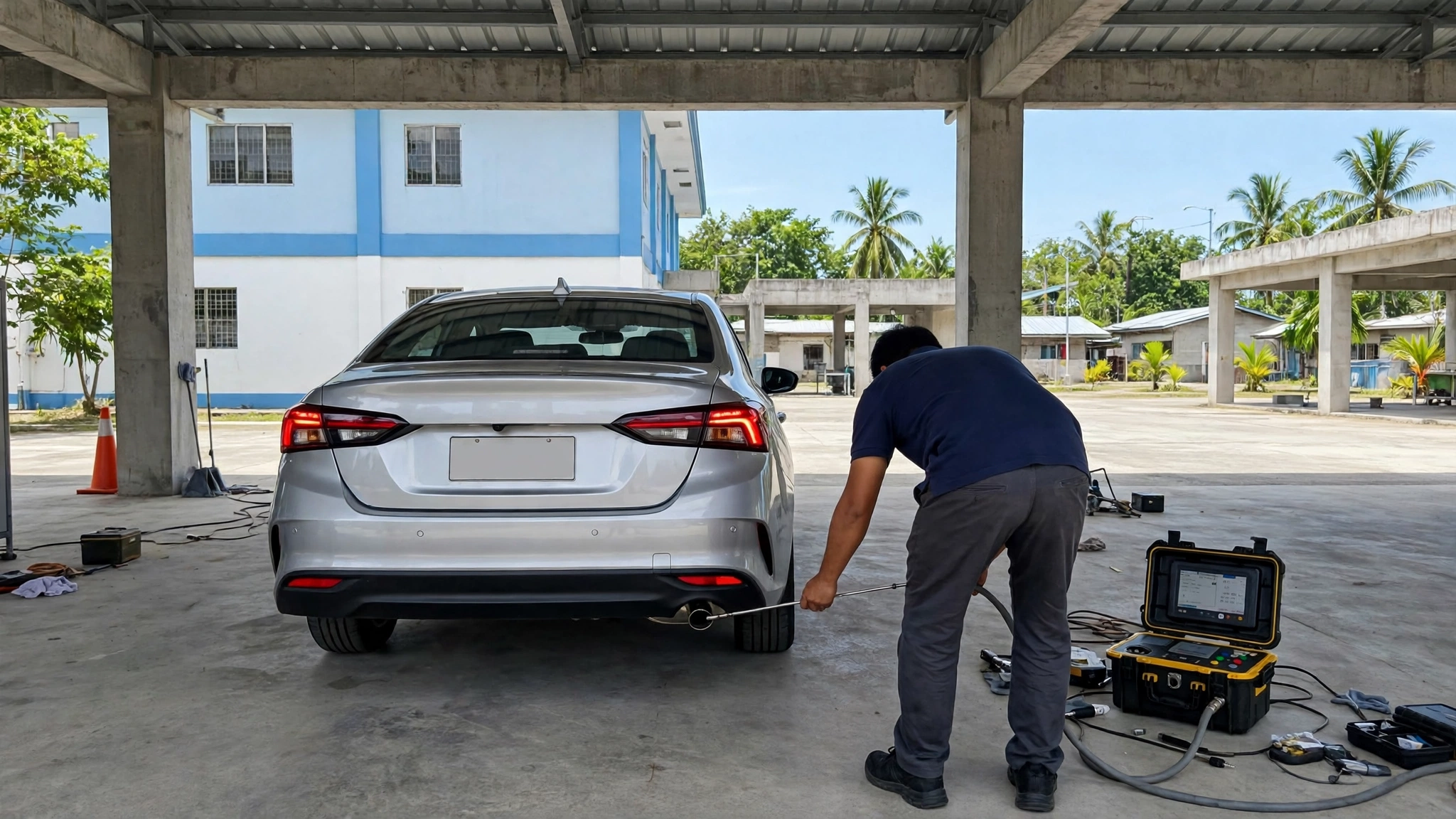
An LTO emission test is the mandatory exhaust check your vehicle must pass before the Land Transportation Office will renew or register it. A technician connects your vehicle to testing equipment, measures what comes out of the tailpipe, and issues a Certificate of Emission Compliance (CEC) if the exhaust is within the legal limits. The result is sent electronically to the LTO system, so there is no paper certificate to carry to the district office. This guide explains where to get the test, what to bring, what the test measures, the pass limits, the fees, and what to do if you fail.
What an LTO emission test is
An LTO emission test measures the pollutants in your vehicle’s exhaust and compares them against limits set under the Philippine Clean Air Act. For a gasoline vehicle, a gas analyzer measures carbon monoxide (CO) and hydrocarbons (HC). For a diesel vehicle, an opacimeter measures how much smoke blocks a beam of light — the smoke opacity.
The test is done only at LTO-accredited Private Emission Testing Centers, known as PETCs — private centers licensed by the LTO to perform the test and transmit results. As of 2026, guides commonly report roughly 1,500 or more PETCs nationwide. Confirm the fee and the queue before you go, since centers set their own prices and busy ones can have long lines.
A passed test earns a Certificate of Emission Compliance (CEC), valid for 60 days — schedule the test within two months of your renewal date, or the certificate expires and you will need to test again.
Why the LTO requires an emission test
Emission testing is mandatory under Republic Act No. 8749, the Philippine Clean Air Act of 1999. The law requires motor vehicles to pass an emission test before registration or renewal, as part of the country’s program to reduce air pollution from vehicles on the road.
The test serves two purposes. First, it keeps visibly polluting vehicles off the road. Second, it tells owners when something is wrong with the engine. A failed test usually means a real problem, such as a worn engine part or a faulty sensor, that is also costing you fuel and power.
Do the emission test first, while the CEC is still valid, then complete the renewal. Our guide to LTO car registration renewal walks through the full renewal sequence, including where the emission test fits.
Where to get the test: PETC locations
A PETC is the only place that can issue a CEC for an ordinary renewal. You cannot get the test done at a roadside mechanic or an unaccredited shop — the LTO system only accepts results from accredited centers.
To find one, search online for a PETC near your area, or ask at your LTO district office for the nearest accredited centers. Most sit near LTO offices, along major roads, or beside inspection centers. Some share a site with a Private Motor Vehicle Inspection Center (PMVIC) — convenient if you also want the full inspection — but for an ordinary renewal, the PETC test alone is enough.
Check the center’s operating hours before you travel. Queues build up quickly, especially in the last week of a renewal month — going in the morning, or in the weeks before your renewal month, usually means a shorter wait.
Documents you need for the test
The list is short. Under the May 2019 joint memorandum of the LTO and the Department of Transportation (DOTr), only a photocopy of the Official Receipt (OR) and Certificate of Registration (CR) plus cash are needed — originals are not required. In practice, some centers still ask to see the originals or a valid ID, so bring them anyway.
| What to bring | Why it is needed |
|---|---|
| Photocopy of OR/CR | Identifies the vehicle and its plate number for the test record |
| Original OR/CR (just in case) | Some centers still ask for originals despite the 2019 memorandum |
| Valid government-issued ID | Some centers ask for identification before testing |
| Cash for the fee | Most centers accept cash only; card payment is not guaranteed |
You do not need insurance papers or a driver’s license for the test itself. The center records the vehicle details from the OR/CR, runs the test, and transmits the result to the LTO.
What happens during the test
The test takes about 15 to 30 minutes, plus queue time. The technician drives your vehicle onto the testing bay, checks that the engine is at normal operating temperature, and runs the measurement.
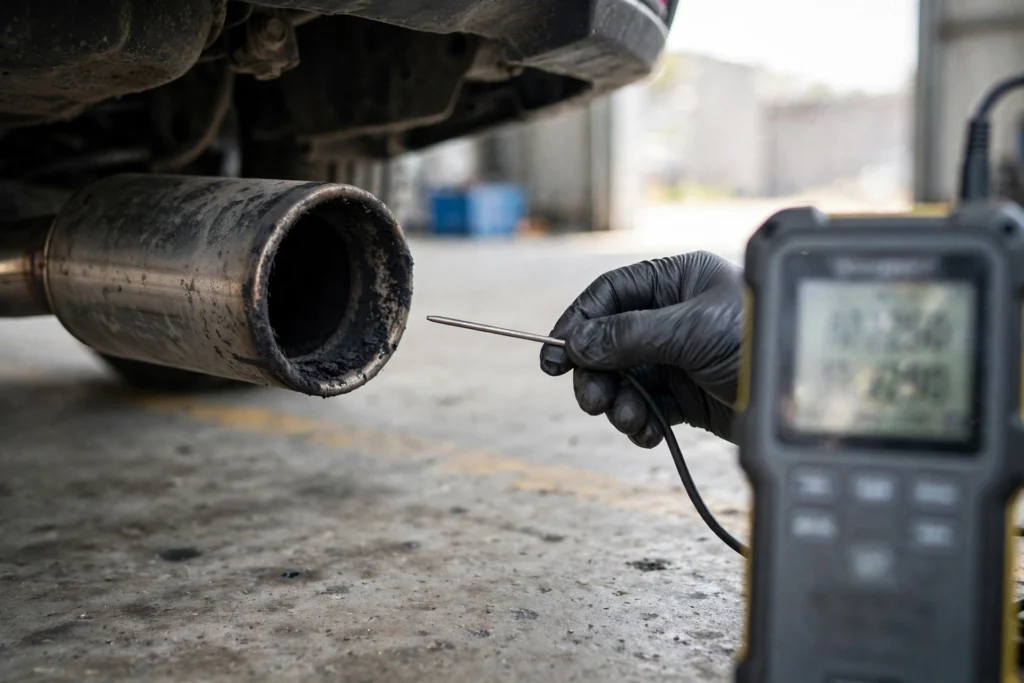
For a gasoline vehicle, the technician inserts a probe into the tailpipe and connects a gas analyzer. The engine runs at idle and at a higher speed while the analyzer reads the carbon monoxide and hydrocarbon levels. For a diesel vehicle, the technician uses an opacimeter: the engine is revved several times, and the machine measures how much the exhaust smoke blocks a light beam.
| Vehicle type | Equipment used | What is measured |
|---|---|---|
| Gasoline | Gas analyzer | Carbon monoxide (CO) and hydrocarbons (HC) |
| Diesel | Opacimeter | Smoke opacity (how dense the exhaust smoke is) |
The technician will also do a visual check. Visible smoke, a check-engine light that stays on, or a damaged exhaust can fail the test before the numbers are read. Fix any of these before you book.
Pass limits for gasoline and diesel vehicles
The limits below are the figures most commonly listed in 2026 guides — confirm the exact limits at your PETC, since the LTO can update its standards.
| Vehicle and condition | Limit (commonly listed) |
|---|---|
| Gasoline, older vehicles — CO at idle | 4.5% maximum |
| Gasoline, newer vehicles with catalytic converter — CO at idle | 0.5% maximum |
| Gasoline, older vehicles — hydrocarbons (HC) | 2,000 ppm maximum |
| Gasoline, newer vehicles with catalytic converter — HC | 300 ppm maximum |
| Diesel — black soot, light absorption coefficient | 2.5 m⁻¹ maximum |
| Diesel — Bosch meter reading | 48% maximum |
| Diesel — Hartridge smoke unit | 66% maximum |
Newer gasoline vehicles have much stricter limits because they are fitted with catalytic converters, which clean the exhaust before it leaves the tailpipe. A vehicle with a working converter should pass easily if the engine is in good condition.
How much does an LTO emission test cost
There is no single official fee — PETCs are private businesses, and prices vary by location and vehicle type. Guides commonly report the following ranges for 2026; confirm the exact fee with the center before you go.
| Vehicle type | Commonly reported fee |
|---|---|
| Gasoline car | ₱400–₱600 |
| Diesel vehicle | ₱500–₱800 |
| Motorcycle or tricycle | ₱500–₱600 |
Another group of guides quotes a wider average of around ₱300–₱600 across vehicle types. Always ask the price before the test starts, so there is no surprise at the counter.
A retest is usually cheaper: a reinspection fee of around ₱300 is commonly reported, though some centers charge the full fee again or offer one free retest.
For the full picture of what a renewal costs beyond the test, see our LTO fees schedule 2026 guide.
Step-by-step: how to get your emission test
- Check your renewal date first. Your plate number sets your renewal month — see our LTO registration renewal schedule guide for the month and week tables. Plan the test within 60 days of the renewal date.
- Find an accredited PETC near you. Search online or ask at your LTO district office. Confirm the fee and the operating hours before you travel.
- Prepare the documents. Bring a photocopy of your OR/CR, the originals just in case, a valid ID, and cash for the fee.
- Warm up the engine before you arrive. Drive for at least 15 to 20 minutes so the engine and catalytic converter reach normal operating temperature. A cold engine runs rich and produces higher emissions.
- Go to the center and queue. Hand over the OR/CR photocopy, pay the fee, and let the technician run the test. The test itself takes about 15 to 30 minutes.
- Get the result. If you pass, the center issues the CEC and transmits it to the LTO system. You can check your records on the LTMS Portal before you go to the district office.
- Renew within 60 days. The CEC expires 60 days after the test date. Complete your registration renewal before then, or you will need to test again.
PETC vs PMVIC: which one do you need
Many owners confuse a PETC with a PMVIC, because both inspect vehicles and both can produce an emission result. They are different facilities with different jobs.
A PETC does one test only: the emission test. A PMVIC is a full computerized roadworthiness inspection center that runs 8 tests, and the emission test is one of them. Our PMVIC inspection guide explains all 8 tests and the fees.
The key point for an ordinary renewal: a PMVIC inspection has been optional since February 2021. Most renewals use the LTO’s own visual inspection plus a PETC emission test. A PMVIC is still required for the first registration of a brand-new vehicle, an imported vehicle, and a change of body, engine, color, or gross vehicle weight (GVW) — in those cases the emission test is part of the PMVIC inspection.
| PETC | PMVIC | |
|---|---|---|
| What it does | Emission test only | Full roadworthiness inspection, 8 tests including emission |
| Required for ordinary renewal? | Yes, the emission test is mandatory | No, optional since February 2021 |
| Still required for | — | First registration of a new vehicle, imported vehicles, change of body/engine/color/GVW |
| Typical fee | Around ₱300–₱800, by vehicle type | Around ₱600 for light vehicles; ₱1,800 for heavy vehicles (commonly reported) |
If your vehicle fails the emission test
A failed test is common, and it is not the end of the process. Fix the cause, then return for a retest.
The most common reasons vehicles fail:
- Visible smoke from the tailpipe. Blue or black smoke usually means oil is burning or the fuel mixture is too rich. Have a mechanic find the cause before you retest.
- Check-engine light is on. A lit light often means a faulty sensor — most commonly the oxygen sensor — and the test will usually fail while it stays on. Have the fault code read and the sensor replaced if needed.
- Overdue maintenance. Old engine oil, a dirty air filter, and worn spark plugs all raise emissions. A basic tune-up fixes many failures.
- Faulty oxygen sensor. The sensor tells the engine computer how to mix fuel and air. When it fails, the engine runs rich and CO and HC readings climb.
- Cold engine at test time. Testing right after a cold start produces higher readings. Warm the engine up first — see the tips below.
After repairs, return to the same center for a retest. A reinspection fee of around ₱300 is commonly reported — ask about the retest policy when you first visit.
Tips to pass the emission test the first time
- Warm up the engine. Drive for 15 to 20 minutes before the test so the engine and catalytic converter reach full operating temperature. Never test right after a cold start.
- Fix the check-engine light first. If the light is on, get the fault read and repaired before you book the test. Testing with the light on is a wasted fee.
- Change the oil and air filter. Fresh oil and a clean air filter lower emissions noticeably. If either is overdue, replace it before the test.
- Replace worn spark plugs. Old plugs cause incomplete combustion, which raises hydrocarbon readings. New plugs are cheap and make a real difference.
- Use the correct fuel. Fill up with the grade your owner’s manual specifies. The wrong fuel can raise emissions and damage the catalytic converter over time.
- Keep up with regular maintenance. A vehicle serviced on schedule rarely fails.
Frequently asked questions about the LTO emission test
1. What is an LTO emission test?
An LTO emission test is the mandatory exhaust check your vehicle must pass before the LTO will renew or register it. A technician at an accredited PETC measures the pollutants in the exhaust — CO and hydrocarbons for gasoline vehicles, smoke opacity for diesel — and issues a Certificate of Emission Compliance if the readings are within the legal limits.
2. How long is the Certificate of Emission Compliance valid?
The CEC is valid for 60 days from the test date. Plan your renewal within that window, or you will need to test again.
3. How much does an LTO emission test cost?
Guides commonly report ₱400–₱600 for gasoline cars, ₱500–₱800 for diesel vehicles, and ₱500–₱600 for motorcycles and tricycles, with some guides quoting a wider ₱300–₱600 average. Confirm the exact fee with the center before you go.
4. What documents do I need for the test?
Only a photocopy of your OR/CR plus cash, under the May 2019 LTO-DOTr joint memorandum. Some centers still ask for the originals or a valid ID, so bring them just in case.
5. Is a PMVIC inspection required for renewal instead of a PETC test?
No. A PMVIC inspection has been optional for renewal since February 2021 — most renewals use the LTO visual inspection plus a PETC emission test. A PMVIC is still required for first-time registration of a new vehicle, imported vehicles, and changes of body, engine, color, or GVW.
6. What happens if my vehicle fails the emission test?
Repair the cause — visible smoke, a lit check-engine light, a faulty oxygen sensor, overdue maintenance, a dirty air filter, or worn spark plugs — then return for a retest. A reinspection fee of around ₱300 is commonly reported.
An LTO emission test is a short, simple step — but only when done at the right time and on a well-maintained vehicle. Book it within 60 days of your renewal date, warm the engine up first, fix any check-engine light before you go, and keep the maintenance up to date. Do that, and the test is a 15-minute formality instead of a failed result and a return trip.