LTO CTPL Insurance Guide 2026: Coverage, Cost, and How to Get It for Registration
LTO CTPL insurance is the one document you cannot skip when you register or renew a vehicle in the Philippines. Without a valid CTPL policy, the LTO will not process your registration — no matter how complete your other papers are. This guide explains what CTPL is, what it covers and what it does not, how much it costs, where to buy it, and how to claim if an accident happens.
What LTO CTPL insurance is and why the LTO requires it
LTO CTPL insurance is short for Compulsory Third Party Liability insurance. It is a motor vehicle insurance policy that pays for the death or bodily injury of a third party hurt in an accident involving your vehicle. The word “compulsory” is the key: it is not optional.
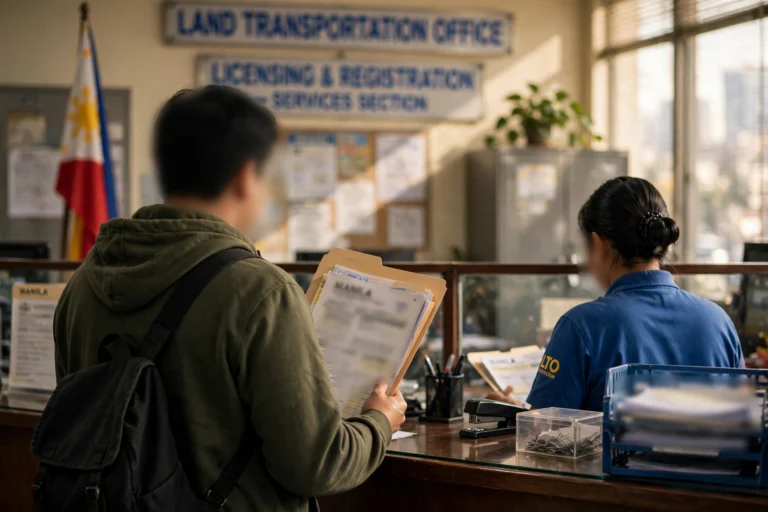
Republic Act 4136 requires insurance before a motor vehicle can be registered, and the Insurance Code (Republic Act 10607) makes it unlawful to operate a motor vehicle on a public road without a compulsory third-party liability policy in force. The LTO enforces that rule at the registration window: no valid CTPL, no registration.
If your vehicle injures a pedestrian or someone in another vehicle, that person needs money for hospital bills or funeral costs right away. CTPL makes sure there is a fund to pay them. It protects the other person — not you, and not your vehicle.
When you buy a CTPL policy, the insurer gives you the policy and a Certificate of Cover (COC) — the document the LTO checks at registration. Keep both safe.
What LTO CTPL insurance covers
CTPL pays for the death or bodily injury of a third party caused by the use of your vehicle — a pedestrian, a cyclist, the driver or passengers of another vehicle, and, as the law words it, a passenger of the insured vehicle. The insurer pays hospital costs and a death benefit to the family, up to the limit on your Certificate of Cover.
The current limit is ₱200,000 per victim, raised from the old ₱100,000 by the Insurance Commission under Memorandum Circular No. 2024-01, effective 24 March 2024. Older guides still show ₱100,000 — the figure that counts is on your own Certificate of Cover.
CTPL also includes a ₱30,000 no-fault indemnity under the same circular — money the victim or family can claim quickly, without first proving who was at fault. Older sources still cite ₱15,000. The law requires the no-fault payment within 10 days once the basic documents are complete.
What CTPL does not cover
CTPL is a narrow policy: it pays other people, not you, and it pays for injuries, not for property.
| Item | Covered by CTPL? |
|---|---|
| Death or bodily injury of a pedestrian hit by your vehicle | Yes, up to ₱200,000 per victim |
| Death or bodily injury of another vehicle’s occupants | Yes, up to ₱200,000 per victim |
| Medical expenses of the injured third party | Yes, within the schedule of indemnities |
| No-fault indemnity to the victim or family | Yes, ₱30,000 |
| Damage to your own vehicle | No |
| Damage to another person’s vehicle or property | No — bodily injury and death only |
| Theft of your vehicle | No |
| Your own injuries as the driver | No |
| Flood, fire, typhoon, or earthquake damage to your vehicle | No |
| Accidents outside the Philippines | No |
Protection for your own car — repairs after a crash, theft, or flood damage — is comprehensive insurance, a separate, optional policy priced as a percentage of your vehicle’s insured value (commonly 1.25% to 3.75% for own damage and theft). Many owners buy both; one does not replace the other.
Who must buy it and when
Every motor vehicle owner in the Philippines must have a valid CTPL policy before the LTO will register or renew the vehicle — private cars, motorcycles, tricycles, trucks, and public utility vehicles alike, with no exemption for a vehicle that is rarely used.
You need CTPL at three moments. First, at new registration: CTPL is one of the required documents, and the policy usually runs for three years to match the initial registration period. Second, at annual renewal: every year, when your registration comes due, you need a fresh one-year CTPL policy before the LTO will renew. For a private car, see our guide to LTO car registration renewal. For a motorcycle, the same rule applies — see our guide to LTO motorcycle registration renewal. Third, for public utility vehicles — see our guide to LTO PUV registration renewal. A PUV also needs CTPL, and its premium is higher because it carries passengers.
How much it costs
The CTPL premium is fixed by the Insurance Commission under Insurance Memorandum Circular No. 4-2006, so every licensed insurer charges the same base rate for the same vehicle class — the 2024 benefit increase did not raise them. What varies between sellers is the fees added on top: taxes, documentary stamps, and the LTO interconnectivity fee.
| Vehicle type | Commonly listed premium (1 year) | Notes |
|---|---|---|
| Private car, jeep, or utility vehicle | About ₱560 (tariff); about ₱610.40 all-in | 3-year: about ₱1,610 |
| Motorcycle, tricycle, or trailer | About ₱250 (tariff); about ₱300.40 all-in | 3-year: about ₱770.40 |
| Light or medium truck | About ₱610–₱660 | Confirm with your insurer |
| Public utility vehicle (PUV) | Varies widely, commonly listed from about ₱700 to about ₱1,500 | Depends on type and capacity |
Treat every figure above as commonly listed, not as a quote. The premium on your own Certificate of Cover and your insurer’s receipt are the final word. For the other charges you pay at registration, see our LTO fees schedule 2026.
Where to buy it
Besides the insurance counters beside the LTO office, any of these works, as long as the seller is licensed by the Insurance Commission and accredited by the LTO:
- Insurance counters at or near the LTO office. Almost every LTO district office has accredited insurer counters nearby, and many have counters inside the building. This is the fastest option on renewal day.
- Insurance company offices and agents. Any licensed non-life insurer can issue CTPL.
- Online. CTPL is sold through insurer websites and apps, and through e-wallets such as GCash’s GInsure. Check the policy and Certificate of Cover carefully — the name, plate number, and engine number must match your OR and CR exactly.
- LBC branches. Since September 2026, LBC branches nationwide sell ProtekSure CTPL for private cars and motorcycles, underwritten by Paramount Life & General Insurance Corporation.
Wherever you buy, the insurer must issue a Certificate of Cover the LTO’s system recognizes — a policy not in the system will not register your vehicle.
What documents you need to buy it
Bring your Official Receipt (OR) and Certificate of Registration (CR) — or the sales invoice and conduction sticker details for a brand-new vehicle — plus a valid government-issued ID. Some insurers also ask for your driver’s license. The insurer needs the plate or MV file number, make and model, and engine and chassis numbers — all on your OR and CR. Check the Certificate of Cover before you leave the counter — a single wrong digit can hold up your registration.

How to file a claim
A claim is filed by the injured third party or their family — or by you, the owner, on their behalf. Your insurer’s policy states its exact requirements, so read it and follow it.
- Help the injured person first. Call for medical help and get the injured person to the nearest hospital.
- Report the accident to the police. Have the accident investigated and documented at the nearest police station. The police report is the foundation of every CTPL claim.
- Notify your insurer as soon as possible. Call the hotline on your policy or Certificate of Cover. Insurers commonly require notice within 30 to 60 days — a late notice can be used to deny the claim.
- Gather the claim documents listed below.
- Submit the documents and wait. Guides commonly report settlement within two to four weeks once the documents are complete.
- Follow up in writing if there is a delay. Keep copies of everything you submit. If the claim is denied, ask for the denial in writing. A formal claim should be filed within one year of the accident.
| Document | Why the insurer needs it |
|---|---|
| Original police or traffic accident report | Proof of the accident |
| CTPL policy and Certificate of Cover | Proof of cover on the accident date |
| OR and CR covering the loss date; driver’s license and receipt | Proof the vehicle was registered and the driver licensed |
| Original medical certificate | Proof of injuries and treatment |
| Original hospital bills and official receipts | Proof of treatment costs |
| Death certificate (for fatal accidents) | Proof of death |
| Government-issued ID of the claimant (birth certificate for minors) | Proof of identity |
| Special Power of Attorney (if a representative files) | Proof of authority |
How long CTPL is valid
A renewal CTPL policy is valid for exactly one year, renewed every year alongside your registration. A policy bought for a brand-new vehicle usually runs for three years, matching the initial three-year registration period. The expiry date is printed on your Certificate of Cover — check it, because the LTO will refuse a renewal if the policy has already expired. There is no grace period: the day it expires, your vehicle is uninsured.
What happens without valid CTPL
The LTO will not register or renew your vehicle. The registration window checks your CTPL electronically, and a missing, expired, or fake policy stops the transaction on the spot.
Driving without registration carries its own penalty: under Joint Administrative Order 2014-01, driving an unregistered motor vehicle carries a fine of ₱10,000, and the vehicle can be impounded.
If your vehicle injures someone while it has no valid CTPL, there is no insurer to pay the victim. The injured person can claim directly against you, and the amount can run into hundreds of thousands of pesos.
Common mistakes to avoid
- Buying a fake CTPL policy. Fixers and online sellers offer fake policies at prices that look too good to be true. Because the LTO verifies CTPL electronically, a fake policy will not register your vehicle — and you will have lost the money.
- Letting the policy expire before renewal day. Check the expiry date on your Certificate of Cover before you go — an expired policy means a wasted trip.
- Confusing CTPL with comprehensive insurance. CTPL does not repair your car, does not pay for theft, and does not cover your own injuries. If you want those, buy comprehensive cover as well — but never skip CTPL because you already have comprehensive.
- Not checking the Certificate of Cover. A wrong plate number, engine number, or name can block your registration. Read it at the counter before you pay.
- Waiting too long to report an accident. Insurers commonly require notice within 30 to 60 days, and a formal claim within one year. Report the accident the same day if you can.
- Assuming the ₱400,000 limit already applies. In June 2025 the Insurance Commission released a draft circular that would raise the CTPL limit to ₱400,000 per incident. It is only a draft — it is not the rule yet.
Frequently asked questions about LTO CTPL insurance
1. What is LTO CTPL insurance?
LTO CTPL insurance is Compulsory Third Party Liability insurance — the policy the LTO requires before it will register or renew any motor vehicle. It pays up to ₱200,000 per victim for the death or bodily injury of a third party hurt in an accident involving your vehicle, plus a ₱30,000 no-fault indemnity. It does not cover your own vehicle, your own injuries, or property damage.
2. How much does CTPL cost in 2026?
The premium is fixed by the Insurance Commission. A private car is commonly listed at about ₱560 for one year under the tariff, or about ₱610.40 all-in. A motorcycle is about ₱250, or about ₱300.40 all-in. Public utility vehicles vary, commonly about ₱700 to ₱1,500.
3. Where can I buy CTPL insurance?
From any insurer licensed by the Insurance Commission and accredited by the LTO — at counters near LTO offices, at insurance company offices, online through insurer websites and apps or e-wallets such as GCash’s GInsure, and at LBC branches nationwide, which sell ProtekSure CTPL. Buy only from a licensed seller: a fake policy will not register your vehicle.
4. How long is a CTPL policy valid?
One year for a renewal, three years for a brand-new vehicle’s first registration. There is no grace period — the day the policy expires, your vehicle is uninsured.
5. What documents do I need to file a CTPL claim?
The police report, CTPL policy and Certificate of Cover, OR and CR, driver’s license, medical certificate, hospital bills and receipts, and a death certificate for fatal accidents. The injured person or their family files the claim, or you file it on their behalf. Notify your insurer as soon as possible — commonly within 30 to 60 days.
6. Is CTPL the same as comprehensive insurance?
No. CTPL is compulsory and covers only the death or bodily injury of third parties, up to ₱200,000 per victim. Comprehensive insurance is optional and covers your own vehicle — repairs, theft, flood, and fire — plus extra liability cover. Many owners buy both, but comprehensive cover never replaces CTPL at registration.
LTO CTPL insurance costs a few hundred pesos a year, and it is the one document your registration cannot proceed without. Buy it from a licensed insurer, check the Certificate of Cover before you leave the counter, and renew it every year before it expires. If an accident happens, report it to the police and to your insurer right away and file the claim while the details are fresh. The policy exists for the other person on the road — and having it in force protects your registration and your finances. Confirm current rules on the LTO website before you travel.