LTO Change of License Classification 2026: How to Switch Between Non-Pro and Professional
LTO change of license classification is the transaction that switches your driver’s license between non-professional and professional — or back again — without changing the vehicles you are allowed to drive. It is a single, specific change to your license record: the classification printed on your card, and the kind of driving it authorizes. If you have stopped driving for a living, or you are about to start, this is the transaction that makes your license match your real life.
Many drivers confuse classification with restriction codes, and the confusion costs them a wasted trip. Classification is about purpose — private driving versus driving for pay — while restriction codes are about vehicle types. Changing your classification does not change your codes, and changing your codes does not change your classification.
What LTO change of license classification means
A Philippine driver’s license carries two separate pieces of information that people often mix up. The first is the classification: non-professional or professional. The second is the set of driver’s license codes, such as A for motorcycles and B for cars, which say what you may drive. An LTO change of license classification touches only the first one. Your codes stay exactly as they are, your license number stays the same, and your expiry date is not reset by the change alone — unless you are also renewing at the same time, which is a different situation covered below.
There are two directions, and they are not mirror images. Downgrading — professional to non-professional — is a short, paper-based transaction with fixed fees and, according to the published procedure, no exam. Upgrading is a bigger process with clearances, tests, and a minimum holding period. This guide covers both, starting with the simpler direction.
Non-professional vs professional: what actually changes
Before you decide to switch, it helps to see the two classifications side by side. The difference is not about skill or experience. It is about whether you drive for money.
| Non-professional (Non-Pro) | Professional (Pro) | |
|---|---|---|
| Who it is for | Private driving only | Driving for pay or hire |
| Typical use | Your own car or motorcycle | Public utility vehicles, company driving, commercial work |
| Clearances on application | Not required | NBI and police clearances required |
| Drug test | Not required | Required |
| Written exam | Required on first application | Required when upgrading |
| Renewal requirements | Standard renewal | Clearances and drug test may be required again |
If you hold a non-professional license and want the full list of what a first non-pro application involves, see our guide to LTO non-pro license requirements. The rest of this article assumes you already hold a license.
A professional license is the right choice when your work involves driving for pay — a public utility jeepney, a taxi, a delivery truck, or a company vehicle where driving is part of the job. Holding one when you no longer drive for a living is not illegal, but it does mean heavier requirements at every renewal, including clearances and a drug test. That is the most common reason drivers downgrade.
Downgrading from professional to non-professional: fees and documents
An LTO change of license classification for a valid professional license costs ₱425 in total, made up of three separate charges.
| Fee | Amount |
|---|---|
| Application fee | ₱100 |
| Replacement fee | ₱225 |
| Change of classification fee | ₱100 |
| Total | ₱425 |
If your professional license has already expired, you can still downgrade — and you can combine the renewal and the classification change in one transaction instead of doing them separately. The expired-license total is higher because it includes the renewal fee, plus a late penalty that depends on how long the license has been expired.
| Fee | Amount |
|---|---|
| Application fee | ₱100 |
| Renewal fee | ₱585 |
| Change of classification fee | ₱100 |
| Subtotal | ₱785 |
| Late penalty, expired 1 day to 1 year | + ₱75 |
| Late penalty, expired 1 year and 1 day to 2 years | + ₱150 |
| Late penalty, expired 2 years and 1 day to 10 years | + ₱225 |
So a license expired for less than a year costs ₱860 in total (₱785 plus the ₱75 penalty) to renew and downgrade in one visit. If it has been expired for more than two years, the penalty rises to ₱225 — confirm at your branch whether any additional step applies.
The documents for a downgrade are short: a completed Application for Driver’s License (ADL) form, a medical certificate, and your original professional driver’s license. The medical certificate is transmitted electronically to the LTO by the accredited clinic, so you do not carry a paper certificate — you visit an accredited clinic, get examined, and the clinic sends the result to the LTO system. Bring your original license because it is surrendered when the new card is issued. If you are also adding a new driver’s license code at the same time, there is an additional restriction code fee of ₱100, and the code change itself is a separate step.
To be eligible, you must hold a professional driver’s license — valid, or expired, in which case the renewal is combined as shown above. You can apply at any LTO licensing office that processes driver’s license transactions, and you should book an LTMS appointment first where the office requires it. No exam is listed in the published downgrade procedure, but confirm at your branch, since local offices can add a verification step.
Step by step: how to downgrade at an LTO office
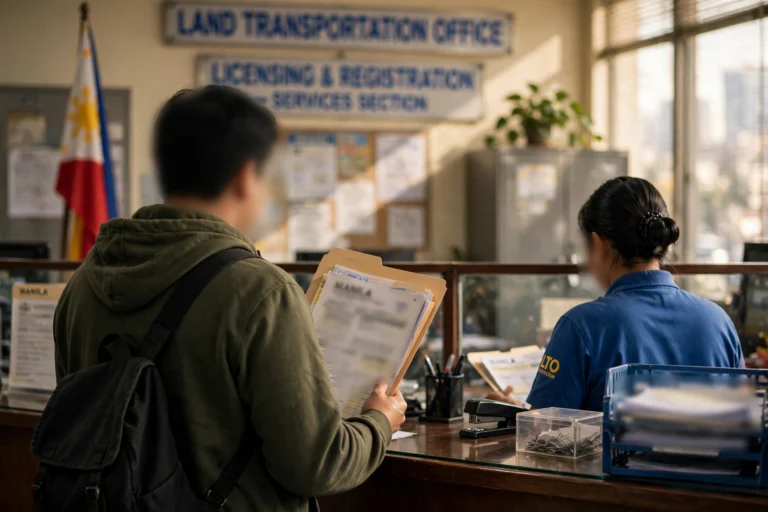
An LTO change of license classification in the downgrade direction follows the same rhythm as most license transactions: a queue, a window, and a new card at the end. Current guides commonly describe it as completed in one visit, but no fixed processing time is published, so treat that as a typical experience rather than a guarantee.
- Book an LTMS appointment if your chosen office requires one. Log in to the LTMS Portal and check the appointment system for your licensing center before you travel.
- Get your medical examination at an LTO-accredited clinic near the office. The clinic transmits your medical certificate electronically to the LTO — keep your receipt and any reference number the clinic gives you.
- Go to the licensing office with your original professional driver’s license. Bring a valid ID as well, in case the evaluator asks for a second one.
- Fill out the Application for Driver’s License (ADL) form, marking clearly that you are changing classification from professional to non-professional.
- Submit your documents at the evaluator’s window. The evaluator checks your license record and your medical certificate in the system.
- Pay the fees at the cashier. For a valid license, that is ₱425. For an expired license, it is ₱785 plus the late penalty for your expiry bracket.
- Have your photo and signature captured, if the office requires a fresh capture for the new card.
- Wait for your new non-professional license card. Your old professional license is surrendered, and your codes carry over unchanged.
Keep your official receipt. It is your proof of payment and your reference if the card is not released on the same day. If the office tells you the card will be released later, the receipt is what you present when you return.
Upgrading from non-professional to professional: what to expect
Upgrading is the reverse direction, and it is deliberately harder. A professional license authorizes driving for pay, so the LTO asks for more proof that you are fit and qualified. This section is a summary only — the full requirements, documents, and steps are in our guide to LTO professional driver’s license requirements, which you should read before you apply.
The license fee most commonly listed for an upgrade is ₱757.50, with one published breakdown totaling ₱1,193 including a change-of-classification fee. Treat both figures as commonly reported rather than final — confirm the exact total at your licensing center, since published breakdowns differ. On top of the fee, you will need an NBI clearance, a police clearance, a drug test, and a medical certificate. A written exam is part of the upgrade, and you must have held your non-professional license for a minimum period first: 6 months for DL codes A or A1, or 1 year for codes B, B1, or B2.
For a straight upgrade with no new code, published guides say the written exam is the only test. If you are also adding a new code — for example, moving from cars to trucks — a practical test can be required, and an additional Practical Driving Course may be needed. Confirm that at your licensing center, because it changes both the cost and the number of visits. Do not arrive expecting a single-window transaction like a downgrade: budget more than one day for clearances and the drug test alone.
What happens to your license codes and your card
This is the part drivers worry about most, and the answer is reassuring: a classification change does not touch your driver’s license codes. If you hold codes A and B as a professional driver, you hold codes A and B after the downgrade. The vehicles you may drive do not change; only the purpose you may drive them for changes. If you want to change your codes as well — adding a motorcycle code, for instance — that is a separate transaction with its own ₱100 fee, covered in our guide to the LTO additional restriction code. To understand what each code covers, see our guide to LTO driver’s license restriction codes.
A new card is issued when the classification changes. Your old license is surrendered, and the new card shows the new classification with the same codes. Your license number stays the same. Under Republic Act No. 10930, a license is valid for 5 years, or 10 years with a clean driving record — and a classification change on its own does not reset that validity period. If you combine the change with a renewal, the new validity period runs from the renewal.
One more practical note: tell your employer or insurer if your classification changes. A driver who downgrades may no longer be covered to drive a company vehicle for work, and an employer who requires a professional license will need to see the new card. The change takes effect when the new card is issued.
Common mistakes to avoid
Most failed or wasted classification-change trips come from a small set of avoidable errors.
Arriving without an LTMS appointment. Some offices now require one for license transactions — check before you travel, or you may be turned away at the gate.
Skipping the medical exam. The certificate must be in the LTO system before the evaluator can process your application — get the exam first and confirm the clinic transmitted the result.
Bringing a photocopy instead of the original license. A downgrade surrenders the original card, and the transaction cannot proceed without it.
Expecting the upgrade to be as quick as a downgrade. It needs clearances, a drug test, a written exam, and a minimum holding period — arrive unprepared and you lose a day.
Mixing up classification and codes. If your goal is to drive a new type of vehicle, a classification change will not help — you need a code change instead. Decide which one you need before you queue.
Forgetting the expired-license penalty. If your license is expired, the total is not ₱425 — it is ₱785 plus the penalty for your expiry bracket. Bring enough for the full amount.
Frequently asked questions about LTO change of license classification
1. What is LTO change of license classification?
It is the LTO transaction that switches a driver’s license between non-professional and professional, in either direction. It changes only the classification — the purpose you may drive for — and does not change your driver’s license codes or the vehicles you may drive.
2. How much does it cost to downgrade from professional to non-professional?
For a valid professional license, the total is ₱425: a ₱100 application fee, a ₱225 replacement fee, and a ₱100 change of classification fee. If your license is expired, the total is ₱785 plus a late penalty of ₱75, ₱150, or ₱225 depending on how long it has been expired.
3. Do I need to take an exam to downgrade?
No exam is listed in the published downgrade procedure — no written test and no practical test. Confirm at your branch before you go, since local offices can add a verification step.
4. Can I downgrade if my professional license is already expired?
Yes. You can combine the renewal and the classification change in one transaction. The fee is ₱785 plus the late penalty for your expiry bracket, and you need the same documents: the ADL form, a medical certificate transmitted electronically by an accredited clinic, and your original license.
5. Will my driver’s license codes change when I change classification?
No. Your codes carry over unchanged, and the vehicles you may drive stay the same. Changing classification is about purpose — private driving versus driving for pay — while codes are about vehicle types. If you also want a new code, that is a separate transaction with a ₱100 fee.
6. How long does a classification change take?
No fixed processing time is published for a classification change. Current guides commonly describe a downgrade as completed in one visit, but queues, card availability, and office workload can add time. For an upgrade, allow extra days for clearances, the drug test, and the exam.
An LTO change of license classification is a small transaction with a big effect on what your license legally allows you to do. Get the direction right, bring the three downgrade documents or the full upgrade set, confirm the fee at your branch before you travel, and book an LTMS appointment where your office requires one. Done properly, a downgrade is a single visit with a ₱425 fee and a new card in hand — and an upgrade, while longer, opens the door to driving for a living.