LTO Electric Vehicle Registration 2026: Requirements, Fees, and Process
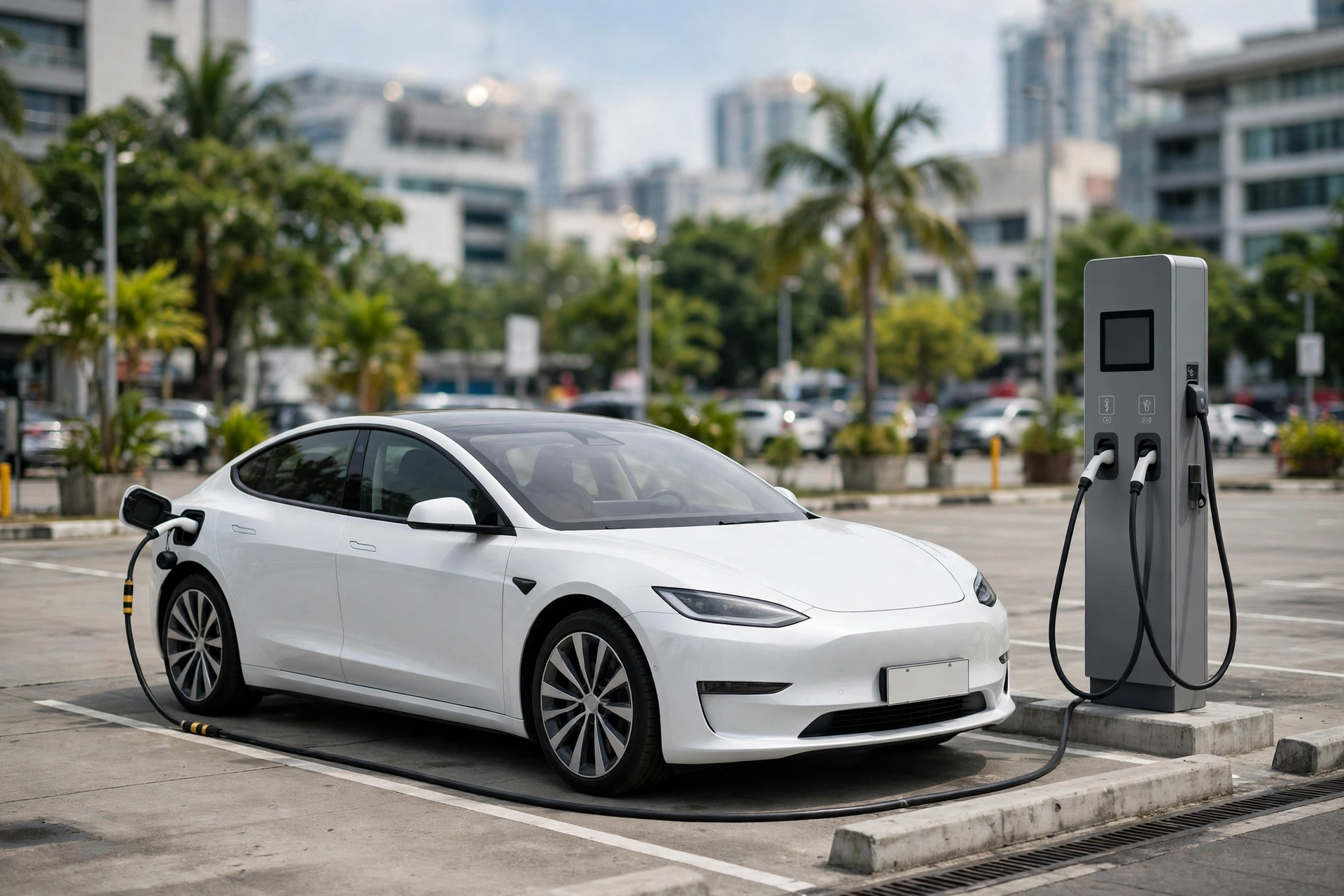
LTO electric vehicle registration is the process of registering a battery-electric or hybrid vehicle with the Land Transportation Office (LTO) so it can legally run on Philippine public roads. Since early 2025, the LTO has been clear: electric vehicles must be registered, just like gasoline and diesel vehicles — with only a few very low-speed exceptions. This guide explains which EVs must register, the documents you need, the fees and the 30% MVUC discount, and the step-by-step process for 2026.
Any figure that could not be confirmed against an official LTO source is flagged in the text so you can confirm it at your branch or dealer before you pay.
What Is LTO Electric Vehicle Registration?
LTO electric vehicle registration is the standard motor vehicle registration process applied to electric vehicles (EVs) — battery-electric cars, e-motorcycles, e-trikes, and e-quads — under the same traffic code that covers every motor vehicle, Republic Act No. 4136, plus the Electric Vehicle Industry Development Act (EVIDA), Republic Act No. 11697, approved on 15 April 2022.
For years, owners of e-bikes and e-trikes were unsure whether they needed to register at all. The LTO ended that gray area in early 2025 through Administrative Order No. VDM-2024-044 and Memorandum Circular No. VDM-2024-2637: EVs used on public roads must be registered, with specific exemptions only for very low-speed personal mobility devices. If your EV can travel faster than 25 km/h, or you use it on a public highway, it needs LTO registration.
Registration gives you an Official Receipt (OR), a Certificate of Registration (CR), and a plate number — the same proof of legal road use every other vehicle carries — and puts your EV on the LTO's records for renewal, transfer, and insurance.
Which Electric Vehicles Must Register (and Which Are Exempt)
The rule turns on speed and where you ride. The table below follows the LTO's 2025 clarification as reported in current guides.
| Vehicle | Must register? |
|---|---|
| Battery-electric car, SUV, or van (Category M) | Yes — full registration, same as a gasoline car |
| E-motorcycle (Category L3) | Yes — if it exceeds 25 km/h |
| E-trike (Category L4) | Yes — if it exceeds 25 km/h |
| E-quad (Categories L5–L7) | Yes |
| E-bike / e-scooter with motor over 250W and speed over 25 km/h | Yes |
| Personal mobility scooter or electric kick scooter, maximum speed below 12.5 km/h | No — exempt from LTO registration |
| Any EV used only on private property, never on public roads | No — registration is for public-road use |
The LTO classifies light EVs under Category L: L2b covers e-scooters and e-mopeds with three wheels, L3 covers e-motorcycles, L4 covers e-trikes, and L5 to L7 cover e-quads. Larger passenger EVs fall under Category M. Your vehicle's category decides your registration fee, so it is worth knowing which one yours falls into before you go to the office.
Two mistakes are worth avoiding. First, "electric" does not mean "exempt": an e-motorcycle that can do 60 km/h is treated like a motorcycle, not like a toy. Second, the kick-scooter exemption is narrow — below 12.5 km/h maximum speed. A scooter that can go faster does not qualify, even if you only ride it slowly. If you are unsure where your vehicle falls, ask your dealer or your LTO office before riding it on a public road.
LTO Electric Vehicle Registration: Documents Checklist
EV registration needs more paperwork than a gasoline vehicle, because one extra certificate — the Department of Energy (DOE) Certificate of Conformity — is required. Gather everything below before your visit.
| Document | Issued by | Purpose |
|---|---|---|
| Original sales invoice | Dealer or seller | Proof of ownership and purchase price |
| Certificate of Stock Report (CSR) | Dealer or manufacturer | Confirms the vehicle is part of dealer inventory and not stolen |
| Certificate of Conformity (COC) | Department of Energy (DOE) | Certifies the EV meets Philippine energy efficiency and safety standards |
| CTPL insurance | Accredited insurer | Compulsory third-party liability cover, transmitted electronically to LTMS |
| Taxpayer Identification Number (TIN) | BIR | Your tax ID for the registration record |
| PNP clearance | Philippine National Police | Confirms the vehicle is not stolen or involved in a crime |
| Motor Vehicle Inspection Report (MVIR) / PMVIC report | LTO / accredited PMVIC | Shows the vehicle passed inspection |
| Motor Vehicle Registration Application Form (MVRAP) | LTO office | The application form, filled out at the office |
If you bought from a dealer, the dealer usually prepares the sales invoice, the CSR, and the COC for you — ask for them explicitly, and check that the COC is included before you leave the showroom. For a private purchase, the deed of sale replaces the sales invoice, and you will need to arrange the COC and clearances yourself. For the standard new-vehicle paperwork in more detail, see our guide to LTO new vehicle registration.
The DOE Certificate of Conformity (COC)
The Certificate of Conformity from the Department of Energy is the one document that causes the most delays in LTO electric vehicle registration — and the LTO will not process your registration without it.
The COC certifies that your specific EV model meets Philippine energy efficiency and safety standards. It is issued per model, not per owner, so a dealer selling a recognized model should already hold it or be able to get it. If your dealer cannot produce a COC, do not pay the registration fees yet — find out first whether the model is certified, because the application cannot move forward without it.
For imported or grey-market EVs, the COC can take longer, since the importer must secure the certification for that model. Ask your seller, in writing, whether the COC is included and how long it will take — a seller who cannot answer that question is a warning sign.
Step-by-Step: How to Register Your EV
The registration process follows the same order as any new vehicle. Done correctly, it can be completed in a single day at the LTO — provided your documents, especially the COC, are already in hand.
Step 1: Gather your documents
Collect the sales invoice, CSR, DOE Certificate of Conformity, CTPL insurance, TIN, PNP clearance, and your ID, following the checklist above. If your dealer is handling registration, confirm in writing which documents they will submit for you.
Step 2: Get the vehicle inspected
Bring the EV to the LTO office or an accredited PMVIC center for inspection. The inspector checks the chassis number, lights, brakes, and other safety items, and issues the inspection report. EVs have no exhaust, so the inspection focuses on safety items rather than emissions — but confirm the exact inspection items at your center, since procedures can vary.
Step 3: Submit your application at the LTO office
Go to the LTO district or licensing office, submit your documents and the MVRAP form at the transaction counter, and get your queue number. The evaluator checks the documents for completeness, including the COC.
Step 4: Pay the fees at the cashier
Pay the registration fees shown on your assessment. Keep the Official Receipt — it is your proof of payment and part of your OR/CR set. The fee table in the next section shows the amounts commonly listed for each EV category.
Step 5: Claim your OR, CR, and plates
After payment, proceed to the releasing counter for your Official Receipt and Certificate of Registration, and your plate number. Your dealer may claim these on your behalf if they handled the registration — ask them for the OR/CR copies and the plate once issued. You can also track your plate status through the LTO tracker.
Registering online through the LTMS portal
Renewals and some registration transactions can be started on the LTMS Portal, where your CTPL and inspection records are already transmitted electronically by accredited providers. For a first-time EV registration, most owners still go through their dealer or visit the office in person, since the COC and the physical inspection need to be handled directly.
Fees and the 30% MVUC Discount
Registration fees for EVs depend on the vehicle category. The figures below are the ones commonly listed in current 2026 guides; confirm the exact total on your LTMS assessment or at the cashier, since the LTO can adjust fees.
| EV category | Commonly listed registration fee |
|---|---|
| L2b (e-scooter, e-moped, three-wheeled) | ₱240 |
| L3 (e-motorcycle) | ₱240–₱300 |
| L4 (e-trike) | ₱300 |
| L5–L7 (e-quad) | ₱1,600 |
| Category M (electric car, SUV, van) | Same MVUC schedule as a gasoline car, less the EVIDA discount |
The big saving for EV owners is the Motor Vehicle User's Charge (MVUC) discount under RA 11697, Section 24(c): battery-electric vehicles pay 30% less MVUC, and hybrids pay 15% less, for eight years from the effectivity of the Act. A battery EV in the ₱1,600 MVUC row therefore pays ₱1,120 instead of ₱1,600 — a saving of ₱480 every year it applies.
For a typical light private car, a full first registration commonly runs around ₱3,400 and an annual renewal around ₱2,900, with the EV discount taken off the MVUC portion. For e-motorcycles, owners commonly report total first-registration costs of around ₱2,000 to ₱5,000 depending on the category and the other charges. For the wider LTO fee picture, see our LTO fees schedule 2026.
The discount applies to the MVUC and related registration and inspection fees under EVIDA — not to the plate fee, CTPL insurance, or computer fee. Your cashier's assessment is final, so treat the figures here as a guide, not a quote.
EV Perks: Number-Coding Exemption and More
Beyond the MVUC discount, EVIDA gives EV owners a practical everyday benefit: electric vehicles are exempt from the number-coding scheme until 15 April 2030. That means an EV can be used on any day of the week regardless of its plate ending, while gasoline and diesel vehicles sit out on their coding day. If you drive in Metro Manila, that exemption alone can be worth more than the fee discount.
Two cautions apply. First, local enforcement can vary — keep a copy of your OR/CR in the vehicle so you can show an enforcer that the vehicle is electric if you are stopped on a coding day. Second, the exemption ends on 15 April 2030. After that, EVs return to the normal coding rules unless the law is extended, so do not plan a purchase around the exemption lasting forever.
Renewing Your EV Registration
Once registered, your EV renews on the same schedule as every other vehicle: by the last digit of your plate number, under the monthly renewal calendar. The renewal month runs from January for plates ending in 1 through October for plates ending in 0, with a weekly window inside the month. See our LTO registration renewal schedule for the full month and week tables.
For renewal you need your current OR/CR, a valid driver's license, CTPL insurance transmitted to LTMS, and an inspection report from an accredited PMVIC center. As with first registration, the 30% MVUC discount for battery EVs and 15% for hybrids applies at each renewal while the EVIDA window runs. If you own a gasoline car as well, the renewal process is the same — see our guide to LTO car registration renewal for the full walkthrough.
At renewal there is no emission test for a battery EV, since there is no exhaust to test. The PMVIC inspection still checks brakes, lights, steering, and other safety items, so book it before your renewal month.
Frequently Asked Questions About LTO Electric Vehicle Registration
Do all electric vehicles need LTO registration?
Almost all of them, if they are used on public roads. Any EV that can exceed 25 km/h must be registered. The only exemption is for personal mobility scooters and electric kick scooters with a maximum speed below 12.5 km/h, and for EVs used only on private property.
What is the DOE Certificate of Conformity, and why do I need it?
The COC is a Department of Energy certificate proving your EV model meets Philippine energy efficiency and safety standards. The LTO will not process an EV registration without it, and it is the document most likely to cause delays — so confirm your dealer has it before you start.
How much does it cost to register an electric car?
The MVUC for a typical light car is ₱1,600, reduced by 30% to ₱1,120 for a battery EV under EVIDA. A full first registration commonly runs around ₱3,400 including plate, CTPL, and other charges, and an annual renewal around ₱2,900. Confirm the exact total at the cashier, since fees can change.
Are electric vehicles exempt from number coding?
Yes — under EVIDA, EVs are exempt from the number-coding scheme until 15 April 2030. Keep your OR/CR in the vehicle so you can prove the vehicle is electric if an enforcer stops you on a coding day.
Do EVs need an emission test?
No. A battery EV has no exhaust, so there is no emission test. You still need the PMVIC safety inspection at registration and renewal, which checks brakes, lights, steering, and other safety items.
How long is the initial EV registration valid?
A brand-new EV gets the same initial registration period as other brand-new vehicles under the current scheme. The exact validity is printed on your OR/CR — confirm it with your dealer.
Can I register my EV online?
Renewals can be started through the LTMS portal, where CTPL and inspection records are transmitted electronically. For a first-time registration, most owners go through their dealer or visit the office in person, because the COC and the physical inspection are handled directly.
LTO electric vehicle registration follows the same road as any other vehicle — documents, inspection, payment, OR/CR — with two EV-specific twists: the DOE Certificate of Conformity, which you must secure before anything else moves, and the EVIDA benefits, a 30% MVUC discount and a number-coding exemption until 15 April 2030. Get the COC confirmed with your dealer first, keep your OR/CR in the vehicle, and renew by your plate-ending month like every other owner.