LTO Written Exam 2026: How Many Questions, Passing Score, and How to Pass

The LTO written exam is the computer-based test you must pass before the Land Transportation Office (LTO) lets you take the practical driving test and move toward a driver’s license. This guide explains how many questions it has, what score you need, what it covers, where and how you take it, what happens if you fail, and how to prepare so you pass the first time.
If you are preparing for the LTO written exam, this guide gives you the numbers, topics, and steps to pass on your first attempt.
What the LTO written exam is
This is the official theoretical test for a driver’s license, taken on a computer at an LTO licensing office. Every question is multiple choice, and you pick one answer per question. The questions are drawn from Philippine traffic law — mainly Republic Act 4136 (the Land Transportation and Traffic Code), Republic Act 10913 (the Anti-Distracted Driving Act), and the road signs and markings every driver is expected to know.
It does not test how well you drive — that comes later, in the practical driving test, scored out of 100 with 70 needed to pass. You must pass the written test first; only then are you called for the practical test.
Do not confuse this exam with two other tests. The 15-hour Theoretical Driving Course (TDC) ends with its own validation exam given by your driving school or Driver’s Education Center. And the Comprehensive Driver’s Education (CDE) online validation exam is for drivers renewing a license, not for first-time applicants. The differences are explained later in this guide.
How many questions are on the exam — and what score you need
The number of questions on the LTO written exam depends on which license you are applying for. The passing scores below come from LTO Memorandum Circular AHS-2008-949 and are repeated by nearly every current guide:
Exam format by license type
| License type | Questions | To pass | Passing mark |
|---|---|---|---|
| Student permit (TDC exam) | 25 | 20 | 80% |
| Non-professional driver’s license | 40 | 30 | 75% |
| Professional driver’s license | 60 | 45 | 75% |
For most first-time drivers, the number that matters is 40 questions and 30 correct answers. The professional exam is longer — 60 questions, 45 correct — because professional drivers are held to a wider scope of rules, including the rules for driving for hire.
Two notes on these numbers. First, the student permit row: the 25-question, 20-correct figure is the one most current guides report for the exam at the end of the Theoretical Driving Course, given by the driving school or Driver’s Education Center rather than the LTO office. Some providers use a longer final exam — one guide reports a 120-question TDC final at 80% — so confirm the format with your school.
Second, a few current guides cite the implementing rules of Republic Act 10930 as setting the driver’s license theoretical exam at 60 randomly selected questions with an 80% passing mark (48 correct) for all applicants, conflicting with the 40-question, 75% figures above. Because guides disagree, confirm the exact format at your LTO office before the day.
What the exam covers
The exam draws on seven topic areas — study all seven:
The seven topic areas
| Topic area | What it covers |
|---|---|
| General driving knowledge | Basic rules of the road and driver duties under RA 4136 |
| Road signs and lane markings | Regulatory, warning, and informative signs; pavement markings |
| Road position | Lane discipline, turning, overtaking, road position |
| Parking | Where parking is allowed or prohibited; stopping rules |
| Handling and driving | Vehicle control, speed management, safe technique |
| Driving emergencies | Brake failure, tire blowouts, what to do after an accident |
| Violations and penalties | Fines, demerit points, consequences of breaking the law |
Most people who fail do so on right-of-way questions and road-sign questions, where the wrong answer often looks almost right. Many questions show a sign and ask what it means, or describe an intersection and ask who goes first. Master those two areas and you are most of the way there. The exam also covers newer laws older reviewers skip, such as the Anti-Distracted Driving Act (RA 10913) on mobile phone use while driving — so use a current reviewer.
Where and how you take the exam
You take the LTO written exam in person, on a computer, at an LTO district or licensing office. It cannot be taken online from home. The online exam you may have heard about is the CDE validation exam for renewals. You can commonly choose between English and Filipino (Tagalog); some offices are said to offer regional languages as well, but that is not confirmed in an official source, so ask your office what is available.
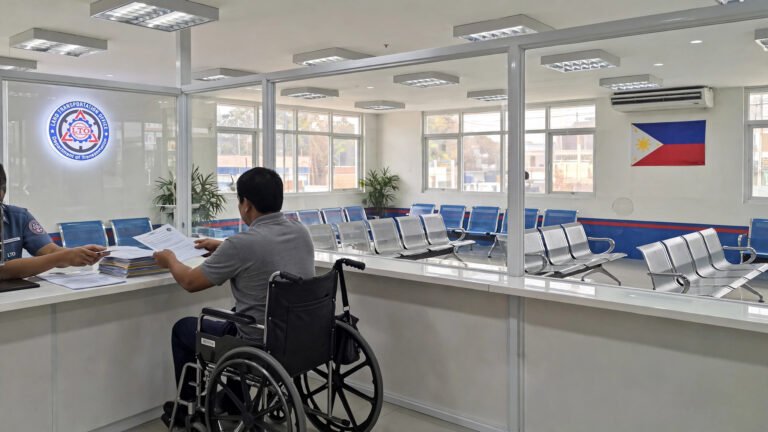
On exam day, the written test usually comes near the end of the process — after your documents are checked, your photo is taken, your signature is captured, and you have paid the application and computer fees. You are then directed to the examination room, where you sit at a computer terminal and answer the questions on screen.
There is no officially published time limit in the circular that sets the passing scores. Guides commonly report 30 minutes for the non-professional exam and 40 to 60 minutes for the professional exam, while the LTO Citizen’s Charter lists 1 hour and 40 minutes for the whole theoretical-examination process step — the full process, not the test itself. Treat the time limit as “commonly reported, confirm at your branch”. Do not rush: read every question fully, and if the system lets you review your answers before submitting, use that chance. The exam fee is commonly listed at ₱150 under the LTO Citizen’s Charter (2025). Confirm the exact amount at your branch, since fees can change.
How to take the exam, step by step
Here is the full path from first application to exam day, in order.
- Step 1. Create your LTMS account. Register on the LTMS Portal and get your LTO Client ID. You need this account for almost every LTO transaction.
- Step 2. Complete the 15-hour Theoretical Driving Course (TDC). This is mandatory before you can apply for a student permit, under Department Order 2017-011. Take it at an LTO-accredited driving school or free at an LTO Driver’s Education Center, subject to slots. See our guide to the LTO Theoretical Driving Course for fees and where to take it.
- Step 3. Apply for your student permit. Bring your TDC certificate, valid ID, and medical certificate to an LTO office, or apply through the LTMS portal where available. The full list is in our guide to LTO student permit requirements.
- Step 4. Hold your student permit for at least one month — you cannot apply for a non-professional license until it is at least 30 days old. Use this month to practise and study.
- Step 5. Complete the 8-hour Practical Driving Course (PDC), required before a non-professional license can be issued. It also prepares you for the practical driving test that follows the written test.
- Step 6. Get your medical certificate. A medical exam from an LTO-accredited clinic is part of the application. Certificates have a limited validity, so do not get yours too early.
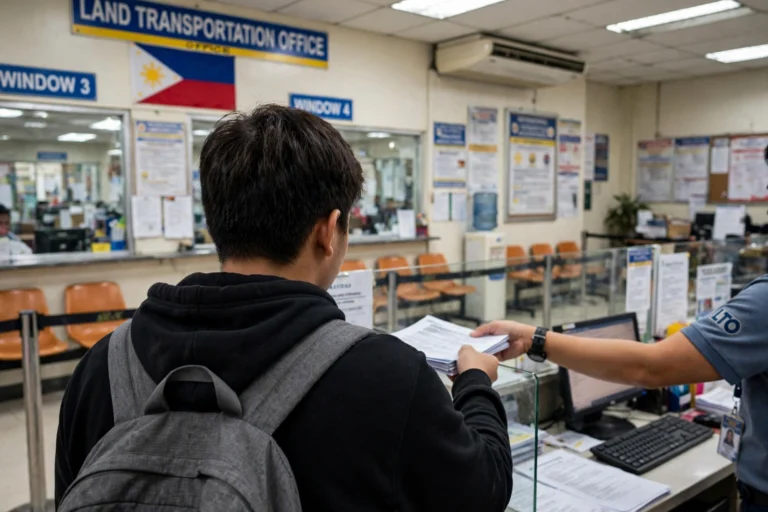
- Step 7. Go to the LTO office and file your license application. Bring your student permit, TDC and PDC certificates, medical certificate, and a valid ID. The full requirements are listed in our guide to LTO non-pro license requirements. Documents are checked, your photo and signature are captured, and you pay the application and computer fees.
- Step 8. Take the written test, then the practical test. Sit the computer-based written test in the examination room. If you pass, you are usually called for the practical driving test the same day. Pass both, and your license is processed.
Bring the originals of every document on exam day, and arrive early: offices commonly set a daily cut-off, and arriving late can mean being told to come back.
What happens if you fail the LTO written exam
Failing is a delay, not the end: you can retake it, but the waiting periods get longer with each failure. The waits below are widely reported by current guides:
Retake waiting periods
| Attempt failed | Wait before retaking |
|---|---|
| First failure | 1 month |
| Second failure | 1 year |
| Third failure | 2 years |
The same waits are commonly reported for the practical driving test. You will also repeat the application process — and pay the fees again — when you return. A few guides add that a failed applicant may need another TDC seminar before retaking, so ask your office what applies to you. Results are commonly reported about an hour after the test: pass, and you go to the waiting area for the practical test; fail, and you are told when you can retake.
Cheating is treated seriously: under Section 23-B of Republic Act 10930, it carries a ₱20,000 fine, revocation of any license granted, and a two-year bar on applying. Do not pay anyone who offers to “fix” your result.
This exam is not the CDE and not the TDC quiz
Three different tests get mixed up constantly:
Three LTO tests often confused
| Test | Who takes it | Questions | Pass mark | Where taken |
|---|---|---|---|---|
| Written exam | First-time applicants | 40 (non-pro) / 60 (pro) | 30 / 45 (75%) | In person, at the LTO office |
| TDC exam | Student permit applicants, after the 15-hour TDC | 25 (commonly reported) | 20 (80%) | At the driving school or DEC |
| CDE validation exam | Drivers renewing a license | 25 | 20 (80%, current guides) | Online via LTMS, or at a DEC |
Note that the CDE passing mark has changed over time: when the CDE launched in 2021, the LTO announced 50% — 13 correct out of 25 — and that figure still appears in older articles. Current guides now report 20 correct out of 25 (80%); confirm on the LTMS portal’s current CDE page.
If you are renewing rather than applying for the first time, read our guide to the CDE online course instead — the CDE is a free refresher exam for renewals, retakable immediately, with no time limit on the portal.
The TDC validation exam comes at the end of your 15-hour course, before you can apply for a student permit. Passing it earns you the TDC certificate. It does not replace the licensing exam — you still sit the written test at the LTO office later, when you apply for your non-professional license.

How to prepare and pass the first time
Passing is mostly steady preparation. Start with the TDC material: the 15-hour course already covers the seven topic areas, and its handouts are the closest thing to an official study guide. If you rushed through the TDC just to get the certificate, go back through it now — especially road signs and right of way.
Practise with real questions, not just reading: the exam tests recognition under time pressure. Use a practice test that mirrors the real format — 40 multiple-choice questions for non-pro, 60 for pro — and time yourself. Our free LTO exam reviewer covers the same topics as the real exam. Aim for 35 or more out of 40 consistently before booking your exam day.
Study the signs visually. Many exam questions show a sign and ask what it means, so use flashcards: sign on one side, meaning on the other. Learn the colour and shape system too — red for prohibition, blue for mandatory instruction, yellow for warning — because it lets you work out signs you have never seen before.
Then do a full mock exam the day before, closed notes: answer 40 questions without looking anything up, write down every miss with its explanation, then redo only your misses. Then rest — cramming on exam morning does more harm than good. On the day itself, read each question twice: many wrong answers come from misreading, not from not knowing. If the system lets you mark a question and come back to it, do that rather than guessing under pressure. No official source states a penalty for a wrong answer, so answer every question.
Frequently asked questions
Q1. What is the LTO written exam?
A1. The LTO written exam is the official computer-based theoretical test you take at an LTO office when applying for a driver’s license. It is multiple choice — 40 questions for a non-professional license (30 correct to pass) and 60 for a professional license (45 correct to pass) — covering traffic rules, road signs, and safe driving under RA 4136 and related laws.
Q2. How many questions are on the exam?
A2. 40 questions for a non-professional license, 60 for a professional license, and 25 (commonly reported) for the student permit exam at the end of the TDC. The passing marks are 30, 45, and 20 correct answers respectively.
Q3. Can I take the exam online?
A3. No. The licensing exam is taken in person on a computer at an LTO office. The only LTO exam you can take online is the CDE validation exam for license renewal, through the LTMS portal.
Q4. What happens if I fail the exam?
A4. You can retake it, but you must wait: one month after a first failure, one year after a second failure, and two years after a third failure. You will also repeat the application process and pay the fees again.
Q5. How long does the exam take?
A5. There is no officially published time limit. Guides commonly report around 30 minutes for the non-professional exam and 40 to 60 minutes for the professional exam. Confirm the time allowed at your branch, and use the full time rather than rushing.
The LTO written exam is straightforward once you know how it works: a computer-based multiple-choice test at your LTO office, 40 questions for non-pro and 60 for pro, with a 75% passing mark, covering seven topic areas you can study in advance. The people who fail are usually the ones who walked in without preparing. Study the signs, practise until you score comfortably above the passing mark, and confirm the exact format at your branch before the day. Then walk in, read every question twice, and pass it the first time.