LTO Driver’s License for PWD 2026: Requirements, Medical Exam, and How to Apply
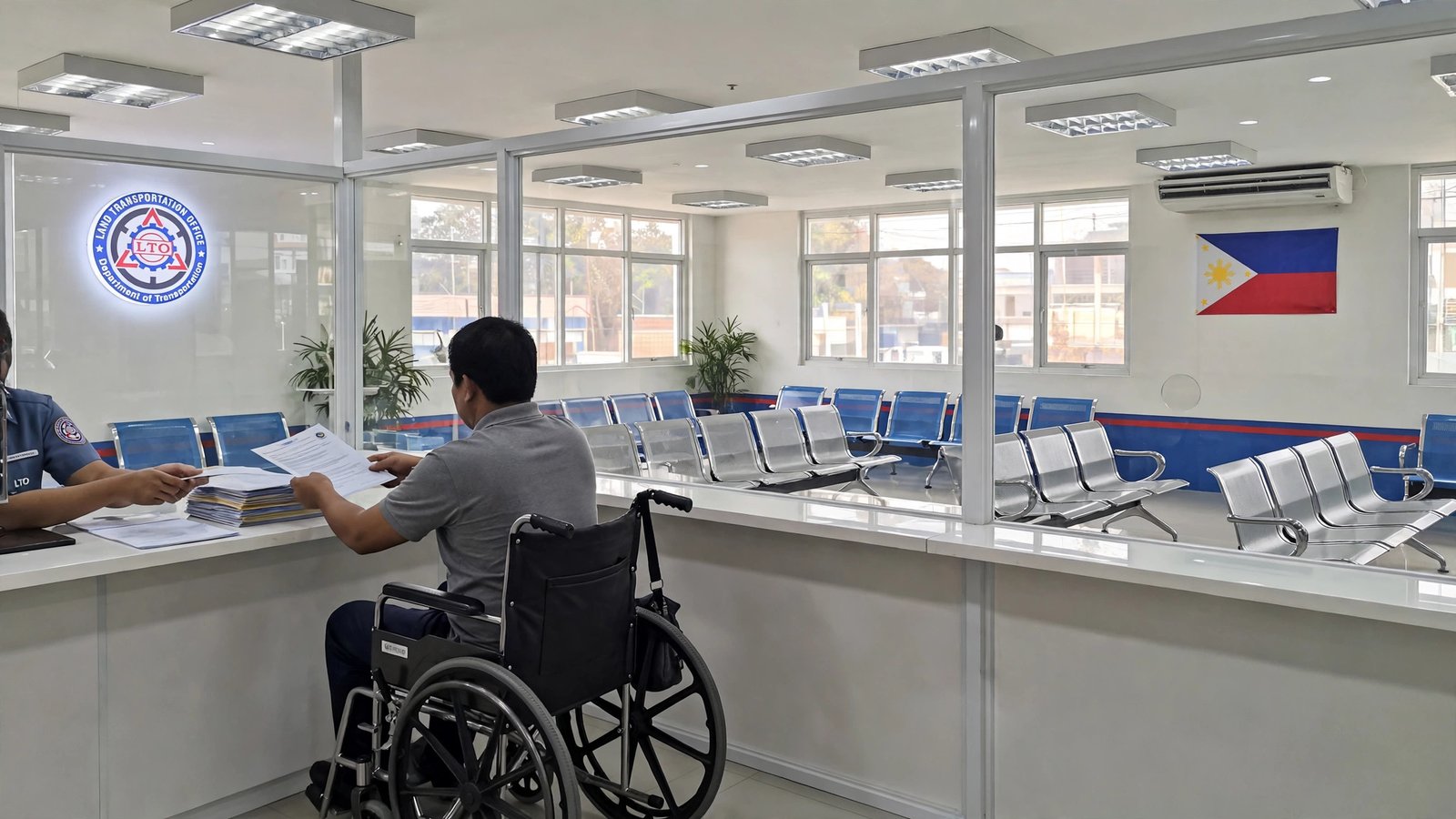
LTO driver’s license for PWD is a real route to legal driving in the Philippines — not a favor, and not a separate license class. If your condition is on the LTO’s list of allowable conditions, you can apply for a non-professional driver’s license through the same student permit, training, and exam path as any other Filipino, with a medical check and extra conditions on your card. This guide covers who qualifies, the documents, the medical exam, the steps, adapted vehicles, restriction codes, and fees for 2026.
Any figure that could not be confirmed against an official LTO source or a current authoritative guide is flagged in the text — confirm it at your branch before you pay.
What Is an LTO Driver’s License for PWD?
An LTO driver’s license for PWD is a standard non-professional driver’s license issued to a person with disability who has passed the LTO’s medical fitness assessment and the written and practical exams. The legal basis is Chapter 6, Section 26 of Republic Act No. 7277, the Magna Carta for Persons with Disability: disabled persons shall be allowed to drive, subject to LTO rules that fit the nature of their disability and the adaptations made on their vehicle.
The LTO issues it only as a non-professional license, for private vehicles only — never for hire, and never convertible into a professional license. It carries a special restriction code and conditions matching your disability, such as daylight driving only or driving only with special equipment. Those conditions are part of the license: driving outside them is a violation.
Who Can Apply — and Who Cannot
Not every disability qualifies. The LTO’s guidelines, set out in its early circulars and revised in Memorandum Circular No. RTL-MC-02373 (2002), list the specific conditions that may apply.
| Condition | May apply? |
|---|---|
| Single arm amputee (left or right) | Yes |
| Single leg amputee (left or right) | Yes |
| Post-polio victim, one paralyzed leg | Yes |
| Weak legs, but not paralyzed | Yes |
| Partially blind — one eye missing, good sight in the other | Yes |
| Speech / hearing impaired — mute or partially deaf | Yes |
| Totally blind | No |
| Double amputee | No |
| Both legs paralyzed | No |
If your condition is not on the allowable list, the LTO will not issue a license, even if you can drive with adaptations. That decision is made on the medical certificate, not at the counter — so get the medical exam done before you spend money on courses. You must also meet the ordinary requirements for any new driver: at least 17 for a student permit, physically and mentally fit, and literate in English and Filipino.
Your PWD ID, issued by your city or municipal Persons with Disability Affairs Office (PDAO) or social welfare office, is the usual proof of disability status — bring it, with a photocopy. If you already hold a regular license and later acquire a disability, the LTO’s guidelines say you must replace it with a special driver’s license, with a medical certificate from an LTO-accredited physician.
LTO Driver’s License for PWD: Requirements
The documents are the standard non-professional license documents, plus the medical certificate stating your fitness to drive and any recommended conditions.
| Document | Issued by | Purpose |
|---|---|---|
| Application form | LTO office | Filled out at the office |
| Valid student permit (original and photocopy) | LTO | Proves a 30-day hold |
| Medical certificate | LTO-accredited clinic | States fitness and conditions |
| PWD ID | LGU PDAO / social welfare office | Proof of disability status |
| Birth certificate (PSA) | Philippine Statistics Authority | Proof of identity and age |
| Valid government ID with photo and signature | Issuing agency | Identity check |
| Tax Identification Number (TIN) | BIR | Tax ID for the record |
| PDC certificate | LTO-accredited driving school | Sent electronically to LTMS |
| TDC certificate | LTO Driver’s Education Center or accredited school | Proves the 15-hour course |
For the full standard list, see our LTO non-pro license requirements. Bring originals and one photocopy of each document; the LTO keeps the photocopies and returns the originals.
The Medical Exam: What the LTO-Accredited Physician Checks
The medical exam is what makes a PWD application different, and it decides the conditions on your license. You take it at an LTO-accredited clinic — but for a PWD applicant, the physician may refer you to a specialist first: an ophthalmologist for visually impaired applicants, a rehabilitation medicine specialist for orthopedically impaired applicants, and an ear, nose, and throat (ENT) specialist for speech and hearing impaired applicants. The specialist’s certificate states your fitness to drive and the appropriate conditions, and that is what the LTO relies on.
The exam covers vision, hearing, limb strength and range of motion, coordination, and mental fitness to drive. For a partially blind applicant, the key question is the sight in the remaining eye; for an orthopedically impaired applicant, whether you can operate the controls safely with or without adaptations; for a speech and hearing impaired applicant, whether you can hear traffic warnings — which is why one condition can require a companion with normal hearing.
Physicians are instructed to give priority to PWD applicants. If a clinic turns you away without a referral, ask for it in writing and go to another accredited clinic. The certificate is transmitted electronically to LTMS — keep the receipt and any specialist certificate you were given. For the general medical exam process, see our LTO medical exam guide.
Step-by-Step: How to Apply
The path to an LTO driver’s license for PWD follows the standard student permit to non-professional license route:
Step 1: Complete the 15-hour Theoretical Driving Course (TDC)
Enroll in the TDC at an LTO Driver’s Education Center or an LTO-accredited driving school. It is free at LTO centers; at private schools it is commonly capped at ₱1,000.
Step 2: Get your student permit
Apply at any LTO licensing center with your birth certificate, valid ID, TDC certificate, TIN, and medical certificate. You must be at least 17. The fee is commonly listed at ₱317.63, and the permit is valid for one year. For the full checklist, see our LTO student permit requirements.
Step 3: Take the Practical Driving Course (PDC)
Complete the PDC at an LTO-accredited driving school — at least 8 hours for a non-professional license. If you will drive an adapted vehicle, tell the school before you enroll so practice uses the right controls. PDC fees vary by school and vehicle; applicants commonly report ₱1,500 to ₱5,000 for a standard course.
Step 4: Hold your student permit for at least 30 days
You cannot apply for a non-professional license until you have held a valid student permit for at least 30 days. Some current guides count 31 days from the issue date — follow the date printed on your permit. Use the wait to practice with a licensed companion, in the vehicle you will use for the test.
Step 5: Apply at the LTO office and take the written exam
Go to your preferred LTO licensing center with all your documents, with your medical exam and any specialist referral already done. Submit the application form, have your photo and signature taken, and pay at the cashier. Then take the computerized written exam on basic driving theory — you must pass it to take the practical test.
Step 6: Take the practical driving exam in your adapted vehicle
Take the practical exam in the vehicle you will actually drive — adapted as needed, and duly inspected and registered. The examiner checks that you can control the vehicle safely with your adaptations. If you pass, claim your license at the releasing counter. You can start the process on the LTMS Portal, where your medical, TDC, and PDC records are already on file.
Adapted and Customized Vehicles for the Practical Test
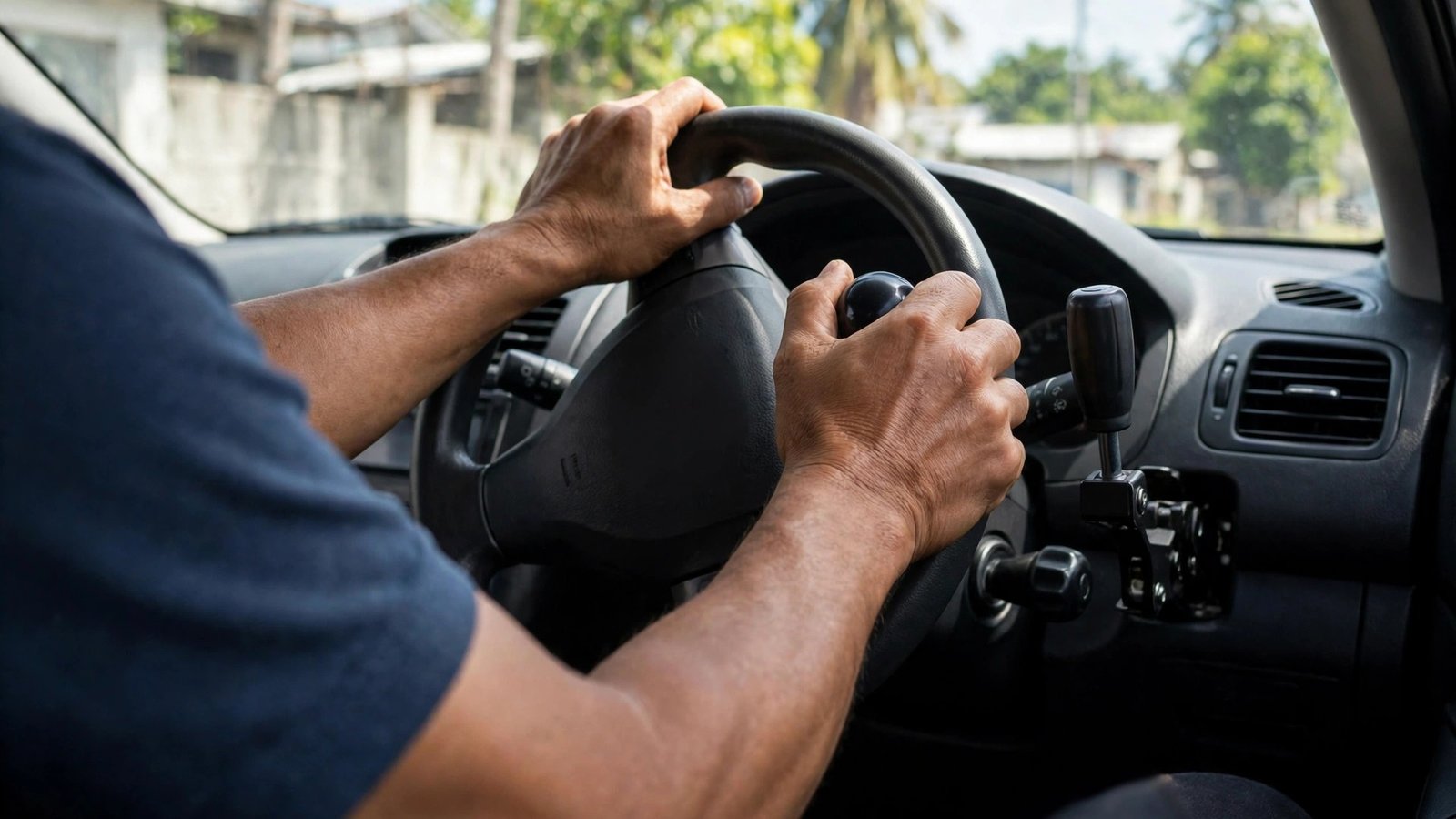
Many PWD drivers need a vehicle changed to fit them — hand controls instead of foot pedals, a spinner knob on the wheel, a left-foot accelerator, or a modified seat and pedal layout. The LTO allows this, with two conditions: the adaptation must meet LTO standards, and it must be requested at the LTO and noted on your license.
The rule is strict: if your license says you may drive only a customized vehicle, you may drive only that vehicle — the one inspected, registered, and written on your license. You cannot borrow an ordinary car on the same license. Before the practical test, confirm with the LTO office that your adaptations are accepted and recorded. If you are still choosing adaptations, ask what setups are commonly approved — one the LTO will not accept is money spent twice.
Restriction Codes and Conditions on Your License
A PWD license carries Restriction Code 9, the code for special licenses for disabled persons under RA 7277, with the ordinary vehicle codes (for example, code 1 for motorcycles and code 2 for cars up to 4,500 kg). The license also lists conditions — letters spelling out exactly how you may drive.
- A — Corrective lenses: wear your glasses or corrective lenses while driving.
- B — Special equipment, upper limbs: approved upper-limb adaptations required.
- C — Special equipment, lower limbs: approved lower-limb adaptations required.
- D — Daylight driving only: drive only from 6:00 AM to 6:00 PM.
- E — Hearing companion: a person with normal hearing must ride with you.
Condition D, daylight driving only, applies to all disabled drivers under the LTO’s guidelines — so a PWD license does not allow night driving. That is the single biggest practical limit: if your work or family needs you on the road after 6:00 PM, this license will not cover it. The conditions are printed on the card, and an enforcer can check them at a stop, so keep your license with you and drive inside your conditions.
Fees: What a PWD Applicant Pays
There is no separate PWD fee schedule, and no PWD discount on LTO license fees was confirmed in any official source checked — so plan on the standard amounts, and treat the cashier’s assessment as final. The figures below are the standard fees as commonly listed in current 2026 guides.
| Item | Commonly listed amount |
|---|---|
| Student permit (LTO fees) | ₱317.63 |
| Non-professional license fee | ₱585 |
| Medical exam (accredited clinic) | ₱300–₱500 |
| Theoretical Driving Course (TDC) | Free at LTO centers; up to ₱1,000 at private schools |
| Practical Driving Course (PDC) | Commonly ₱1,500–₱5,000, varies by school and vehicle |
| Computer / validation fee | Around ₱67.63 |
A first-time applicant commonly spends around ₱3,000 to ₱6,000 in total from student permit to license, including courses and the medical exam — the wide range is mostly the PDC, which depends on your school and vehicle. The license is valid for 5 years, or 10 years if your record stays clean under RA 10930. For the wider fee picture, see our LTO fees schedule 2026.
One warning: the 20% PWD discount under RA 10754 covers specific goods and services listed in that law, and it was not confirmed to cover LTO license fees. Do not assume a discount at the cashier.
Frequently Asked Questions About LTO Driver’s License for PWD
Who can apply for an LTO driver’s license for PWD?
A Filipino citizen with a disability on the LTO’s allowable list: single-arm or single-leg amputees, post-polio victims with one paralyzed leg, people with weak but not paralyzed legs, partially blind people with good sight in one eye, and speech and hearing impaired people. You must be at least 17 for a student permit and 18 for the license, fit to drive, and literate in English and Filipino.
Can a totally blind person get a driver’s license?
No. Total blindness is not on the LTO’s allowable list, and neither are double amputation or two paralyzed legs.
Do PWD applicants need to take the TDC and PDC?
Yes. PWD applicants follow the same training as any new driver: the 15-hour Theoretical Driving Course before the student permit, and the Practical Driving Course — at least 8 hours — before applying. There is no exemption.
What is Restriction Code 9?
Restriction Code 9 is the code for special licenses for disabled persons under RA 7277. It appears on the license with the ordinary vehicle codes and the condition letters A to E — lenses, special equipment, daylight driving only, or a hearing companion.
Can a PWD drive at night?
No — not on a PWD license. Condition D, daylight driving only, applies to all disabled drivers under the LTO’s guidelines, limiting driving to 6:00 AM to 6:00 PM. Night driving on a PWD license is a violation.
How much does it cost, and is there a PWD discount?
Plan on the standard fees: a student permit commonly listed at ₱317.63, a non-professional license fee of ₱585, a medical exam commonly ₱300 to ₱500, and driving school fees on top. No PWD discount on LTO fees was confirmed, so budget for the full standard amounts.
Can a PWD drive any car, or only an adapted one?
Only the vehicle noted on the license. If your license requires a customized vehicle, you may drive only the adapted vehicle written on your license. An unadapted car is not covered, even if you could physically drive it.
An LTO driver’s license for PWD is not a shortcut and not a consolation — it is the same license, earned the same way, with the medical exam and the conditions matching the license to the driver. If your condition is on the allowable list, start with the medical exam: it tells you whether you qualify and what conditions will apply, before you spend anything on courses. Then take the TDC, get your student permit, finish the PDC in the vehicle you will actually drive, and take the exams. Drive inside your conditions, and the license gives you the same road as everyone else.