LTO Temporary Plate and Conduction Sticker Guide 2026: Rules, Fees, and What to Do If Yours Is Lost

LTO temporary plate and conduction sticker rules confuse many new car owners, because the two things look similar but are not the same. The conduction sticker is the numbered sticker your dealer puts on your brand-new vehicle. The temporary plate is the plate you display — using that conduction number, or later your MV file number — while you wait for your official metal plates from the LTO. This guide explains, in plain language, what each one is, how long each one is valid, how number coding works without metal plates, what the temporary plate must look like, and what to do if your sticker or plate is lost or damaged.
The short version: keep the conduction sticker on the vehicle until your metal plates are installed, carry your OR and CR once they are released, and never drive with no identifier at all — an unregistered vehicle carries a ₱10,000 fine. LTO temporary plate and conduction sticker rules are straightforward once you know which identifier to display at each stage.
LTO temporary plate and conduction sticker: what is the difference?
A conduction sticker is a sticker with a unique conduction number, issued by your dealer when you buy a brand-new vehicle. It is the vehicle’s first, temporary identity: it proves the car was legally bought in the Philippines and lets you drive it off the dealership lot while your initial 3-year LTO registration is being processed. The LTO does not print or hand out conduction stickers to individuals — it assigns the number series to car manufacturers, and the dealers and manufacturers print and attach the stickers themselves.
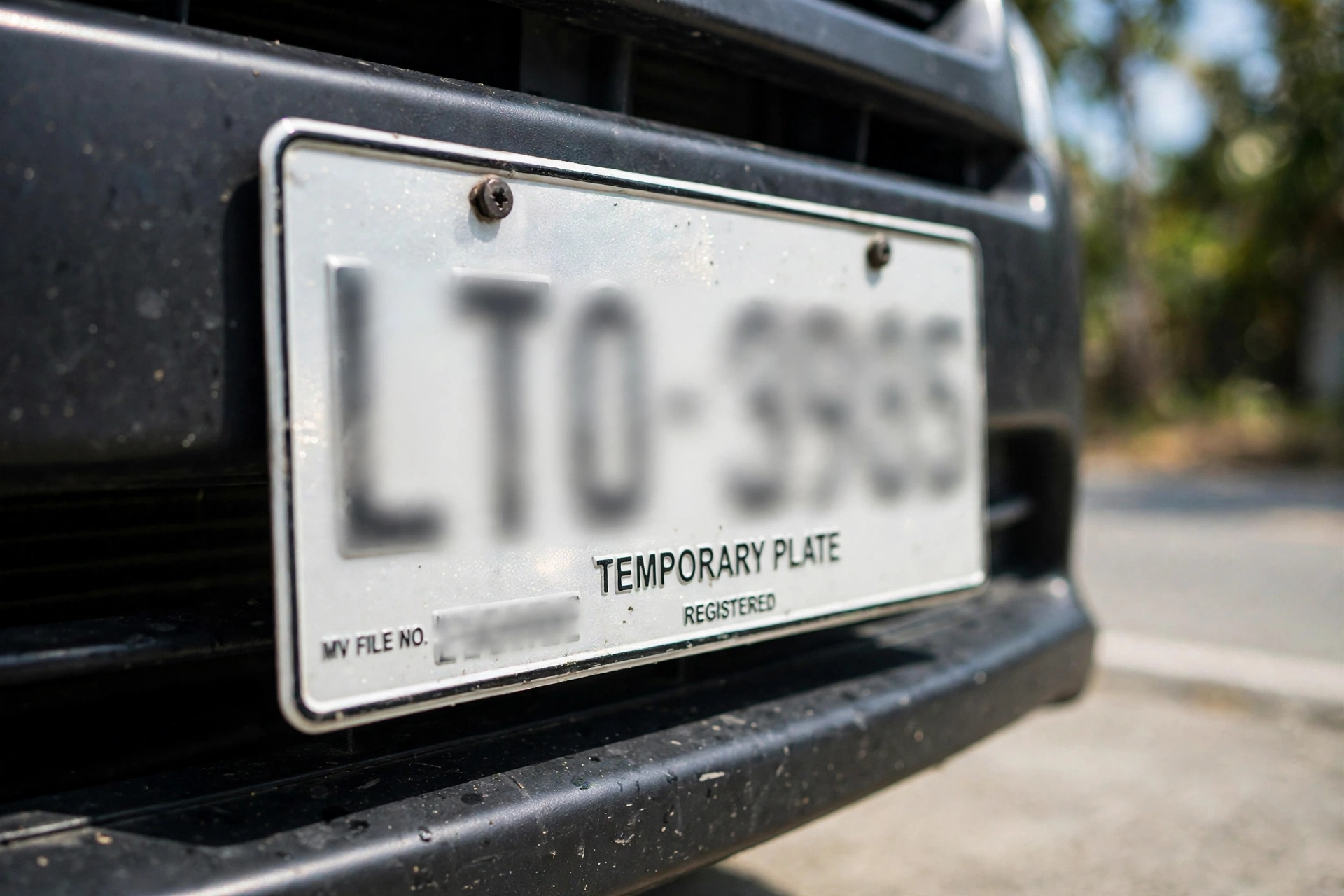
A temporary plate is the plate you display on the vehicle while waiting for the official metal plates. For a brand-new vehicle, the temporary plate uses the conduction number. Once the LTO approves your initial registration and issues your Certificate of Registration (CR), the CR contains a 15-digit MV file number — and that number becomes your official “virtual plate” if the metal plates have not been released yet. From that point, the MV file number, not the conduction number, is what you display and what determines your number-coding day.
| Identifier | When it is used | Determines number coding? |
|---|---|---|
| Conduction sticker | First weeks after dealership release, before the CR is issued | Yes, by its last digit |
| MV file number (virtual plate) | Once the CR is released but metal plates are not yet available | Yes, by its last digit — overrides the conduction sticker |
| Metal license plate | Once physically issued by the LTO and installed | Yes, final and permanent coding day |
So the sequence is: conduction sticker first, then MV file number as the virtual plate, then the metal plate. At each stage there is always one identifier that enforcement officers, toll operators, and traffic cameras use to identify your vehicle.
How long is a temporary plate valid?
Under LTO Memorandum Circular VDM-2024-2721, issued in August 2024, a temporary plate for a private motor vehicle is valid for only 15 days from the issuance of the sales invoice. That 15-day validity is the official LTO position as of 2024 and into 2026. It exists for the gap between registration and metal-plate release.
You may also see a separate “7-day” rule online. That rule refers to driving on your sales invoice alone, before your OR/CR is released — a shorter window, and a different situation from driving with a temporary plate. Do not mix the two up: the 15 days run from the sales invoice date for the temporary plate, while the 7 days relate to the sales-invoice-only period.
What happens after the 15 days? You do not get penalised simply for waiting for your plates. As long as you carry your valid OR (Official Receipt) and CR (Certificate of Registration), you can keep driving — the LTO stopped apprehending vehicles for missing plates while owners wait for plate release. The practical rule is: carry your OR and CR, display the correct temporary identifier, and keep following up on your plates.
Your dealer is part of this timeline too. The dealer is required to submit your registration documents to the LTO within five working days of the sale, including the sales invoice, the Certificate of Stock Reported, and other proofs. If your dealer is slow, your registration — and your plates — will be slow. Ask your dealer for the OR/CR timeline in writing when you take delivery.
There is good news on the backlog that made these rules necessary. The nationwide plate backlog was declared cleared when the LTO reported zero plate backlog to the House transport committee on 20 May 2026, ahead of the Republic Act 12209 deadline of 30 June 2026. The temporary-plate rules above still apply while your own plates are being produced, but the long waits of previous years should be shorter now. Confirm the current situation at your branch, because local release times can still vary.
Number coding with a conduction sticker or temporary plate
A common myth is that a brand-new car without metal plates is exempt from the MMDA number-coding scheme (UVVRP). That is false. Traffic enforcers use the last digit of your conduction sticker to work out your coding day, exactly as they would use the last digit of a metal plate. If your sticker ends in 4, for example, you are banned from driving during rush hours on Tuesdays — the same as a plated car ending in 4.
Once your CR is released, the MV file number takes over: its last digit becomes your coding day and overrides the old conduction sticker. And once your metal plates arrive, the plate number’s last digit is final. At every stage, the coding day follows the identifier you are currently using, so check the last digit again each time your identifier changes.
For the full picture of what happens after registration, including the 3-year initial registration period for new vehicles, see the new vehicle registration guide.
What a temporary plate must look like
A temporary plate is not a piece of cardboard with a number scribbled on it. Under Memorandum Circular VDM-2024-2721, temporary and improvised plates must follow a strict layout, and using the wrong format can draw a fine for improper display — commonly reported as ₱5,000 under Joint Administrative Order 2014-01.
The layout commonly described in current guides is:
| Element | Requirement |
|---|---|
| Font | Arial, on reflective material |
| Colour of characters | Black for private vehicles, green for electric vehicles, red for government vehicles |
| Centre | Conduction sticker number (or MV file number once the CR is released) |
| Bottom | MV file number |
| Sides | Dealer name |
The plate must be reflectorised and clearly visible from a distance — commonly described as visible from 50 metres. It must be placed in the designated plate slots, front and rear. Do not use a falsified or unauthorised improvised plate: using one is treated as a serious offence, equivalent to tampering under Section 31 of Republic Act 4136.
Motorcycles follow the same framework, with one historical detail worth knowing: motorcycles bought before 1 January 2023 could use the MV file number on their temporary plate, while motorcycles bought after that date follow the same rules as other vehicles. If you ride a motorcycle, confirm the current format at your branch or dealer before having a plate made.
Do not assume your conduction sticker lets you drive out of town immediately. Your dealership must issue a delivery receipt or a temporary permit to travel; without it, driving a car using only a conduction sticker across provincial borders is commonly reported as risking impoundment. Ask your dealer for that travel document before any long trip.
When can you remove the conduction sticker?
Only peel the conduction sticker off your windshield and rear glass once you have received your official LTO metal license plates and bolted them on. Until then, the sticker is part of your vehicle’s legal identity, and removing it early leaves you with no visible identifier while you wait.
That is also why you should not treat the sticker as decoration or dealership branding. It is your car’s temporary legal shield: it is what an enforcer, a toll gate, or a camera uses to identify your vehicle until the metal plate takes over.
What to do if your temporary plate or conduction sticker is lost or damaged
Losing a conduction sticker or a temporary plate is not the same as losing a metal plate, and the fix depends on which one you lost and what stage your registration is at.
If the conduction sticker is lost or damaged before your CR is released, go back to your dealer first. The dealer issued the sticker and holds the conduction number records, so the dealer is the one who can reissue or confirm the number. Do not print a replacement yourself and do not drive with no identifier while you sort it out — coordinate with the dealer and, if needed, your LTO district office.
If your CR has already been released, your MV file number is your identifier. Use the MV file number as your temporary plate, in the format described above, and keep your OR and CR in the vehicle. The conduction sticker matters less at this stage, because the MV file number has already taken over as your official virtual plate.
If a metal plate is lost, stolen, or damaged after it was issued, the process is different and more formal. It generally involves a notarised Affidavit of Loss, a police report if the loss involved theft, a physical inspection of the vehicle for a Motor Vehicle Inspection Report, and a PNP-Highway Patrol Group Motor Vehicle Clearance Certificate — a requirement under current LTO circulars for duplicate-plate applications. The LTO then issues an Authorization to Use Temporary Plate while the duplicate is being made, so you can drive legally in the meantime.
The duplicate plate fee is commonly reported as around ₱450 per plate plus a ₱50 sticker fee, and processing commonly takes 7 to 15 working days — both figures are commonly reported, not officially confirmed, so confirm them at your office. Never use an improvised plate without written LTO authority: an affidavit or a police report records what happened, but it is not by itself permission to drive without a displayed plate.
To check whether your plates are ready for release, you can use the site’s LTO plate tracker before travelling to the office. If you need to visit an office in person, the LTO branch directory can help you find the district office where your vehicle is registered.
Fines and mistakes to avoid
The fines below are the figures commonly reported in current guides. Confirm the exact amount with the LTO or at your branch, because enforcement and amounts can change.
| Violation | Commonly reported fine |
|---|---|
| Driving an unregistered vehicle (no plate, no conduction sticker, no MV file number displayed) | ₱10,000 |
| Failure to attach, improper attachment, or tampering with an authorised plate or third-plate sticker | ₱5,000 under JAO 2014-01 |
| Driving with an expired or invalid temporary identifier and no valid OR/CR | Treated as unregistered — see above |
The mistakes that cause most of these fines are avoidable: driving with no identifier at all, removing the conduction sticker before the metal plates arrive, using a homemade plate that does not follow the LTO layout, driving out of town on the sticker alone without the dealer’s travel document, and forgetting to carry the OR and CR once they are released. Keep the OR and CR in the vehicle at all times — they are your proof of registration while the metal plates are pending.
Frequently asked questions
What is a conduction sticker?
It is the numbered sticker your dealer puts on a brand-new vehicle. It gives the vehicle a temporary identity so you can drive it legally while your initial registration is processed. The LTO assigns the number series to manufacturers; dealers print and attach the stickers.
How long is a temporary plate valid?
Under Memorandum Circular VDM-2024-2721, a temporary plate for a private motor vehicle is valid for 15 days from the issuance of the sales invoice. After that, you can keep driving as long as you carry a valid OR and CR while you wait for your metal plates.
Does number coding apply to a car with only a conduction sticker?
Yes. Enforcers use the last digit of the conduction sticker to work out your coding day. Once your CR is released, the last digit of your MV file number takes over; once your metal plates arrive, the plate number’s last digit is final.
What is the MV file number?
It is the 15-digit number on your Certificate of Registration. Once the CR is released, it becomes your official “virtual plate” if the metal plates have not been released yet, and its last digit determines your number-coding day.
When can I remove the conduction sticker?
Only after you have received your official LTO metal license plates and installed them on the vehicle. Until then, keep the sticker on the windshield and rear glass.
What should I do if my conduction sticker is lost?
Go back to your dealer first — the dealer issued the sticker and holds the conduction number records. If your CR has already been released, use your MV file number as your temporary plate and keep your OR and CR in the vehicle.
What if my metal plate is lost or stolen?
File a notarised Affidavit of Loss, get a police report if theft was involved, have the vehicle inspected, and secure a PNP-Highway Patrol Group clearance before applying for a duplicate plate at the LTO district office where the vehicle is registered. The LTO issues an Authorization to Use Temporary Plate while the duplicate is made. For the step-by-step process, confirm the current checklist at your office or through the LTMS portal guide.
Can I drive out of town with only a conduction sticker?
Not on the sticker alone. Your dealership must issue a delivery receipt or a temporary permit to travel; without it, driving across provincial borders on a conduction sticker alone is commonly reported as risking impoundment.
A conduction sticker and a temporary plate are two halves of the same bridge: the sticker identifies your brand-new vehicle on day one, the temporary plate carries that identity — and then your MV file number — until the metal plates arrive. Keep the sticker on until the plates are bolted on, display the right number in the right format, carry your OR and CR, and remember that number coding applies at every stage. For official announcements and any rule change, check the LTO official website or confirm at your branch. Done that way, LTO temporary plate and conduction sticker rules are straightforward — and your new car stays legal from the dealership lot to the day its permanent plates go on.