LTO Car Registration Renewal 2026: Complete Guide for Private Cars, SUVs, and Pickups

This LTO car registration renewal guide covers everything a private car owner in the Philippines needs to renew on time in 2026: your renewal schedule from your plate number, the documents to prepare, the inspection and insurance steps, the fee components by vehicle weight, the online and branch processes, and what happens if you renew late. It is written for cars, SUVs, and pickups, not motorcycles, because the fees, inspection checks, and weight classes for four-wheel vehicles are different, and mixing the two is how owners end up budgeting for the wrong amount.
If you already renewed a motorcycle, do not reuse that checklist for your car. The motorcycle process is covered separately here: motorcycle registration renewal. This guide stands on its own for four-wheel private vehicles, with its own fee table, inspection notes, and worked examples.
When to Renew: Your Plate Number Sets the Schedule
Car registration renewal in the Philippines follows a plate-number schedule, not the date you bought the car. After the initial registration period for a brand-new vehicle, which is commonly three years, renewals become annual, and your deadline each year is set by the last two digits of your plate number:
- The last digit sets the month. 1 means January, 2 means February, 3 means March, 4 means April, 5 means May, 6 means June, 7 means July, 8 means August, 9 means September, and 0 means October.
- The second-to-last digit sets the week. Digits 1, 2, and 3 mean the first week (1st to 7th of the month); 4, 5, and 6 mean the second week (8th to 14th); 7 and 8 mean the third week (15th to 21st); and 9 and 0 mean the fourth week (22nd to the end of the month).
Worked example: a plate ending in 34 renews in April, in the first week, because the last digit 4 means April and the second-to-last digit 3 falls in the first-week group. A plate ending in 89 renews in September, in the third week, because the last digit 9 means September and the second-to-last digit 8 falls in the third-week group. Read the two digits separately every time, because swapping them is the most common scheduling mistake.
Start at least a month before your scheduled week. The inspection, insurance, and any repair after a failed inspection all take calendar time, and a car that is ready in the first week of its month but inspected late is still a late renewal if the paperwork lands after the deadline.
LTO Car Registration Renewal Requirements: Documents Checklist
For a standard private-car renewal, prepare these before you book an inspection or open the portal:
- Original Certificate of Registration (CR) and latest Official Receipt (OR). These are the two documents every step refers back to, so check that the plate number, engine number, chassis number, and owner’s name match each other and match your identity document.
- Valid Compulsory Third Party Liability (CTPL) insurance. CTPL is mandatory. Buy it from an insurer whose certificate of cover is transmitted to the LTO system, and confirm the transmission before you proceed, because a paper policy that never reaches the system will block the renewal.
- Vehicle inspection result. Your car must pass the required inspection at an accredited center, and the result must be transmitted to the LTO. The inspection section below explains what is checked and what happens if your car fails.
- Valid government-issued photo ID of the registered owner.
- Authorization letter and the representative’s ID, if someone else renews on your behalf. The name on the authorization must match the name on the certificate of registration.
- Your LTMS account, if you renew online. The portal steps are covered below, and the full portal walkthrough is here: LTMS portal guide.
If any document shows a different name, plate number, engine number, or chassis number from the others, fix that mismatch before you pay anything. Paying first and discovering a mismatch later means rework, and in the case of an ownership or record error, a separate correction transaction.
The Vehicle Inspection: PMVIC Checks for Cars
A car renewal requires a roadworthiness and emissions inspection. For most private cars this happens at a Private Motor Vehicle Inspection Center (PMVIC), which runs a standardized set of checks and transmits the result electronically to the LTO. Older private emission testing arrangements still appear in some guides, but for online renewal the transmitted PMVIC result is what the system looks for, so confirm with your chosen center that its result goes to LTMS before you pay for the test.
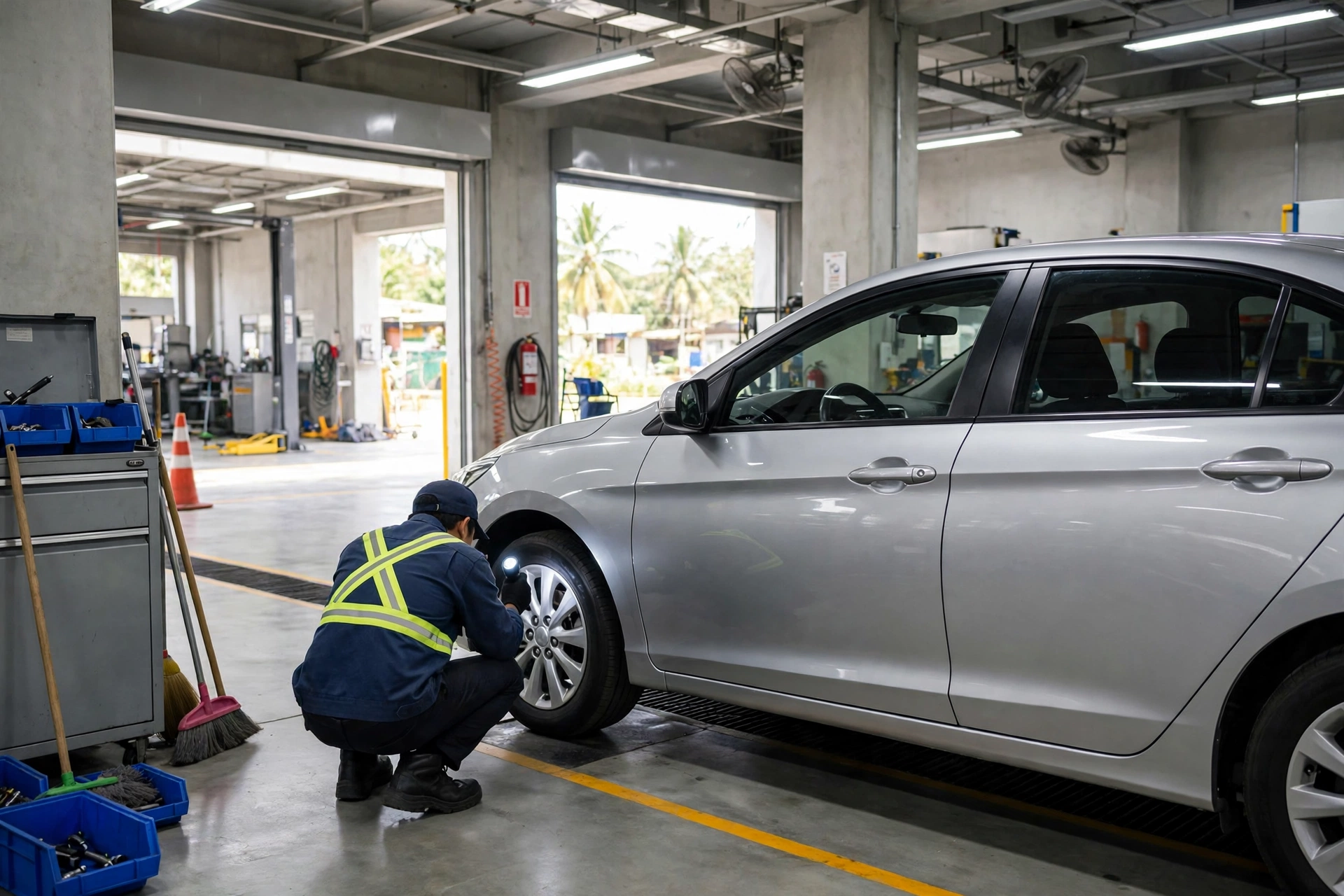
A typical car inspection covers the items a roadworthiness check is built around: brakes, lights and signals, steering, suspension, tires and wheels, horn, mirrors, wipers, seatbelts, exhaust and emissions, and the underbody and chassis condition. It also verifies the car’s identity details against the certificate of registration. This is not a full mechanical service, and it will not fix anything it finds. If your car fails, the center reports the failed items, you repair them, and you return for re-inspection of those items. Budget for that possibility: the cheapest renewal is the one where a worn tire, a dead bulb, or a weak brake is fixed before inspection day, not discovered on it.
Practical preparation that costs nothing: check every light, including brake lights and indicators, before you go; check tire condition and pressure; top up fluids; make sure the horn, wipers, and seatbelts work; and bring the car clean enough that the underbody and chassis checks can actually be done. None of this guarantees a pass, but each item is a common, avoidable failure.
CTPL Insurance for Cars
CTPL insurance covers third-party injury and death claims arising from an accident involving your car, and it is a legal requirement for renewal, not an optional extra. It is different from comprehensive insurance, which covers damage to your own car and is not required for renewal. When you buy CTPL, confirm three things: that the policy period covers your renewal year, that the plate number and engine or chassis details on the policy match your certificate of registration, and that the insurer transmits the certificate of cover to the LTO system. A mismatch in any of those three is a common reason a renewal stalls at the assessment step even though the owner ‘already has insurance.’
Prices vary by insurer and vehicle, and current guides put private-car CTPL roughly in the range of ₱400 to ₱750. Treat that as a shopping range, not a fixed price: your actual premium is whatever your insurer quotes for your car, and the figure that matters is the one on the policy you buy.
LTO Car Registration Renewal Fees: The MVUC Table and the Full Cost
Car renewal is not a single fee. It is a bundle, and the largest component is the Motor Vehicle User’s Charge (MVUC), which is set by law (Republic Act No. 8794) and varies with your vehicle’s gross vehicle weight as printed on your certificate of registration. The table below gives the private-car MVUC bands most commonly published for 2026:
| Private car gross vehicle weight | MVUC |
|---|---|
| Up to 1,600 kg | ₱2,000 |
| 1,601 to 2,300 kg | ₱3,600 |
| 2,301 to 2,700 kg | ₱6,000 |
| Over 2,700 kg | ₱8,000 |
Find your car’s gross vehicle weight on your certificate of registration before you budget. A sedan and a large SUV sit in different bands, and guessing the band is how owners under-budget by thousands of pesos. If your certificate shows a weight near a band boundary, use the band your certificate actually falls in, and confirm the assessed amount when the LTO system generates it, because that assessment is the figure you actually pay.
The other components, with the ranges current guides report, are:
| Cost component | What current guides report | Notes |
|---|---|---|
| MVUC | ₱2,000 to ₱8,000 by weight band (table above) | Largest component; set by gross vehicle weight |
| CTPL insurance | Roughly ₱400 to ₱750 for a private car | Paid to your insurer; certificate must be transmitted to LTO |
| PMVIC inspection | Roughly ₱600 to ₱1,800 | Paid to the inspection center; varies by center and vehicle |
| Other LTO charges | Small registration, computer, and sticker-type charges | Shown on your official assessment; do not guess them |
Worked example, clearly labeled as illustrative: a light private car at the ₱2,000 MVUC band, with CTPL at ₱400 to ₱750 and inspection at ₱600 to ₱1,800, comes to roughly ₱3,000 to ₱4,550 before the small LTO charges and before any penalty. A medium car at ₱3,600 MVUC lands roughly ₱1,600 higher on the same basis. These are planning ranges built from the published component ranges, not an official total: your official assessment in LTMS or at the branch is the only exact figure, and it is the one you should pay against.
Two warnings about fee figures you will see online. First, some older guides quote much lower MVUC figures for cars, in the ₱720 to ₱3,500 range, from older schedules or from motorcycle figures mixed into car tables. Do not use those for a 2026 car budget. Second, any guide that gives you a single ‘total’ for all cars is guessing, because the MVUC alone spans ₱2,000 to ₱8,000 by weight. A guide that does not ask for your weight band cannot give you your total.
How to Renew Your Car Registration Online via LTMS
Online renewal through the LTMS portal handles the application and payment, but the inspection and insurance still happen in the real world first. The full workflow is:
- Get CTPL insurance from an insurer whose certificate of cover is transmitted to the LTO, and confirm the transmission.
- Pass the PMVIC inspection and confirm the result was transmitted to LTMS. Without a transmitted inspection result, the online system cannot proceed.
- Log in to your LTMS account and make sure your vehicle record is linked and your details match your certificate of registration.
- Start the motor vehicle renewal transaction, confirm the vehicle and owner details, and review the assessment the system generates. Check the MVUC band and the total before you pay.
- Pay the fees through the portal’s payment channels and keep your official receipt.
- Collect your updated Official Receipt and registration sticker as directed by the portal or your branch. Some steps still require a branch visit, especially if anything on the record needs verification, so read the portal’s instruction for your transaction rather than assuming everything is delivered.
Online renewal generally covers a plain renewal only. If you want to change the vehicle’s color, register a modification, transfer ownership, or correct a record, expect an in-person transaction instead, because those changes need verification the online renewal flow does not do.
How to Renew at an LTO Branch
The branch route follows the same preparation, with the paperwork in person:
- Secure CTPL insurance and pass the inspection first, exactly as in the online route, and confirm both transmissions to the LTO system.
- Go to the branch or authorized renewal site with your original certificate of registration, latest official receipt, CTPL policy, inspection result, and photo ID, plus an authorization letter if you are renewing for someone else.
- Submit the documents for assessment, check the assessed fees against your weight band and the component ranges above, and ask about any line you do not recognize before you pay.
- Pay at the cashier and keep the official receipt.
- Claim your updated Official Receipt and sticker once released, and check on the spot that the plate number, expiry, and owner details are correct before you leave.
Branch processing time varies widely by branch, day, and queue, and no guide can promise you a time. Arriving with complete, matching documents and transmitted insurance and inspection results is the one factor you control, and it is the factor that most often decides whether a renewal takes one visit or several.
Late Renewal: Penalties and the Cost of Driving Unregistered
Renewing late adds cost, and the exact surcharge is shown on your official assessment, because published guides describe the late-renewal surcharge differently: some describe it as a percentage of the MVUC, others as a monthly or weekly amount. Do not budget from a single blog’s penalty formula. What is consistent across current guides is that the surcharge grows with how late you are, that it is tied to the MVUC, and that it is separate from the normal fees, so a late renewal always costs more than the same renewal done on time.
Driving with an expired registration is a separate and much larger problem. Current enforcement guides report a ₱10,000 fine for driving an unregistered motor vehicle, with possible impounding of the vehicle, on top of the renewal fees and surcharges you still have to pay. That fine is an apprehension penalty, not a renewal surcharge, and it applies whether you were ‘on your way to renew’ or not. Do not drive the car to the inspection center or the branch on an expired registration. Have it towed, or renew the paperwork through the proper route first and confirm the position with the branch if you are unsure.
If your registration has been expired for a long time, confirm your vehicle’s status in LTMS or at a branch before you assume a standard renewal will work. Long-expired, encumbered, or record-mismatched vehicles can need extra steps, and discovering them at the assessment window wastes the trip.
Car Renewal Mistakes That Cost Owners Money
The same handful of mistakes appears in almost every late or failed renewal:
- Renewing in the wrong month. Owners who renew by purchase date or by memory instead of by plate number miss their scheduled week and pay a surcharge they could have avoided.
- Budgeting from a motorcycle table. Motorcycle MVUC bands are a few hundred pesos; car bands start at ₱2,000. Using the wrong table under-budgets the renewal by thousands.
- Buying insurance or inspection that never transmits. A policy or inspection result that stays on paper and never reaches the LTO system blocks the renewal just as surely as not having one at all. Confirm transmission at the point of purchase.
- Ignoring a failed inspection item. A failed item does not go away, and re-inspection after repair is part of the process. Fix it promptly, because the renewal clock keeps running while the car sits unrepaired.
- Letting someone else renew on a mismatched authorization. An authorization letter with the wrong name, plate number, or scope gets rejected at the window. Check it before the representative travels.
- Driving unregistered to ‘save a trip.’ The apprehension fine dwarfs any towing or scheduling cost, and an impounded car costs more still.
After Renewal: Check the Result Before You Drive Away
Once your renewal is approved, check three things on the spot: that the updated Official Receipt shows the correct plate number and owner, that the new validity matches your schedule, and that the sticker, where issued, matches the receipt. If anything is wrong, raise it at the window immediately, because correcting it later means another transaction. Afterwards, if there is any delay in release or delivery, you can check your plate or transaction status for the latest position shown.
For drivers rather than vehicles, the companion guides cover the other half of the journey: the LTMS portal guide for the account itself, and the driver’s license renewal guide for license renewal, including the CDE exam and medical certificate. And if you still need the official portal, start here: LTO official site.
Frequently Asked Questions
When do I renew my car registration?
By your plate number. The last digit sets the month (1 for January through 9 for September, 0 for October) and the second-to-last digit sets the week (1 to 3 first week, 4 to 6 second week, 7 to 8 third week, 9 to 0 fourth week). After a new car’s initial multi-year registration, renewals are annual on that schedule.
What documents do I need for LTO car registration renewal?
Your original certificate of registration, latest official receipt, valid CTPL insurance with a transmitted certificate of cover, a transmitted vehicle inspection result, and a valid photo ID. Add an authorization letter and the representative’s ID if someone else renews for you.
How much is LTO car registration renewal in 2026?
It depends mainly on your car’s gross vehicle weight. The private-car MVUC bands most commonly published for 2026 are ₱2,000 (up to 1,600 kg), ₱3,600 (1,601 to 2,300 kg), ₱6,000 (2,301 to 2,700 kg), and ₱8,000 (over 2,700 kg), plus CTPL (roughly ₱400 to ₱750), inspection (roughly ₱600 to ₱1,800), and small LTO charges. Your official assessment is the exact total.
Can I renew my car registration online?
Yes, for a plain renewal, through the LTMS portal, once your CTPL certificate and PMVIC inspection result have been transmitted to the LTO system. Changes such as color, modification, ownership transfer, or record correction generally need an in-person transaction.
What happens if my car fails inspection?
The center reports the failed items. Repair them and return for re-inspection of those items. The renewal clock keeps running, so fix failures promptly rather than waiting until after your scheduled week.
What is the penalty for late car registration renewal?
Late renewal adds a surcharge tied to your MVUC, and published guides describe its formula differently, so use the surcharge shown on your official assessment rather than a single blog’s formula. Driving an unregistered vehicle is separate and much costlier: enforcement guides report a ₱10,000 fine with possible impounding.
Is CTPL the same as comprehensive insurance?
No. CTPL is the mandatory third-party cover required for renewal. Comprehensive insurance covers damage to your own car and is optional for renewal purposes.
Does a brand-new car need annual renewal right away?
No. Initial registration for a brand-new vehicle is commonly valid for three years, after which renewals become annual on the plate-number schedule. Confirm your car’s initial validity on its certificate of registration.
This guide summarizes publicly available LTO rules and current third-party guides as of October 2026. LTO procedures and fees change through new memoranda, so confirm the current requirements and your assessed fees in your LTMS account or at your chosen LTO branch before transacting. This guide is not affiliated with or endorsed by the Land Transportation Office.