PMVIC Inspection Guide 2026: Tests, Fees, and What to Expect

PMVIC Inspection Guide 2026: Tests, Fees, and What to Expect
PMVIC inspection guide searches usually come from a driver who has just been told their vehicle needs one — at first registration, after a modification, or because a renewal checklist mentioned it — and who wants to know what actually happens inside the inspection lane. PMVIC stands for Private Motor Vehicle Inspection Center: an accredited private facility that runs a computerized roadworthiness inspection and sends the result electronically to the Land Transportation Management System (LTMS). This guide explains which vehicles need a PMVIC inspection, what the inspection tests, what it costs, what to bring, and what happens if your vehicle fails.
The single most important fact first: for an ordinary registration renewal, a PMVIC inspection is no longer mandatory. In February 2021 the Office of the President made PMVIC inspection optional for standard renewals, and the LTO has reiterated since then that motorists renewing a registration may instead have the vehicle inspected at an LTO office and the emissions tested at a private emission testing center (PETC).
PMVIC inspection remains required in specific cases — first-time registration of a new vehicle, imported vehicles, and registrations involving a change of body, engine, color, or gross vehicle weight — and it remains available to any owner who wants the fuller roadworthiness check. If someone tells you a plain renewal cannot proceed without a PMVIC certificate, that is not the current rule; confirm it at your LTO branch before paying for an inspection you may not need.
PMVIC Inspection Guide: Which Vehicles Need It
First-time registration. A brand-new vehicle goes through PMVIC inspection as part of its first registration, together with the dealer’s documents, the certificate of conformity, and PNP clearance where required.
Imported vehicles. A vehicle brought into the country and registered for the first time in the Philippines goes through the inspection so its roadworthiness is on record from the start.
Modified vehicles. A registration that involves a change of body type, engine, color, or gross vehicle weight triggers an inspection, because the registration record itself is changing and the vehicle must be verified against the new record.
Any owner who wants it. Even where it is optional, any owner may choose a PMVIC inspection for a full roadworthiness report before a long trip, before selling a vehicle, or simply for peace of mind. The inspection report is a genuinely useful document: it measures things a visual check cannot, like brake efficiency and headlight alignment.
Ordinary renewals. Not mandatory. Renewal inspection for most vehicles is still the LTO’s own visual inspection plus a PETC emissions test, and most renewals — the LTO has said around 80 percent — continue to be processed that way. If your renewal checklist mentions PMVIC, check whether your case is one of the mandatory categories above before booking. Our guide to car registration renewal walks through the full renewal sequence and where inspection fits into it.
PMVIC Inspection Guide: The 8 Automated Tests
A PMVIC inspection is not a mechanic looking under the hood. The vehicle drives through a lane of computerized equipment, and the system measures and records the results. Current guides describe 8 automated tests covering roughly 70 inspection points. The tests are:
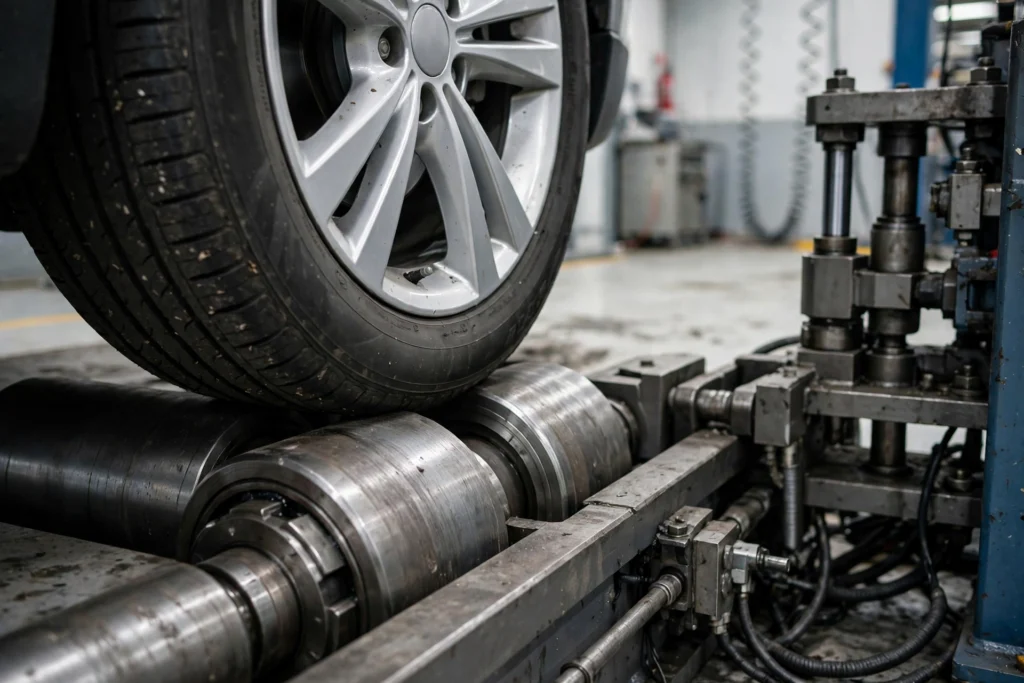
- Brake test. Brake efficiency for the service brake and the parking brake, measured on rollers. Worn pads, a weak handbrake, or uneven braking between wheels all show up here, and brake failure is one of the most common reasons vehicles fail.
- Headlight test. Headlight alignment and intensity, measured against standard. Misaligned headlights — too high, too low, or pointing sideways — are a common failure, and they are usually a cheap fix: a headlight alignment at any auto shop before the inspection.
- Side slip test. The vehicle’s wheel alignment, measured as it rolls over a side-slip plate. Excessive side slip means the wheels are not tracking straight, which wears tires and hurts handling.
- Suspension test. Suspension performance per wheel, measured on a suspension tester. Worn shock absorbers show up as weak damping on one corner.
- Emission test. Exhaust gas analysis against the Department of Environment and Natural Resources (DENR) standards. This is the test the old PETCs did alone; at a PMVIC it is one test among eight. A smoking exhaust, a faulty oxygen sensor, or overdue maintenance are the usual causes of failure.
- Under-chassis inspection. A visual and physical check of the underbody, chassis, steering components, and suspension parts for damage, rust, leaks, and worn joints.
- Sound level and horn test. Horn functionality and exhaust noise level, checked against the standard. A dead horn is a trivial fix that still counts as a failure if it is not fixed before the lane.
- Visual inspection of lights, tires, mirrors, and safety equipment. Signal lights, brake lights, hazard lights, tail lights, tire condition and tread depth, mirrors, windshield condition, wipers, and seatbelt condition and function. This is the part of the inspection most owners can pre-check themselves in ten minutes at home.
The whole lane takes about 15 to 30 minutes per vehicle. You do not need to stay with the vehicle through the automated lane — the center’s staff drive it through the equipment — but you should be present to answer questions and to receive the report.
PMVIC Inspection Guide: Fees
Here the published guides disagree, so this guide states the disagreement instead of picking one figure and presenting it as settled. The fee schedule most current guides attribute to the DOTr/LTO schedule is: ₱600 for light vehicles up to 4,500 kg gross vehicle weight, ₱600 for motorcycles, ₱300 for public utility jeepneys, and ₱1,800 for heavy or modified vehicles. A second group of current guides quotes higher figures for light vehicles — around ₱1,000 to ₱1,200 for cars and SUVs — and ₱1,500 to ₱1,800 for trucks and vans.
| Vehicle type | Fee most often quoted | Notes |
|---|---|---|
| Light private vehicle (up to 4,500 kg) | ₱600 | Some guides quote ₱1,000–₱1,200; confirm at the center |
| Motorcycle | ₱500–₱600 | Guides differ by ₱100; confirm at the center |
| Public utility jeepney | ₱300 | Consistently quoted |
| Heavy or modified vehicle | ₱1,800 | Consistently quoted at the top of the range |
What is consistent across sources: reinspection after a failure is free within one year of the original test at the same center, under the arrangement the PMVIC operators agreed with the DOTr and LTO. And where no PMVIC operates in your region, a PETC emissions test — around ₱450 to ₱500 — remains the available route. Before you go, call the center and confirm its current fee for your vehicle type; the fee on the day is the fee that matters, and a one-minute call avoids an argument at the counter. For the wider cost picture, see our LTO fees schedule 2026.
PMVIC Inspection Guide: What to Bring and How to Prepare
Bring the vehicle’s OR and CR, a valid ID, and any document related to the reason for inspection — for a modified vehicle, the documents supporting the modification. The center needs the OR/CR to encode the vehicle correctly and to transmit the result to the right LTMS record.
Preparation is where most failures are avoided, and most of it costs nothing:
- Lights first. Check every light: headlights, tail lights, brake lights, signal lights, hazard lights, reverse light. Replace any dead bulb before the lane. Check headlight aim at night against a wall — both beams should sit level and straight ahead.
- Tires and brakes. Check tread depth and tire pressure, and listen for grinding or squealing brakes. If the brake pedal feels soft or the vehicle pulls to one side when braking, get it checked before the inspection, not after a failed brake test.
- Horn, wipers, mirrors, seatbelts. Honk the horn, run the wipers, check every mirror, and tug every seatbelt. All four are trivial fixes that still fail a vehicle if left broken.
- Exhaust and engine. If the exhaust smokes visibly, or the check-engine light is on, fix it first — the emission test measures it precisely, and a failed emission test means a repair plus a return visit. A basic tune-up and an oil change before inspection help more than any additive.
- Clean the vehicle. A clean underbody and engine bay make the under-chassis inspection faster and make leaks visible to you before the inspector finds them.
- Remove loose items from the test path. Nothing should obstruct the pedals, the wheels, or the inspector’s access to the underbody.
Do not arrive with a known defect hoping the equipment will miss it. The equipment is the point of the PMVIC system: it measures what a visual check cannot, and a known defect found in the lane costs you the same return visit as a surprise one.
PMVIC Inspection Guide: Step by Step on the Day
- Find an accredited center. Use the LTO website or ask your nearest LTO district office for the accredited PMVICs in your area. Only an accredited center’s report transmits to LTMS, so a non-accredited “inspection” is worthless for registration. Our LTO branch directory lists the regional and district offices you can ask.
- Book or walk in. Some centers accept bookings; others run on arrival order. Weekday mornings are quietest. Allow an hour including waiting, even though the lane itself takes 15 to 30 minutes.
- Present your documents. The center encodes the OR/CR details and confirms the vehicle identity against the record.
- The vehicle goes through the lane. Staff drive it through the brake rollers, headlight tester, side-slip plate, suspension tester, and emission analyzer, then complete the under-chassis and visual checks.
- Receive the Motor Vehicle Inspection Report (MVIR). The report lists every test result, pass or fail, item by item. It is valid for 60 days, and the result is transmitted electronically to LTMS through the center’s value-added service provider — you do not carry a paper certificate to the LTO as the only proof.
- Proceed to the LTO step. For a mandatory case, the MVIR is one of the documents in your registration file. For an optional case, keep it as your roadworthiness record and proceed with the renewal steps in our car registration renewal guide.
What Happens If Your Vehicle Fails
A failure is specific, not general: the MVIR names the exact test and the exact measurement that failed. That specificity is your repair list. Take the report to your mechanic, fix exactly the failed items, and return to the same center for reinspection — free within one year of the original test. You do not pay the full fee again for the retest, and you do not need a new MVIR for the items that passed.
Three cautions. First, do not let the failure sit: the MVIR is valid for 60 days, and letting it lapse means starting over. Second, fix the failed items properly rather than temporarily — a retest measures the same things, so a cosmetic fix fails again. Third, never pay anyone to “pass” a vehicle that should fail. A falsified inspection puts an unroadworthy vehicle on the road and creates a record problem that surfaces at the next registration or after an accident.
Common failure patterns and their usual fixes: headlight misalignment (alignment service), brake efficiency (pad or shoe replacement, brake fluid), emission failure (tune-up, oxygen sensor, exhaust repair), tire failure (replacement — tread depth cannot be repaired), and horn or light failure (bulb or horn replacement). None of these is exotic; all of them are cheaper fixed before the lane than discovered in it.
PMVIC or PETC: Which One Do You Actually Need
The choice depends on your case. If your registration falls in a mandatory PMVIC category — first registration, imported vehicle, or a modification recorded on the CR — you need the PMVIC inspection, and a PETC emissions test alone will not complete the file. If yours is an ordinary renewal, you need the PETC emissions test and the LTO’s own inspection, and a PMVIC inspection is optional.
If no PMVIC operates in your region, the PETC route is the available one regardless. If you are unsure which category your vehicle falls in, ask your LTO district office before booking either — the office that will process your registration is the authority on what it requires. You can check your record and transaction status beforehand through the LTMS portal or the LTO tracker page.
Frequently Asked Questions
Is PMVIC inspection required for car registration renewal in 2026?
No, not for an ordinary renewal. Since February 2021, PMVIC inspection has been optional for standard renewals; renewals use the LTO’s own inspection plus a PETC emissions test. PMVIC remains required for first-time registration, imported vehicles, and registrations involving a body, engine, color, or weight change.
How much does a PMVIC inspection cost?
Most current guides quote ₱600 for light vehicles up to 4,500 kg and motorcycles, ₱300 for public utility jeepneys, and ₱1,800 for heavy or modified vehicles, but some guides quote ₱1,000–₱1,200 for light vehicles. Confirm the fee with your chosen center before going. Reinspection after a failure is free within one year at the same center.
How long does a PMVIC inspection take?
About 15 to 30 minutes in the lane itself. Allow an hour including waiting and document processing.
How long is the inspection report valid?
The Motor Vehicle Inspection Report (MVIR) is valid for 60 days, and the result is transmitted electronically to LTMS.
What happens if my vehicle fails the PMVIC inspection?
The MVIR names the exact failed items. Repair those items, return to the same center within one year for a free reinspection, and the passed items do not need retesting.
What is the difference between PMVIC and PETC?
A PETC (private emission testing center) tests emissions only. A PMVIC runs a full computerized roadworthiness inspection — brakes, headlights, side slip, suspension, emissions, under-chassis, and a visual check of lights, tires, mirrors, and seatbelts — across roughly 70 inspection points.
Do I need to bring anything besides the OR and CR?
Bring a valid ID and, for a modified vehicle, the documents supporting the modification. The center encodes the OR/CR details to transmit the result to the correct LTMS record.
This PMVIC inspection guide compiles the inspection scope, fees, and rules from DOTr/LTO announcements and multiple current third-party guides as of October 2026. Fee figures differ between published guides and are stated here as a range with a confirm-at-the-center instruction, not as a single settled schedule. Procedures and fees vary by center and case, so confirm the exact requirement and fee with your chosen PMVIC and your LTO branch. This guide is not affiliated with or endorsed by the Land Transportation Office.