LTO Traffic Violations and Fines 2026: Complete Penalty Guide for Filipino Drivers

LTO traffic violations and fines are the penalties the Land Transportation Office and its deputized enforcers impose when a driver or vehicle owner breaks a road rule — from driving without a license to skipping the seatbelt, from an unregistered vehicle to drunk driving.
The fine schedule most enforcers still work from is Joint Administrative Order (JAO) No. 2014-01, the revised schedule of fines and penalties, together with special laws that carry their own penalties: the Anti-Distracted Driving Act (RA 10913), the Anti-Drunk and Drugged Driving Act (RA 10586), the Seat Belts Use Act (RA 8750), the Motorcycle Helmet Act (RA 10054), and the Clean Air Act (RA 8749).
This guide gives the full first-offense penalty table that current guides agree on, explains how repeat offenses escalate, and covers how to pay, how to contest, and what happens if you ignore a ticket.
One warning before the table. Fine figures in online guides conflict on repeat-offense tiers, because different sources quote different editions and different issuing authorities (LTO, MMDA, and local government units can each add their own ordinance fine for the same act).
The first-offense figures below are the ones multiple current guides agree on, and they are the figures to budget from. Where repeat tiers differ between sources, this guide says so rather than picking one version and presenting it as settled.
The figure that controls your case is always the figure on your citation and the assessment at settlement — check it before you pay, and keep the receipt.
LTO Traffic Violations and Fines: The Complete First-Offense Table
The table below is the core of this guide. Fines are in Philippine pesos. “First offense” means the first time the LTO records that violation against you; repeat offenses for the violations marked with escalation bring higher fines and, for the serious ones, suspension or revocation.
| Violation | First-offense fine | What else happens |
|---|---|---|
| Driving without a valid driver’s license (including expired, suspended, revoked, or fake license) | ₱3,000 | May include disqualification from holding a license for a period after payment |
| Driving with the wrong restriction code or classification | ₱3,000 | Same tier as driving without a valid license |
| Failure to carry your driver’s license while driving | ₱1,000 | Applies even if the license itself exists and is valid |
| Failure to carry the OR or CR while driving | ₱1,000 | Applies even if the registration itself is current |
| Reckless driving | ₱2,000 | Repeat offenses escalate to ₱3,000, then ₱10,000, with suspension or revocation for repeat violators |
| Driving an unregistered motor vehicle | ₱10,000 | Vehicle may be impounded until the registration is renewed and penalties are paid |
| Failure to attach, or tampering with, authorized plates or stickers | ₱5,000 | Covers missing, improvised, or improperly attached plates |
| Unauthorized motor vehicle modification | ₱5,000 | Covers modifications not reflected in LTO records or not allowed under the rules |
| Defective or unauthorized accessories, devices, or parts | ₱5,000 | Covers defective brakes, lights, mirrors, horn, muffler, or early warning device, and accessories prejudicial to road safety |
| Operating a right-hand-drive vehicle | ₱50,000 | Separate from any registration or importation issue |
| Failure to wear a seatbelt (driver or front passenger) | ₱1,000 | Second offense ₱2,000; third and succeeding offenses ₱5,000 plus possible one-week suspension |
| Failure to wear a motorcycle helmet (driver or backrider) | ₱1,500 | Escalates to ₱3,000, then ₱5,000 on repeat offenses |
| Distracted driving (using a mobile phone or gadget while driving) | ₱5,000 | Second offense ₱10,000; third offense ₱15,000 plus three-month suspension; fourth offense ₱20,000 plus revocation, under RA 10913 |
| Smoke belching | ₱2,000 | Second offense ₱4,000; third offense ₱6,000 plus possible one-year registration suspension |
| Drunk driving (RA 10586) | ₱20,000 and up | Fine rises with the circumstances and the offense count, plus suspension, revocation, and possible criminal liability |
| Disregarding a traffic sign, illegal turn, or obstruction | ₱1,000 | The MMDA or the city may add an ordinance fine for the same act |
| Illegal parking / wrong parking | ₱1,000 | Towing and storage fees are charged on top where the vehicle is towed |
| Overloading (passenger or cargo, LTO schedule) | ₱1,000 | Axle overloading on trucks is charged separately, at a percentage of the MVUC |
Two patterns in the table are worth memorizing. First, the ₱1,000 default: most ordinary violations — failure to carry documents, disregarding a sign, illegal parking, obstruction — sit at ₱1,000 under JAO 2014-01.
Second, the expensive three: an unregistered vehicle (₱10,000), a missing or tampered plate (₱5,000), and any form of driving without a valid license (₱3,000) are the fines that hurt most often, and all three are avoidable by keeping papers current. If your registration is due, renew it before it lapses: read our guide to car registration renewal and check the current lines in our LTO fees schedule 2026.

LTO Traffic Violations and Fines: How Repeat Offenses Escalate
Repeat offenses cost more than the first fine, and for the serious violations they cost the license itself. The escalation pattern under JAO 2014-01 and the special laws is consistent in shape even where guides differ on a tier figure: the second offense roughly doubles the first fine, the third offense roughly triples it or jumps to a fixed higher amount, and repeat serious offenses add suspension, then revocation.
The escalations that multiple current guides state identically are the ones to rely on:
- Seatbelt: ₱1,000, then ₱2,000, then ₱5,000 plus a possible one-week suspension on the third and succeeding offenses.
- Motorcycle helmet: ₱1,500, then ₱3,000, then ₱5,000.
- Distracted driving: ₱5,000, then ₱10,000, then ₱15,000 plus a three-month suspension, then ₱20,000 plus revocation on the fourth offense.
- Smoke belching: ₱2,000, then ₱4,000, then ₱6,000 plus a possible one-year suspension of the vehicle’s registration.
- Reckless driving: ₱2,000, then ₱3,000, then ₱10,000, with suspension or revocation for repeat violators.
For the remaining violations — driving without a license, wrong restriction code, failure to carry documents, plate violations — guides disagree on the repeat tiers. Some quote ₱3,000 / ₱5,000 / ₱10,000 for driving without a license; others quote ₱3,000 / ₱6,000 / ₱10,000 plus suspension. This guide does not choose between them, because choosing would present one guide’s table as the law.
The safe rule for the reader is simpler: never collect a second offense for the same violation, because every version of the table makes the second one substantially more expensive than the first, and a repeat serious violation can suspend the license that a first offense only fined.
Repeat violations also add demerit points to the driver’s record under the LTO demerit system. Points accumulate across violations, and a driver who accumulates enough points faces suspension or revocation regardless of whether any single fine was paid. Paying the fine does not erase the points.
The practical consequence is that a driver with several small paid fines can still lose the license on points — another reason to treat the first offense as the warning and change the habit, rather than treating fines as a price list for repeat behavior.
LTO Traffic Violations and Fines by Category
License violations. These are the most common LTO apprehensions, and they divide into three cases drivers confuse. Driving without any license at all, driving with an expired license, and driving with a suspended, revoked, or fake license all carry the same ₱3,000 first-offense tier in current guides.
Driving outside your restriction code — for example, driving a manual-transmission vehicle on an automatic-only license — carries the same ₱3,000. Merely forgetting to carry the license, when the license itself is valid, is the cheaper ₱1,000 tier.
The distinction matters at the roadside: an expired license is not a forgotten license, and claiming the cheaper tier for an expired card will not survive the record check. If your license is expired, renew it before driving again; the renewal procedure, including the expired-license tiers, is explained in our guide to driver’s license renewal requirements.
Registration and plate violations. Driving an unregistered vehicle is the single most expensive common violation at ₱10,000, and it is the one most likely to end with the vehicle impounded.
Note the difference between an unregistered vehicle (never registered, or registration long lapsed) and a vehicle whose registration simply expired recently: both draw apprehension, and the impoundment risk rises the longer the lapse. A missing, improvised, or tampered plate draws ₱5,000 even when the registration itself is current, which is why a lost plate must be handled through the LTO’s replacement process with an Authority to Use an Improvised Plate, not a hand-painted substitute.
Failure to carry the OR or CR is the cheaper ₱1,000 tier, but it still blocks the roadside check and can delay the journey.
Safety-equipment violations. Seatbelt and helmet fines are the most consistently enforced small fines, and the easiest to avoid completely. Every occupant of the front seats must wear a seatbelt; the driver is also liable if a front passenger does not.
For motorcycles, both driver and backrider must wear a standard protective helmet with the chin strap fastened — a helmet carried on the arm, or a substandard helmet, does not satisfy the rule. Defective equipment — brakes, lights, mirrors, horn, muffler, early warning device — draws ₱5,000, and the defect must be fixed before the vehicle is cleared, so the fine is not the whole cost.
Behavior violations. Reckless driving (₱2,000 first offense) covers swerving, aggressive maneuvering, and endangering pedestrians or other road users; it is an enforcer-judgment violation, which makes it the hardest to contest after the fact.
Distracted driving (₱5,000 first offense) covers holding or using a mobile phone or gadget while driving, including at a red light in some enforcements — the safe rule is that the phone stays out of the hand until the vehicle is parked. Drunk driving under RA 10586 is in a different class from every other violation in this guide: fines start at ₱20,000 and rise with the circumstances, the license is suspended or revoked, and criminal liability can follow. There is no cheap version of a drunk-driving apprehension, and no settlement shortcut.
Road-use violations. Disregarding a traffic sign, making an illegal turn, obstructing traffic, and illegal parking all sit at the ₱1,000 LTO tier, but the total bill is often higher: the MMDA or the city government may add its own ordinance fine for the same act, and a towed vehicle adds towing plus daily storage fees.
Number-coding violations under the UVVRP fall in this group as well; current guides report a ₱500 figure under the Single Ticketing System in Metro Manila, with an LTO alarm if unpaid. Because the coding and parking rules are set locally as well as nationally, the ordinance fine for your city is the figure to check alongside the LTO tier.
How to Pay an LTO Fine
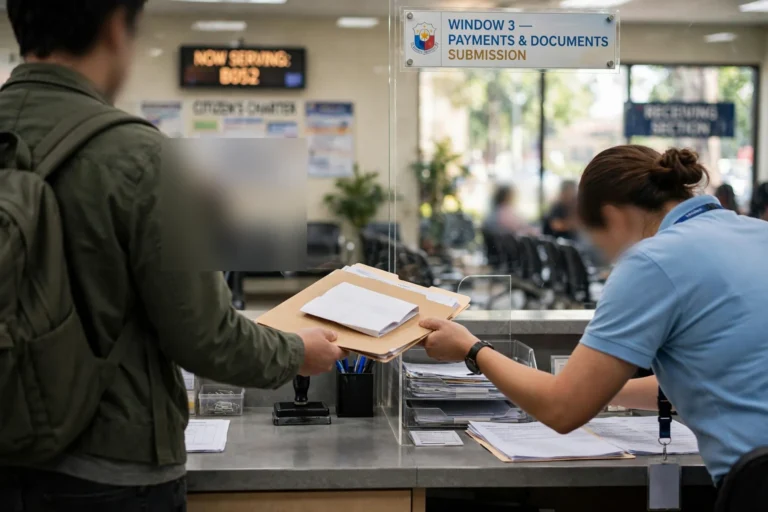
Paying is straightforward, but the order of steps matters, because paying the wrong amount to the wrong window does not clear the record:
- Read the citation completely. Check the violation written on it, the fine amount, the apprehending agency (LTO, MMDA, or LGU), and the deadline printed on it. The deadline on your ticket controls your case — some 2026 guides cite a 15-working-day settlement window under new circulars, but that figure could not be confirmed against an official LTO source for this guide, so do not rely on it over the printed deadline.
- Pay through the channel the citation names. LTO fines are settled at LTO offices and through the LTMS portal and its accredited payment partners, depending on the citation type. MMDA and LGU tickets are settled with the issuing agency, not with the LTO. Paying the LTO for an MMDA ticket, or vice versa, does not clear either record.
- Pay only the assessed amount, and keep the official receipt. If the amount on the assessment differs from the table in this guide, the assessment controls — but ask the cashier to explain the difference before paying, because an alarm, a repeat-offense tier, or an added ordinance fine may be included.
- Confirm the clearance. After payment, check that the violation is cleared from your record through the LTMS portal or the LTO tracker page. Do not assume a paid receipt automatically cleared the alarm: confirm it, especially before a renewal, because an unpaid or uncleared violation blocks renewal and other LTO transactions. For the latest official announcements, see the Land Transportation Office official website.
How to Contest an LTO Fine
Contesting is a right, but it is a procedural one: it must be exercised in the right place, within the deadline, and with evidence. The general route is:
- Do not ignore the citation. Ignoring it does not make it go away; unpaid violations generate an alarm on the license or vehicle record, and that alarm blocks renewal, transfer, and other transactions until it is settled. An ignored ticket gets more expensive and more complicated, never cheaper.
- File the contest with the issuing agency. An LTO citation is contested through the LTO adjudication process; an MMDA or LGU citation is contested with that agency. Filing with the wrong agency wastes the deadline.
- Bring evidence, not argument alone. Dashcam footage, photographs, the valid license or registration that the citation claims was missing, or a repair receipt for a fixed defect are evidence. A claim that the enforcer was rude, or that other drivers were doing the same thing, is not evidence about your violation.
- Attend the hearing if one is scheduled. Failure to appear can result in a decision against you by default. Bring the citation, the official receipt of any payment made under protest where applicable, and copies of your evidence.
- Accept the decision or appeal it through the proper channel. If the contest fails, pay the assessed fine promptly; continued refusal adds penalties and prolongs the alarm on your record.
Two cautions. First, never pay a fixer or an enforcer on the roadside to “settle” a citation off the books: an off-books payment leaves the violation on the record, and the alarm will surface at renewal.
Second, a citation that is factually wrong — wrong plate number, wrong violation code, wrong vehicle — is the strongest kind of contest, because it attacks the record itself; check those details on the citation before anything else.
What Happens If You Ignore an LTO Fine
An unpaid fine does not expire quietly. The violation is entered as an alarm on the license or vehicle record, and while the alarm is active, renewal, transfer of ownership, and other LTO transactions are blocked.
For license alarms, the driver cannot renew until the fine is settled; for vehicle alarms, the owner cannot renew the registration or transfer the vehicle until it is cleared.
Current guides also report that, under recent circulars, an unpaid fine can lead to license suspension after the settlement window passes — another figure this guide does not state as a fixed rule, because the circulars could not be confirmed against an official source — but the direction is consistent across sources: delay makes the outcome worse, not better.
The practical sequence for a driver who discovers an old unpaid fine at renewal time is: settle the fine first, confirm the alarm is cleared, and only then file the renewal. Arriving at the renewal counter with an uncleared alarm wastes the visit. Check your record before any LTO visit through the LTMS portal or the tracker page, and clear alarms in advance.
Avoiding Fines: The Five Habits That Cover Most Apprehensions
Almost every common LTO fine is avoided by five habits, and they cost nothing:
- Keep the license valid and in the wallet. Renew before expiry, and carry the card every time you drive. The ₱3,000 no-license tier and the ₱1,000 failure-to-carry tier are both avoided by one habit.
- Keep the registration current and the OR and CR in the vehicle. Renew on schedule, carry the papers, and keep the plate properly attached. The ₱10,000 unregistered tier and the ₱5,000 plate tier are both avoided by one habit.
- Wear the seatbelt and the helmet, every trip, every occupant. The cheapest fines in the table are also the most consistently enforced.
- Put the phone away while driving. The ₱5,000 distracted-driving first offense is five times the seatbelt fine and escalates to revocation.
- Never drive after drinking. No other violation in this guide combines a five-figure fine, suspension or revocation, and criminal liability.
Frequently Asked Questions
How much is the fine for driving without a license in the Philippines? ₱3,000 for the first offense under the LTO schedule, and the same tier applies to an expired, suspended, revoked, or fake license, and to driving outside your restriction code. Merely forgetting to carry a valid license is the cheaper ₱1,000 tier.
How much is the fine for driving an unregistered vehicle? ₱10,000, and the vehicle may be impounded until the registration is renewed and the penalties are paid. Renew before the registration lapses to avoid this entirely.
How much is the seatbelt fine? ₱1,000 for the first offense, ₱2,000 for the second, and ₱5,000 plus a possible one-week suspension for the third and succeeding offenses.
How much is the distracted driving fine? ₱5,000 for the first offense under RA 10913, rising to ₱10,000, then ₱15,000 plus a three-month suspension, then ₱20,000 plus revocation on the fourth offense.
How long do I have to pay an LTO fine? The deadline printed on your citation controls. Some 2026 guides cite a 15-working-day settlement window under new circulars, but that figure could not be confirmed against an official LTO source for this guide, so follow the printed deadline and settle promptly rather than relying on the cited window.
What happens if I do not pay an LTO fine? The violation becomes an alarm on your license or vehicle record, and while the alarm is active, renewal, transfer, and other LTO transactions are blocked. Settle the fine, then confirm the alarm is cleared before your next LTO visit.
Can I contest an LTO traffic violation? Yes, through the issuing agency’s adjudication process, within the deadline on the citation, with evidence such as dashcam footage or the valid document the citation claims was missing. Do not ignore the citation while deciding: an ignored ticket adds an alarm and can lead to suspension.
Do LTO fines increase for repeat offenses? Yes. Repeat offenses bring higher fines and, for serious violations, suspension or revocation. Seatbelt, helmet, distracted driving, smoke belching, and reckless driving escalations are listed in this guide; for other violations the repeat tiers differ between published guides, so the figure on your citation and assessment controls.
Where can I check whether I have a violation or alarm? Through the LTMS portal and the LTO tracker page linked in this guide. Check before any renewal or transfer visit, so an old alarm does not waste the trip.
This LTO traffic violations and fines guide compiles first-offense penalties from JAO 2014-01 and the special laws (RA 10913, RA 10586, RA 8750, RA 10054, RA 8749) as reported by multiple current third-party guides as of October 2026. Repeat-offense tiers differ between published guides and are stated here only where sources agree. Procedures, offices, and fines vary by issuing agency and case, so confirm the exact amount and deadline on your citation and at settlement. This guide is not affiliated with or endorsed by the Land Transportation Office.