LTO Driver’s License for Foreigners: How to Drive Legally in the Philippines
LTO driver’s license for foreigners is the process by which a foreign national converts a valid license from their home country into a Philippine driver’s license. If you plan to stay beyond a short visit, conversion keeps you driving legally — because permission to drive on your foreign license alone has a strict time limit, and driving past it can leave you effectively unlicensed.
This guide explains the 90-day rule, what an International Driving Permit does and does not do, the documents you need, the conversion steps, which exams you will and will not face, the residency and validity questions to confirm at your branch, the fee picture, and the common mistakes that delay applications.
The 90-Day Rule Under RA 4136
The starting point is Republic Act No. 4136, the Land Transportation and Traffic Code: a foreigner holding a valid license issued by their home country may drive in the Philippines for 90 days. The key details:
- Counted from your latest arrival. The clock starts from the date stamped in your passport on your most recent arrival, not from your license’s issue date or an earlier trip.
- Your foreign license must be valid. An expired license gives you no 90-day privilege, and conversion is treated differently (see the exams section below).
- Leaving and returning resets the clock. Each fresh arrival starts a new 90-day period, which is why frequent travelers sometimes never need a conversion.
- After 90 days, you need a Philippine license. Once the period lapses, driving on the foreign license alone is no longer covered.
If you are staying long-term, do not wait until day 89: gathering documents, getting a medical certificate, and visiting an office all take time, and an expired 90-day window leaves no margin for delay.
What an International Driving Permit Does — and Does Not — Do
An International Driving Permit (IDP) is often misunderstood, so here is the plain version:
- An IDP is a translation of your existing license, not a license on its own. It must accompany your original foreign driver’s license; presented alone, it is not a valid credential.
- An IDP does not extend the 90 days. It does not replace conversion; it simply makes your foreign license readable to enforcers and rental companies during the period you are already allowed to drive.
- An IDP is issued in your home country, before you travel, normally by your home country’s authorized automobile association. You generally cannot obtain a genuine one from inside the Philippines.
- If your license is not in English, a translation matters more. An official English translation is part of the conversion requirements in any case (see below), and an IDP can serve as supporting translation during the 90-day period.
In short: an IDP is a useful companion for a short stay, not a substitute for a Philippine license for a long stay.
Documents You Need for Conversion
Gather these before you visit an LTO office; requirements can vary slightly by office, so confirm at your branch if unsure.
| Document | Notes |
|---|---|
| Original foreign driver’s license + photocopy | Must be valid; an expired license changes the process |
| Passport + photocopies of key pages | Bio, visa, and latest arrival stamp pages |
| ACR I-Card, long-term residents | The Alien Certificate of Registration Identity Card, if you hold one |
| Official English translation, if license not in English | From your embassy or an authorized body — confirm at your branch which are accepted |
| Medical certificate, LTO-accredited clinic | Transmitted electronically; a paper-only certificate from a non-accredited clinic will not do |
| LTMS account | Created through the official portal before or during your application |
| Drug test result, some cases | Some offices ask first-time conversion applicants for a DOH-accredited drug test — confirm at your branch |
The passport pages that matter
Photocopy three parts: the bio page, the visa page showing your current status, and the page with your latest arrival stamp — that stamp proves when your 90 days began. If you renewed your passport since arriving, bring the old one too if you still hold it.
The ACR I-Card and the English translation
Long-term residents are generally issued an ACR I-Card by the Bureau of Immigration. If you hold one, bring it: it supports your residency status. If you are on a short-term stay and do not hold one, your passport and visa pages carry the application instead. Confirm at your branch which applies to your visa type.
If your foreign license is not in English, you need an official English translation, normally from your embassy. A casual translation is not enough — the LTO needs one it can rely on. Ask your embassy what it charges and how long it takes, and get this done before your LTO visit, since it is one of the most common causes of delay.
The medical certificate
Like every Philippine license transaction, conversion requires a medical certificate from an LTO-accredited clinic, transmitted electronically into the LTO system. For what the examination covers, see our guide to the LTO medical exam. Do not pay a non-accredited clinic for a paper certificate and expect the LTO to accept it.
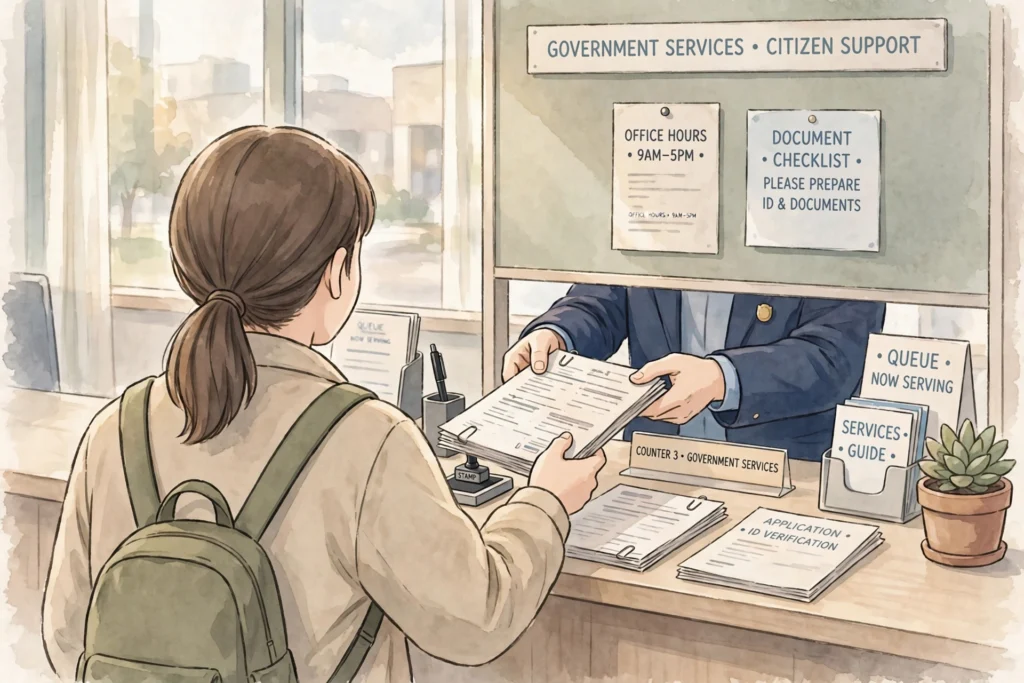
LTO driver’s license for foreigners: Conversion Steps
The LTO driver’s license for foreigners process goes through the LTMS portal and an LTO licensing office:
- Create your LTMS account. Register on the official LTMS portal. If you have not used the portal before, our LTMS portal guide walks through registration and login.
- Get your medical certificate. Visit an LTO-accredited clinic, and confirm it has transmitted the result electronically before you leave.
- Prepare your documents and translation. Assemble the passport copies, ACR I-Card if you hold one, original foreign license plus photocopy, and the official English translation if needed.
- Go to an LTO licensing office. Not every LTO office handles licensing transactions — our LTO branch directory can help you find a suitable office, and confirm at your branch that it processes foreign conversions before you travel.
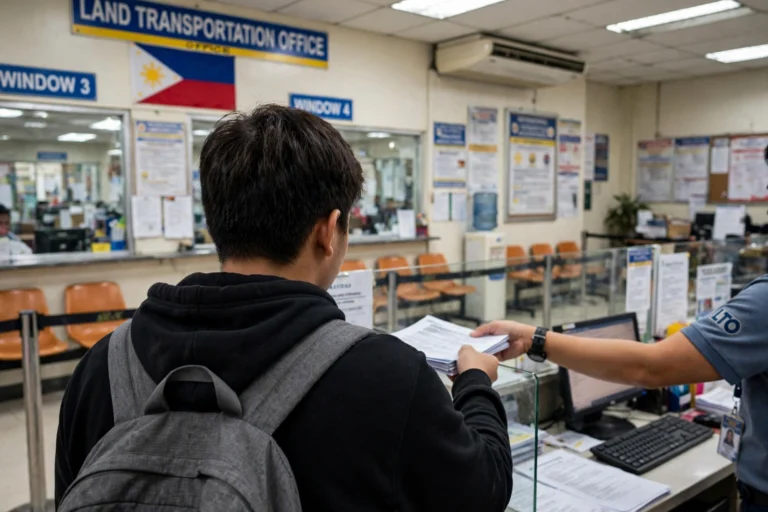
- Submit your application for evaluation. Present your documents at the evaluator’s window, where your license validity, arrival date, and visa status are checked, and any required exam confirmed.
- Take any required exam. Most conversions from a valid foreign license need no exam — but there are exceptions, explained next.
- Pay the assessed fees at the cashier. See the fee section below for what to expect.
- Have your photo and biometrics taken, and receive your license. Check your name, classification, and validity before you leave the counter.
Which Exams Will You Face?
For an LTO driver’s license for foreigners, the answer depends on your situation:
- Valid foreign license, standard case: generally no written or practical exam. Conversion is normally documentary — the LTO recognizes the license your home country already issued, rather than re-testing you.
- Exception: drivers from left-side-traffic countries commonly face a practical test. If your home country drives on the left side of the road — commonly cited examples include the United Kingdom, Australia, and Japan — the LTO commonly requires a practical driving test, because the driving position and road orientation differ from Philippine practice, where vehicles drive on the right. Confirm at your branch whether this applies to your country, since office practice is described as varying.
- Expired foreign license: treated as a new applicant. If your foreign license has expired, the conversion route generally does not apply. You are treated as a new applicant, which means written and practical examinations, and the new-applicant path through a student permit, the Theoretical Driving Course (TDC), and the Practical Driving Course (PDC). For that path, see our guide to student permit requirements.
- Additional restriction codes later. Once you hold a Philippine license, adding a new category follows the standard additional-code process, which may involve its own practical test.
The practical point: keep your foreign license valid. Letting it expire while you delay conversion is the single most expensive mistake, because it moves you from a documentary conversion into the full new-applicant process.
Validity and Residency: Two Requirements to Confirm at Your Branch
Two requirements are commonly cited for foreign conversion, but sources note ambiguity about them, so this guide presents them honestly rather than as settled official rules:
- At least 120 days of remaining visa validity. Many guides state your visa should have at least 120 days remaining at application. This is commonly cited, not confirmed against an official LTO page, so confirm at your branch whether your remaining validity is sufficient before you file.
- At least one month in the Philippines. Many guides also state you should have been in the Philippines for at least one month before applying. Again, this is commonly cited and flagged as “confirm at your branch,” since sources note that practice varies by office.
Why the hedging? Different guides phrase these requirements differently, and no single official LTO conversion checklist was confirmed during drafting that states both figures in the same terms. Ask the licensing office directly, early in your stay, what it requires for your visa type.
The Drug Test Question, and What Conversion Costs
Some offices ask first-time conversion applicants for a drug test from a DOH-accredited drug testing center, similar to the requirement for new professional license applicants. Others do not ask conversion applicants for one at all, so this guide does not state it as universal. Ask your licensing office whether one is required in your case, and if so, have it done at a DOH-accredited center.
The fee most commonly cited in guides is around ₱685, flagged here explicitly as confirm-at-assessment, not asserted as the official fee: what you actually pay is the cashier’s assessed computation, which can include other standard charges. Bring a margin above it, keep the official receipt, and treat the assessed amount as final.
For comparison, a first-time Philippine license through the student permit route involves a different and larger set of costs (TDC, PDC, medical, and license fees) — another reason to convert while your foreign license is still valid.
Common Mistakes That Delay Conversion
- Waiting until the 90 days are nearly up. Start early — document gathering, embassy translation, and clinic visits all take time.
- Letting the foreign license expire. An expired license ends the conversion route and pushes you into the new-applicant process.
- Arriving without the English translation. If your license is not in English, the translation is not optional — get it from your embassy first.
- Using a non-accredited clinic. Only an accredited clinic’s electronically transmitted certificate counts.
- Going to an office that does not process conversions. Confirm at your branch that it handles conversions before you travel.
- Assuming the IDP is enough. An IDP accompanies your foreign license during the 90 days; it does not extend them or replace conversion.
- Not bringing the passport pages. The bio, visa, and arrival-stamp pages are the core of the application — photocopy them first.
After You Receive Your Philippine License
An LTO driver’s license for foreigners, once issued, is subject to the same rules as any other Philippine license: the same renewal cycle, demerit points system, and requirement to carry it while driving. Keep your foreign license as well — it remains your home-country credential. If you later change your visa status or address, update your LTO records.
If you will leave within 90 days of your latest arrival, you may not need conversion at all — your valid foreign license, with an IDP if applicable, covers you for that period. Conversion is for those who stay longer.
Frequently Asked Questions
How long can a foreigner drive in the Philippines on a foreign license?
Under RA 4136, a foreigner with a valid foreign driver’s license may drive for 90 days from the latest arrival stamp in the passport. Leaving and returning resets the 90 days. After 90 days, a Philippine driver’s license is required.
Does an International Driving Permit extend the 90 days?
No. An IDP must accompany your original foreign license and does not extend the 90-day period. It is a translation aid, not a substitute for conversion.
What documents do I need to convert my foreign license?
Your original valid foreign license plus a photocopy, passport photocopies (bio, visa, and arrival stamp pages), an ACR I-Card if you hold one, an official English translation if the license is not in English, and a medical certificate from an LTO-accredited clinic transmitted electronically. Some offices also ask first-time conversion applicants for a DOH-accredited drug test — confirm at your branch.
Do I need to take the written and practical exams to convert?
Generally no, if your foreign license is valid — conversion is normally documentary. Two exceptions: a practical test is commonly required for left-side-traffic countries such as the UK, Australia, and Japan, and an expired foreign license is treated as a new application, meaning written and practical exams plus the student permit, TDC, and PDC path.
Is there a minimum visa validity or stay required for conversion?
Two requirements are commonly cited — at least 120 days of remaining visa validity and at least one month in the Philippines — but sources note ambiguity, so both are presented as commonly cited and to confirm at your branch, not as confirmed official rules.
How much does foreign license conversion cost?
Around ₱685 is the figure most commonly cited in guides, but it is flagged as confirm-at-assessment rather than asserted as the official fee. The amount you pay is the cashier’s assessed computation.
What happens if my foreign license expires before I convert?
You lose the conversion route. An expired foreign license is treated as a new application, so you would go through the student permit, TDC, PDC, written exam, and practical exam path instead. Keep your foreign license valid while you convert.
For a long stay, an LTO driver’s license for foreigners is the document that keeps your driving legal after the 90-day period ends.