LTO Online Exam & Free Driver’s License Reviewer
Planning to get your driver’s license? This is the first big step you need to take. Whether you’re applying for a non-professional or professional license — our free online practice exam covers traffic rules, road signs, and safe driving so you can pass on your first try.
What Is the LTO Exam?
Before you get your driver’s license in the Philippines, you need to pass the LTO written exam. Here’s what it actually is and what to expect.
The LTO exam is a written test given by the Land Transportation Office (LTO) of the Philippines. It measures your knowledge of traffic laws, road signs, and safe driving practices before they hand you a driver’s license.
The test is taken at an LTO-authorized computer testing center. You sit in front of a computer, answer multiple-choice questions, and the system scores you automatically. No pen, no paper — just you and the screen.
The exam is officially called the theoretical exam, and it’s one of two tests you need to pass. The other is the practical driving exam — where you actually demonstrate you can drive.
Good to Know
Since the LTMS portal launched, you can also take the LTO online exam through the portal website. You don’t need to go to an LTO office just for the written test anymore — though some steps still require a physical visit.
Purpose of the Exam
The LTO exam checks if you understand Philippine traffic laws well enough to drive safely on public roads. It’s not just about passing — it’s about making sure every driver knows the rules.
Computer-Based Format
The exam is taken on a computer at an authorized testing center, or through the LTMS portal online. Questions are multiple choice with 4 options each.
Part of a Bigger Process
The written exam is just one step in getting your driver’s license. You also need to complete a medical exam, submit documents, and pass the practical driving test.
Who Needs to Take the LTO Exam?
Not sure if this applies to you? Here’s a quick breakdown.
First-Time Applicants
If you’ve never had a Philippine driver’s license before, you need to take the LTO written exam as part of your initial application — no exceptions.
License Renewal Applicants
Even if you’ve been driving for years, the LTO now requires a written exam when renewing your expired license. This is the LTO renewal exam through the LTMS portal.
Upgrading to Professional
If you have a non-professional license and want to upgrade to a professional driver’s license (for trucks, buses, or public transport), you’ll need to pass an additional exam.
Motorcycle Riders
Riders applying for a motorcycle license (restriction code 1) also take the same theoretical exam. The questions are the same as for regular vehicle applicants.
Student Permit Holders
If you already have a Student Permit (SP) and are converting it to a non-professional license, you need to pass the written exam before your driving test.
CDE Exam Takers
The CDE exam (Comprehensive Driver’s Education) is an online validation exam for renewal applicants. If your license has expired, you’ll likely encounter this requirement.
Types of LTO Driver’s Licenses in the Philippines
There are different license categories, and each one has a different exam scope. Know which one you’re applying for.
| License Type | Who It’s For | Exam Questions | Passing Score |
|---|---|---|---|
| Non-Professional (Non-Pro) Restriction 1, 2, 3 |
Personal use drivers — sedans, SUVs, motorcycles, light vehicles | 40–60 questions | 75% (30 of 40 or 45 of 60) |
| Professional Restriction 4, 5, 6, 7, 8 |
Drivers for hire — trucks, buses, UV Express, taxis, public transport | 70 questions | 75% |
| Student Permit (SP) | Learners who are not yet licensed — must be with a licensed driver | 40–60 questions | 75% |
Passing Score Note
The LTO non-pro exam passing score is 75%. For a 40-item exam, that means you need at least 30 correct answers. For 60 items, you need 45. The professional license exam has more questions and covers additional topics like public transport regulations.
How to Take the LTO Exam Online (LTMS Portal)
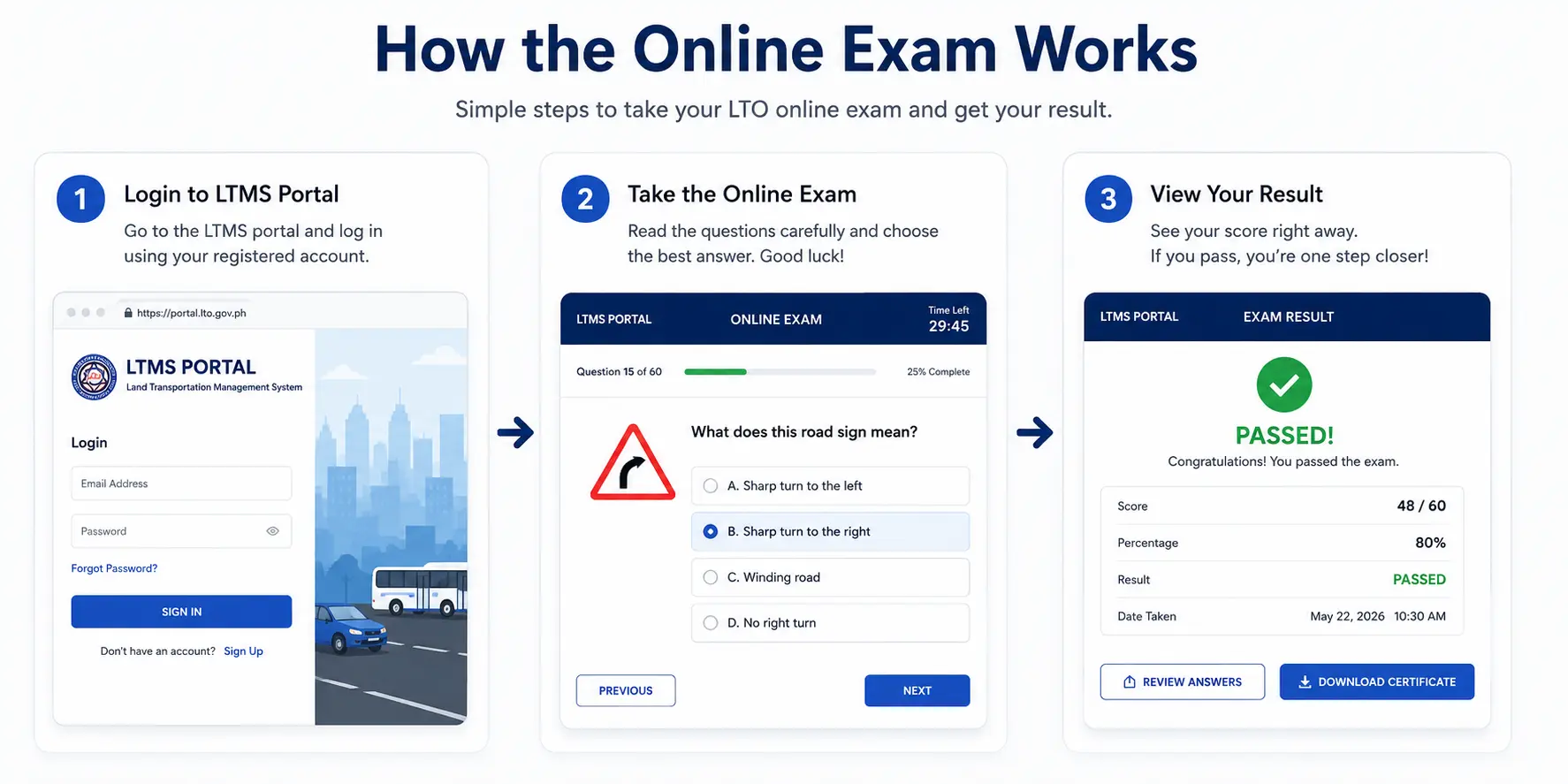
Here’s exactly how the LTO online exam works — from opening the portal to getting your result.
Go to the LTMS Portal
Open your browser and visit ltms.lto.gov.ph. This is the official LTO Management System portal. Do not use third-party websites that might charge fees — the official portal is free.
Create an Account or Log In
First-time users need to register with a valid email address. Make sure you verify your email after signing up. If you already have an account, just log in directly.
Find the Exam Section
Once logged in, look for the exam or “Driver’s License Exam” option in the dashboard. Renewal applicants will see the option to take the LTO portal renewal exam or the CDE exam validation.
Verify Your Identity
The system may ask you to confirm your details before proceeding. Double-check your name, birthdate, and address to avoid any issues later during your appointment.
Start the Exam
Click “Start Exam” when you’re ready. You’ll see multiple-choice questions one at a time. Answer all items — there’s no penalty for guessing. Don’t close the tab mid-exam or it may lock you out (session timeout).
Get Your Result
After submitting, the portal shows your score immediately. If you pass, print or save the certificate. You’ll need this for your LTO appointment. Results are valid for a limited time, so book your appointment soon.
Tracking Your Driver’s License Delivery
Once your LTO appointment is done and your driver’s license is processed, it is often delivered via LBC Express courier to your address. You can track your license delivery anytime using LBC Tracking — just enter the tracking number from your LBC delivery receipt to see real-time delivery updates.
📅 Important Reminders
- Use a stable internet connection — a dropped connection can cause a session timeout mid-exam
- Avoid mobile data for the actual exam, use WiFi if possible
- The exam has a time limit, so don’t overthink each question
- Your LTMS portal account must have correct information matching your valid ID
- You can only take the exam a limited number of times per application cycle — practice first!
How Long Is the Result Valid?
The LTO online exam result (certificate) is valid for a specific period. Once you pass, schedule your LTO office appointment as soon as possible. Don’t wait too long or you may have to retake the exam.
What Topics Are Covered in the LTO Exam?
The LTO written exam covers 3 main areas. Knowing the breakdown helps you study smarter.
Traffic Signs & Road Markings
Warning, regulatory, informational signs, lane markings
Traffic Rules & Regulations
R.A. 4136, road right-of-way, speed limits, penalties
Safe & Defensive Driving
Safe following distance, weather driving, DUI rules
Mobile Phone While Driving
Anti-Distracted Driving Act (R.A. 10913)
Parking Rules
Where you can and cannot park, yellow curb rules
Motorcycle Rules
Helmet use, motorcycle lanes, backrides
Pedestrian & School Zones
Crosswalk rules, school zone speed limits
Traffic Violations & Penalties
Fines, license suspension, apprehension rules
Vehicle Lights & Equipment
Headlight rules, plate light color, horn use
Road Signs You Need to Know for the LTO Exam
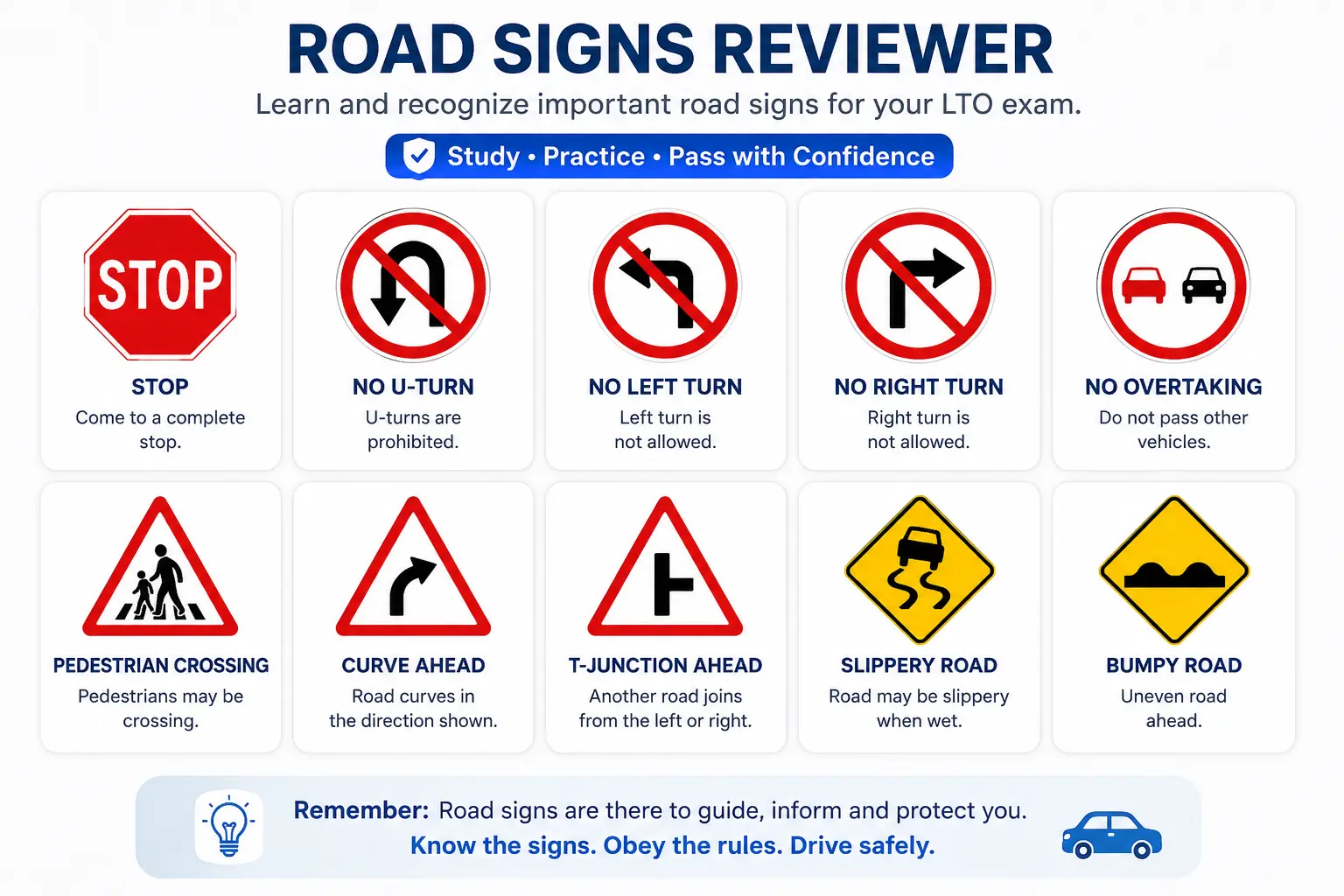
Road signs are one of the most tested topics on the LTO exam. Here are the main categories you’ll see on exam day.
Regulatory Signs
These tell you what you must do (or must not do). Red borders usually mean prohibition — like No Entry or No U-Turn.
Warning Signs
Yellow/orange signs that warn you about road hazards ahead — sharp turns, pedestrian crossings, schools, slippery roads.
Informational Signs
Blue signs that give directions, distances, or guide you to places like hospitals, rest areas, or gas stations.
Road Markings
Lines painted on the road — like solid yellow lines (no overtaking), white broken lines (lane change allowed), and yellow curbs (no parking).
Common Road Sign Questions on the LTO Exam
- What does a red circle with a line mean?
- What does a yellow diamond sign warn you about?
- What does a yellow curb mean for parking?
- What color are informational road signs?
- What does a broken white line in the center mean?
- When can you overtake on a two-lane road?
Quick Tip on Road Signs
Don’t just memorize the signs — understand what they mean. The LTO exam often asks about real situations (“You see a yellow diamond sign ahead — what should you do?”). If you know the purpose of each sign type, these questions become easy.
Key Traffic Rules Covered in the LTO Written Exam
The LTO exam heavily tests Philippine traffic laws. These are the rules you’re most likely to see as exam questions.
Republic Act 4136 (Land Transportation Code)
This is the main traffic law in the Philippines. The LTO exam draws a lot of questions from RA 4136. It covers vehicle registration, license requirements, speed limits, right-of-way rules, and traffic violations.
- Maximum speed on national highways: 80 km/h
- Speed limit in residential areas and schools: 30 km/h
- Speed limit inside tunnels: 60 km/h
- Right-of-way at intersections without signals
- Proper use of headlights (both low and high beam)
- Overtaking rules and when it’s prohibited
- Rules on towing, trailers, and maximum loads
Other Laws That Appear on the Exam
- RA 10913 – Anti-Distracted Driving Act (no phone use while driving)
- RA 10666 – Children’s Safety on Motorcycles Act
- RA 4136 Sec. 35 – Reckless driving rules
- RA 8750 – Seat belt use for all passengers
- RA 10054 – Helmet use for motorcycle riders
- PD 1096 – Drunk driving and alcohol testing
Using Your Phone While Driving
RA 10913 prohibits the use of mobile phones while driving unless using a hands-free device. First offense fine: ₱5,000. This is a very common LTO exam question — “Is using a mobile phone illegal while driving?”
| Violation | Penalty (Approximate) | Exam Tip |
|---|---|---|
| Reckless driving | ₱2,000 – ₱10,000 + license suspension | Know the definition of reckless driving under RA 4136 |
| No seatbelt | ₱1,000 first offense | Applies to driver AND all passengers |
| Using phone while driving | ₱5,000 – ₱15,000 | Hands-free devices are the only exception |
| Drunk driving (DUI) | License confiscation + criminal charges | Know the BAC limit: 0.05% for regular drivers |
| Overspeeding | ₱1,200 – ₱3,000+ | Know the speed limits per zone type |
Safe and Defensive Driving — What the LTO Exam Tests
About a quarter of the exam focuses on safe driving habits. These concepts are straightforward once you understand the logic behind them.
Safe Following Distance
The general rule is at least a 3-second gap between your car and the vehicle in front. In bad weather, double that to 6 seconds. This is a classic exam question.
Driving in Rain or Fog
Slow down, turn on your headlights (low beam in fog, not high beam), increase following distance, and avoid sudden braking. The exam often asks what to do in poor visibility.
Drunk Driving (DUI) Rules
Never drive after drinking alcohol. The legal Blood Alcohol Concentration (BAC) limit is 0.05% for private vehicle drivers and 0.00% for professional drivers and those under 18.
Checking Blind Spots
Before changing lanes, always check your mirrors AND physically look over your shoulder to check blind spots. Mirrors alone are not enough.
Pedestrian Right-of-Way
Always yield to pedestrians at crosswalks. Even if there’s no signal, a pedestrian crossing at a marked crosswalk has the right of way.
Proper Use of Headlights
Turn on headlights from dusk to dawn and during rain. Switch to low beam when meeting oncoming traffic. High beams should only be used on dark roads with no other vehicles nearby.
Common Mistakes That Cause People to Fail the LTO Exam
Most people who fail don’t fail because the questions are hard. They fail because of these avoidable reasons.
Before the Exam
- Not reviewing at all, thinking common sense is enough
- Only using social media posts or outdated PDF reviewers
- Not knowing the specific laws (like RA 4136 or RA 10913)
- Ignoring road signs and only focusing on traffic rules
- Not doing any practice tests beforehand
During the Exam
- Spending too much time on one question
- Changing answers too many times — your first instinct is often right
- Closing the browser tab mid-exam (causes session timeout)
- Not reading the question fully before choosing an answer
- Guessing randomly on road sign questions without understanding them
The Biggest Misconception
Many applicants think the LTO exam is just common sense. It’s not. Some questions are specifically designed to test your knowledge of exact laws — like the exact BAC limit for professional drivers, or the exact speed limit near a school. These aren’t things you’d know just by driving.
What Happens If You Fail?
If you fail the LTO exam, you can retake it. The LTO allows multiple retakes, but there may be a waiting period and additional fees involved depending on your application type. Use the time between attempts to study the topics you missed.
How to Pass the LTO Exam on Your First Try
These tips come from what the exam actually tests — not just generic advice.
Take Practice Tests First
This is the single most effective thing you can do. Practice tests show you which topics you’re weak on and get you familiar with how the questions are worded. Our free LTO mock exam covers the same topic areas as the real test.
Study Road Signs Visually
Don’t just read about road signs — look at pictures of them. The exam shows you images of signs and asks you to identify them. Spend at least 20 minutes reviewing sign images before exam day.
Know Your Key Laws
Focus on RA 4136 (the main traffic code), RA 10913 (anti-distracted driving), and RA 8750 (seatbelt). These three laws alone cover a big chunk of the exam questions.
Memorize the Numbers That Matter
Speed limits (30 km/h in school zones, 80 km/h on highways), BAC limits (0.05%), passing score (75%), and fine amounts for major violations. Number-based questions are very common.
Don’t Rush, Don’t Overthink
Read each question carefully. Most wrong answers are caused by misreading the question, not actually not knowing the answer. Take your time, especially on questions with tricky wording.
Rest Well the Night Before
A tired brain makes silly mistakes. You know more than you think — just make sure you’re awake and alert enough to recall it during the actual exam.
LTO Exam Reviewer — What to Actually Study
People search for an “LTO exam reviewer with answer” all the time. Here’s what a good reviewer actually covers — and what ours gives you.
An LTO exam reviewer is a study guide that covers the topics you’ll be tested on. The best reviewers include practice questions similar to the real exam, with answer explanations so you actually learn the concept — not just memorize the answer.
You’ll find reviewers in English and in Filipino/Tagalog. Both cover the same material since the actual LTO exam is available in either language too.
What a Good Reviewer Covers
- All categories of road signs with explanations
- Philippine traffic laws in plain language
- Sample questions in the same format as the real exam
- Answers with short explanations — not just answer keys
- Tips on tricky questions
Watch Out for Outdated Reviewers
Some PDFs and printed reviewers you find online are 5–10 years old. Laws and penalties have changed since then. Always use an updated reviewer — preferably one that reflects 2025 or 2026 traffic regulations.
Our Free LTO Mock Exam Tool
Our practice exam simulates the real LTO exam format — multiple choice questions, timed, with instant scoring. You can take it as many times as you want for free.
- Available in English and Filipino
- Covers non-pro and professional license topics
- Instant score and answer review
- New questions every session
- No registration required
Ready to Practice? Take the Free LTO Mock Exam
Test yourself before the real thing. Our mock exam covers road signs, traffic rules, and safe driving — the same topics as the actual LTO written test.
Questions per session (Non-Pro)
Passing score to aim for
Free practice attempts
No sign-up needed. Works on mobile. Available in English and Filipino.
Benefits of Using an Online LTO Practice Exam
Practicing online before the real exam is much better than just reading a PDF. Here’s why.
You Learn What You Don’t Know
Reading a reviewer doesn’t always show you where your weak spots are. Practice tests do. When you get a question wrong, you know exactly what to study next.
You Get Used to the Format
The real LTO exam is computer-based with time pressure. Practicing online puts you in that same mindset so exam day doesn’t feel unfamiliar or stressful.
Repetition Builds Memory
Taking multiple practice rounds reinforces what you’ve learned. By the time you take the real exam, many questions will feel familiar — because you’ve seen similar ones before.
Study Anywhere, Anytime
No need to go to an LTO office or a review center. Practice from home, on the bus, or during your lunch break. Our tool works on phones too.
Track Your Progress
See your score improve over time. Going from 60% to 85% across multiple practice sessions means you’re actually ready for the real exam.
It’s Completely Free
No need to pay for a review center or buy a book. Our online LTO practice exam is free and covers everything you need.
Non-Professional vs Professional Driver’s License — What’s the Difference?
A lot of first-time applicants are confused about which license to apply for. Here’s a clear comparison.
| Feature | Non-Professional License | Professional License |
|---|---|---|
| Purpose | Personal driving only — for your own use | Driving as a job or for hire — taxi, bus, truck, delivery |
| Vehicles Covered | Cars, SUVs, vans, motorcycles (personal use) | All above + public transport, heavy trucks, trailers |
| Exam Questions | 40–60 questions | 70 questions (includes public transport rules) |
| Passing Score | 75% | 75% |
| Age Requirement | At least 17 years old (with guardian consent) | At least 18 years old |
| Additional Requirement | None beyond the standard requirements | Must hold a Non-Pro license first (or simultaneously) |
| Validity | 5 years | 5 years |
Which One Should You Apply For?
If you’re just driving your own car or motorcycle for personal use, get the Non-Professional license. If you plan to drive as a job — like being a delivery driver, truck driver, or work in public transport — get the Professional license. Most first-time applicants start with Non-Pro.
What Is the LTMS Portal and How Does It Work?
You’ll hear “LTMS portal” mentioned a lot in the LTO exam process. Here’s what it is and how to use it.
The LTMS portal stands for Land Transportation Management System. It’s the official online platform of the LTO where you can apply for a driver’s license, schedule appointments, take the online exam, and track your application status.
Before the LTMS portal, you had to show up at an LTO office for every single step. Now, a big part of the process — including the written exam — can be done online through the portal.
What You Can Do on the LTMS Portal
- Create your LTO applicant account
- Take the online written exam (theoretical exam)
- Complete the CDE exam for license renewal
- Schedule your LTO office appointment
- Upload required documents
- Track your license application status
Official LTMS Portal URL
The official URL is ltms.lto.gov.ph. Be careful of fake or copycat websites that charge fees for services that are supposed to be free. Always use the official .gov.ph address.
Common LTMS Portal Issues
- Session timeout during the exam — use stable WiFi
- Email verification not received — check spam folder
- Account mismatch — make sure your name matches your valid ID exactly
- Exam result not showing — take a screenshot as backup
LTO License Renewal — Do You Still Need to Take the Exam?
Yes — license renewal in the Philippines now requires passing the LTO renewal exam. Here’s what that means for you.
Starting with the LTMS portal rollout, the LTO requires a written exam as part of the license renewal process. This is sometimes called the LTO portal